






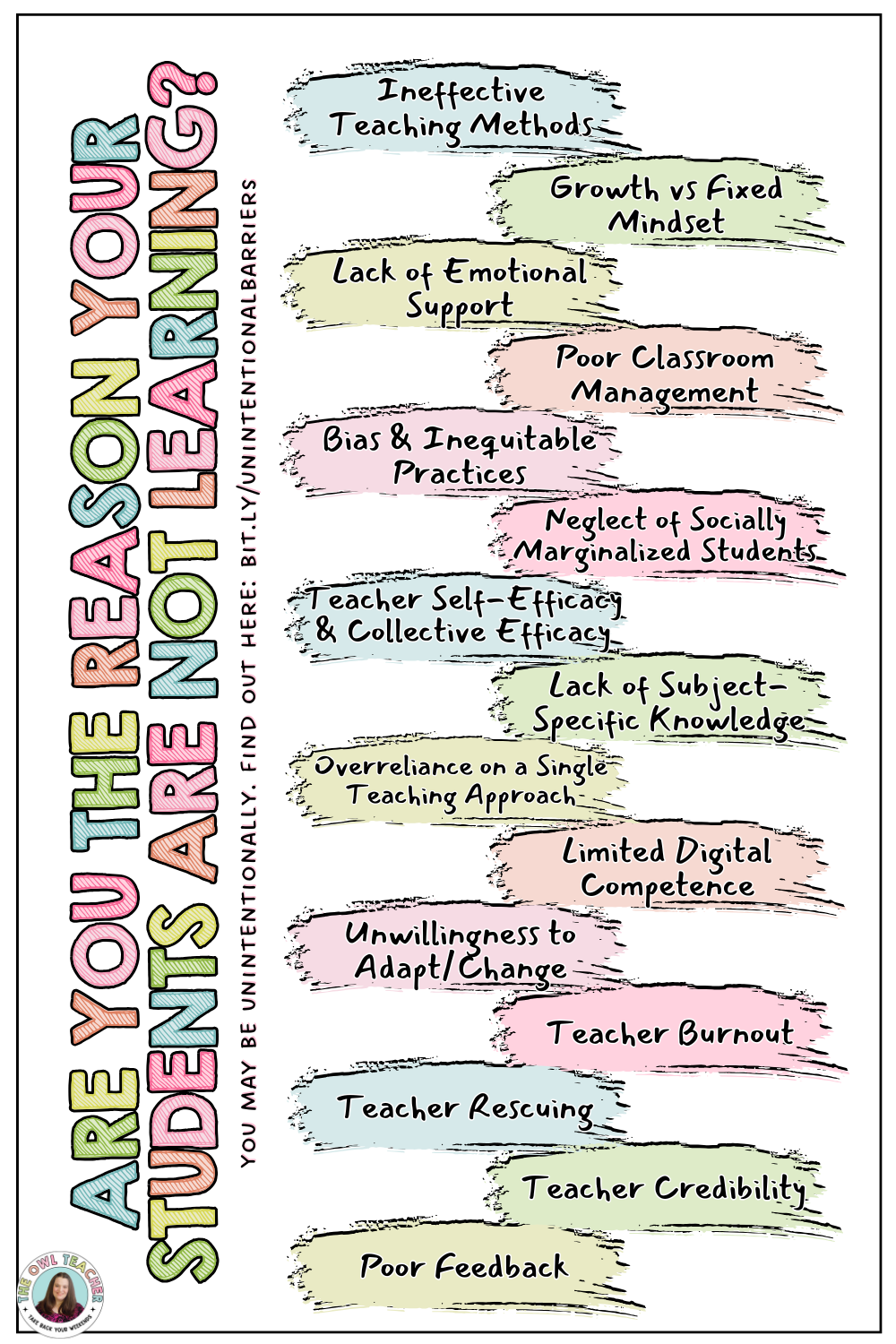
You pour your heart into lesson plans, stay late grading, and deeply care about your students. Yet, despite your best efforts, some kiddos just aren’t thriving. Could it be that certain well-intentioned habits are quietly undermining their success? Have you ever considered the subtle, unintentional ways our practices might inadvertently create roadblocks to students’ learning? It’s a tough question, one that requires courage and honest reflection. This isn’t about assigning blame; it’s about fostering an environment where every student can flourish. It’s about bringing some of those patterns into the light so we can reflect, adjust, and do what we’re all here to do: help every student grow. Let’s explore some of these unintentional barriers to learning that limit student growth and, more importantly, discover ways to adjust.
#1. Instructional Habits that Miss the Mark
Overreliance on A Single Teaching Approach
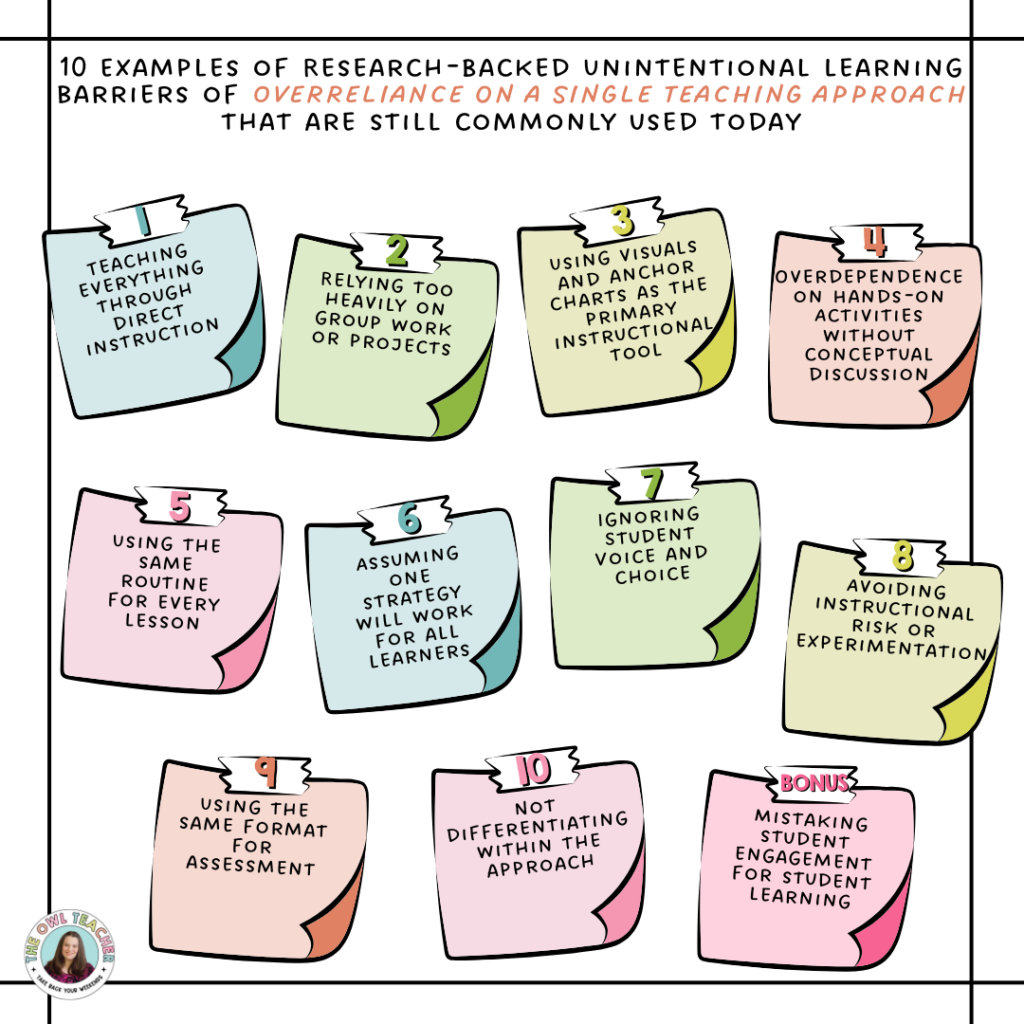
When something “works,” we tend to stick with it. Maybe it’s a lesson format we love, a structure that runs smoothly, or a strategy that kept our class on track one chaotic year. I’ll never forget my third year teaching—I had just discovered how effective mini-lessons followed by independent practice were. I used that model every single day in math. It felt safe, efficient, and the kids knew what to expect. But over time, I noticed the engagement started to dip. My strongest students were flying through the work. My struggling students were zoning out. And my class discussions? Flat as a pancake.
It wasn’t the strategy that was failing; it had become the only strategy.
Research backs this up. We risk leaving students behind when we rely too heavily on one instructional method, even a good one. Some kids need collaboration to process. Others need visuals, movement, or discussion. According to Tomlinson (2014), when teachers differentiate how students access content—not just what they’re learning—we’re more likely to reach diverse learners. And Hattie (2012) emphasizes the importance of instructional flexibility, showing that no strategy works best in all situations. The most effective teachers are responsive, not repetitive.
I started intentionally mixing it up—swapping in inquiry-based challenges, partner problem-solving, and a gallery walk here and there. It wasn’t about ditching my go-to methods but expanding my toolkit. When we vary our approaches, we don’t just keep things fresh—we honor the truth that learning doesn’t look the same for every student, every day.
TRY THIS INSTEAD:
If you always start with direct instruction, try…
- A “Notice & Wonder” launch using a visual or problem
- A quick retrieval quiz to see what they already know
- A mistake analysis activity where students critique a flawed example
If you always assign independent work, try…
- A partner relay where students solve alternating steps
- A math chat: each student explains a strategy before solving
- A station where they work backward from the answer to find the question
If you always use visual anchors or notes, try…
- A build-your-own anchor chart session where students design part of the visual
- Sketch-noting or symbol-based summaries
- A quick “blind sort” where students organize pieces of information before formal notes
If you always lead the discussion, try…
- A “One-Minute Expert” round where students explain today’s concept to a peer
- Talking chips: each student contributes before anyone speaks twice
- A walk-and-talk where partners discuss questions before the whole group
Lack of Subject-Specific Knowledge
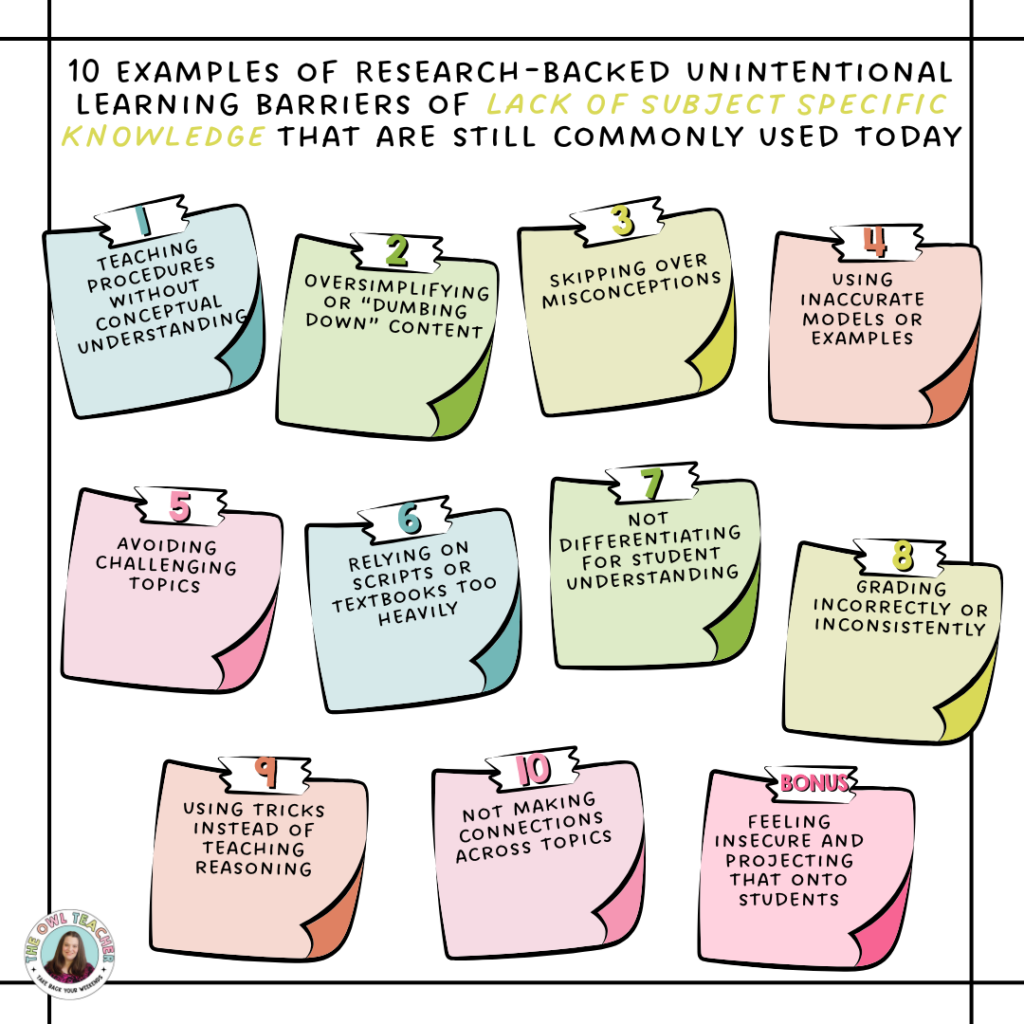
Unfortunately, many upper elementary teachers were taught a broad range of topics rather than being intensely trained, especially in the math or science content they now teach. Unfortunately, it also shows in subtle, unintentional ways. Sometimes procedures are taught without conceptual understanding, like “carry the one” or “move the decimal” (Guilty! Whoops!), leaving students with memorization knowledge that doesn’t transfer or isn’t applicable. Complex ideas are oversimplified, key misconceptions are missed, and lessons rely heavily on the teacher’s editions (which may be outdated) rather than meaningful explanations. When you aren’t confident in the content, you avoid student questions or unintentionally pass along inaccuracies. Over time, this creates learning gaps that widen with each grade level.
TRY THIS INSTEAD:
If you feel unsure about a concept (like exponents, volume, or ecosystems), try…
- Watching a short teacher-focused video before the lesson (not a student video!)
- Reading the teacher’s notes in your curriculum before looking at the student workbook
- Asking yourself, “What’s the misconception here?” to pre-teach or anticipate confusion
If you’re tempted to teach a shortcut or “trick,” try…
- Using a visual or concrete model first (e.g., base-10 blocks, fraction strips, area models)
- Asking students to explain why the trick works, then re-teaching with conceptual language
- Swapping the “trick” for a real-world example that builds meaning
If you rely heavily on the textbook or scripted guide, try…
- Looking at a standard or objective and asking: What’s the big idea here?
- Comparing how two different curriculum sources explain the same concept
- Creating one simple visual (like a diagram or anchor chart) based on your understanding
If a student asks something you don’t know, try…
- Saying, “Let’s figure it out together,” modeling curiosity and resourcefulness
- Giving a “parking lot” sticky note to research the answer together later
- Turning the question into a class investigation or mini-exploration
Limited Digital Competence
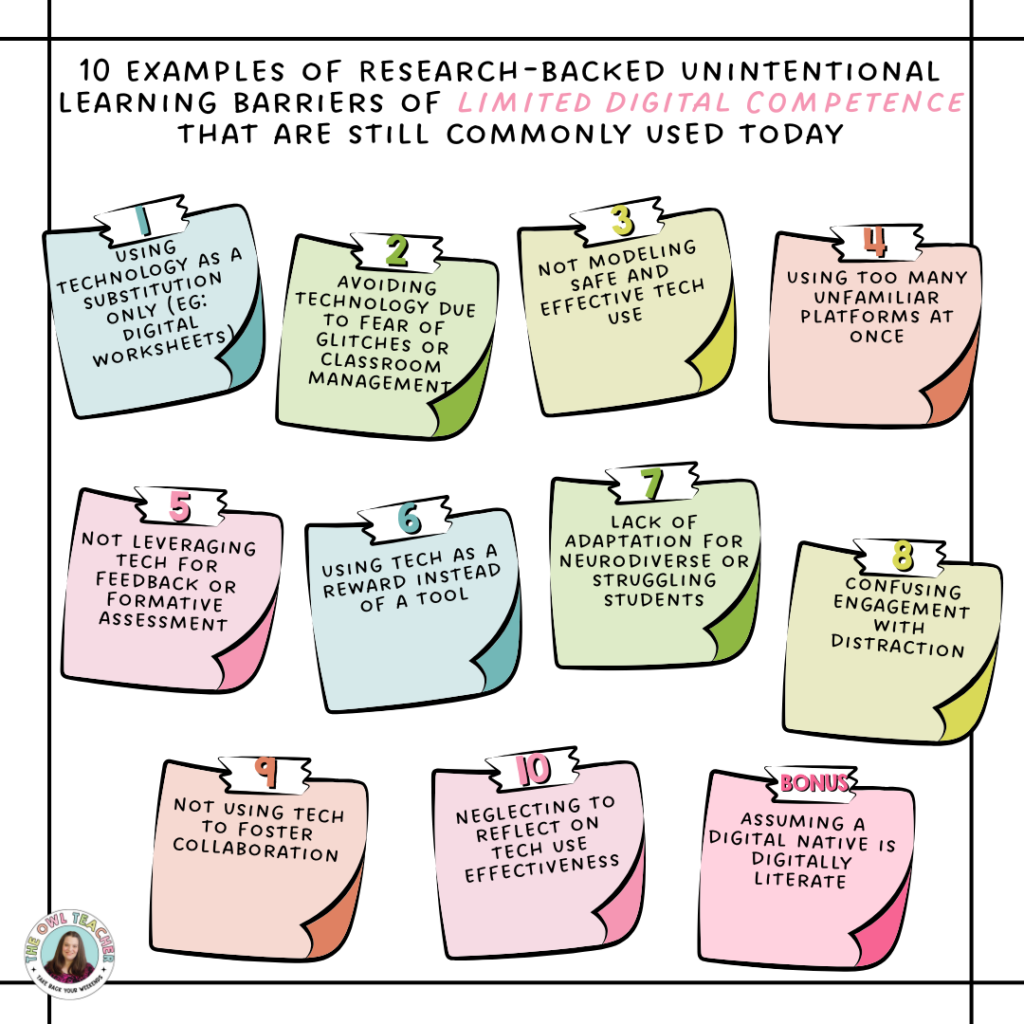
I’ll be honest: I’ve never liked using computers with my students. It can be frustrating to move from one computer to the next, frantically trying to help students who don’t know what to do (ever mistakenly think they know what to do because they all have tech? Whoops!). With 6 minutes left and a room full of kids who were excited they got to do math games websites instead of our activity, I started to wonder if it’s really even worth it.
When we create these unintentional barriers to student growth, we limit how our students engage with technology, collaborate, or build the digital skills they need beyond your classroom (and their careers). Often, technology gets used more for substitution. For example, “I use technology because I give my students math games time,” or use digital worksheets rather than using them for transformation. And if you’re counting on the following year’s teacher, what if s/he thinks like this too? Imagine several in a row!
TRY THIS INSTEAD:
If you’re using tech to deliver a worksheet or slideshow, try…
- Turning one question into a Padlet, FigJam, Lucidspark, or Canva, where students brainstorm in real-time
- Using Google Forms for a quick warm-up that gives instant feedback
- Swapping slides for an Edpuzzle with embedded questions and students answer as they go
If students finish tech tasks too quickly or misuse the tools, try…
- Adding digital reflection prompts: What strategy worked best for you today?
- Giving them a checklist before submission: Did you answer in complete sentences? Did you cite evidence?
- Pairing students for peer review using a comment function (if applicable)
If you avoid tech due to fear of glitches or lack of training, try…
- Practicing with one tool per quarter—like Flip, Canva, or Formative—and using it for your planning first
- Creating a student “tech squad” that helps with common tech issues in class
- Recording your screen to model steps, so students (and you!) have something to refer back to
If you assume students are already tech-savvy, try…
- Teaching digital citizenship and navigation explicitly (how to search, evaluate sources, or troubleshoot)
- Building digital tasks with check-ins: What part was tricky? What did you Google?
- Letting students teach you a tool or shortcut—and make it a class celebration
Poor Feedback
Student growth starts with feedback, but this is one unintentional barrier we can quickly fix! When I started teaching, I used to assign something for every subject (7) every day (5) because that was what I thought I was supposed to do to know if they were learning and what to reteach the next day. If you’re doing math with me, that’s 35 assignments per student – say 30, which is 1,050 assignments (approximately) a week. Insane, right? Then I wouldn’t even look at some of them; I’d toss them in the trash because I decided I had too many or that it was more “busy work.” The ones I did grade often received vague feedback such as “great effort” or “Nice!” While I never used the red pen (I got that a lot as a kid, so I chose pink), I often never followed through with anything beyond marking it right or wrong – not even a rubric*. Wow, that’s a lot of Whoops!
*(My resources do have rubrics.)
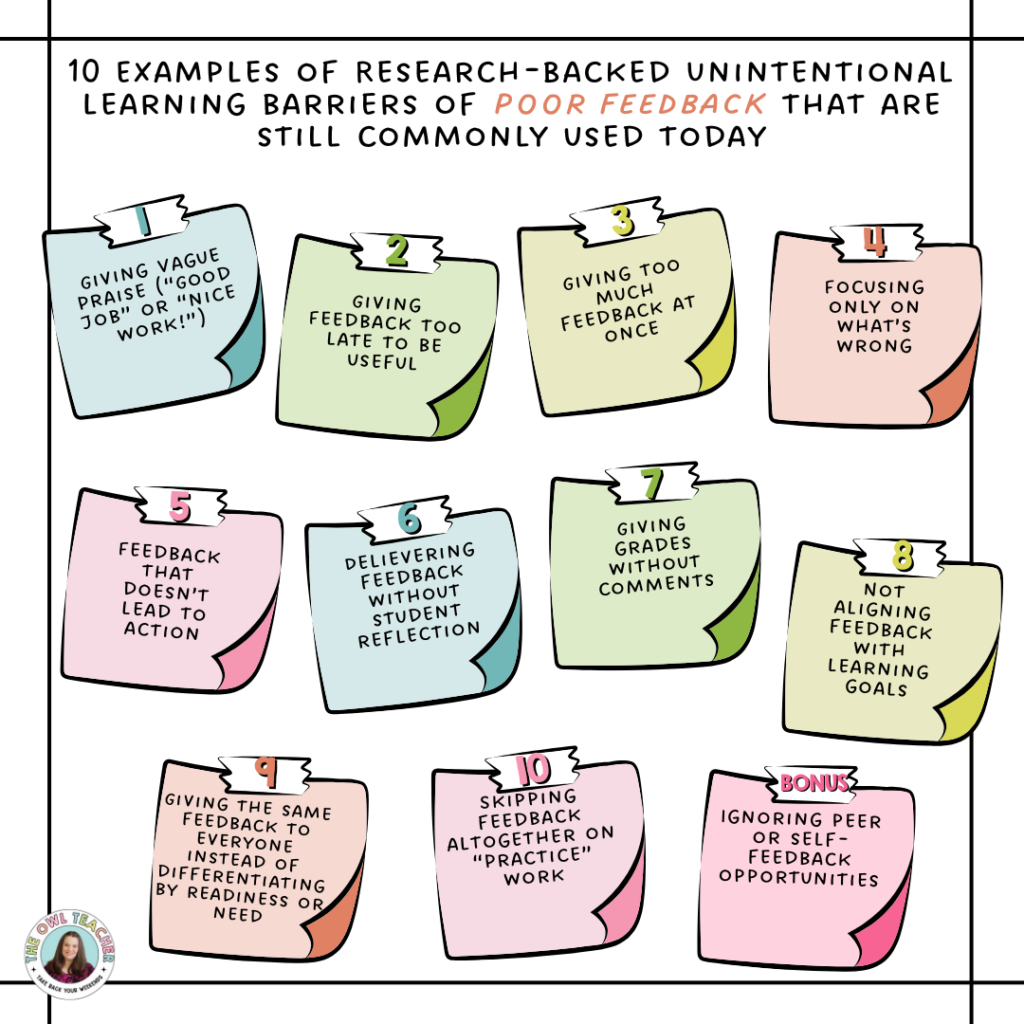
Feedback is among the most often misused but powerful tools in upper elementary. Feedback that is vague, overwhelming, or delayed (such as “we’ll talk about that tomorrow”) can create unintentional barriers and stunt student growth. Grades don’t guide us. They don’t help students reflect. Instead, they react.
We don’t just want to evaluate students. We want to help students focus on their future. According to Hattie & Timperly (2007), feedback has a high impact on student achievement when students can answer:
- Where am I going? (Set goal criteria for success & commit)
- How am I doing? (Reflect on improvements made)
- What is next? (Feeding Forward – how to improve and which choices make moving forward)
TRY THIS INSTEAD:
If you’re writing “Nice work!” or “Try harder,” try…
- “You supported your opinion with two reasons. Can you explain one more?”
- “You added decimals correctly. Now check the place value when subtracting.”
- “Your introduction is clear. What could you add to your conclusion to wrap it up?”
If you’re giving feedback only after an assignment is done, try…
- Mid-task check-ins: “Thumbs up if your strategy is working, sideways if you need to adjust…”
- Feedback rounds: give one warm (strength) and one cool (next step) halfway through
- Exit slips that ask, “What part of today’s work do you want feedback on?”
If your feedback is all teacher-led, try…
- Student self-assessment checklists
- Peer reviews with prompts like: “I noticed…” and “You might try…”
- Color-coding revisions: highlight one change you made based on feedback
If you’re grading everything, try…
- Use “feedback-only” scores on drafts
- Give verbal comments during conferences instead of written notes
- Focus written feedback on one goal at a time (e.g., clarity, evidence, structure)
Ineffective Teaching Methods
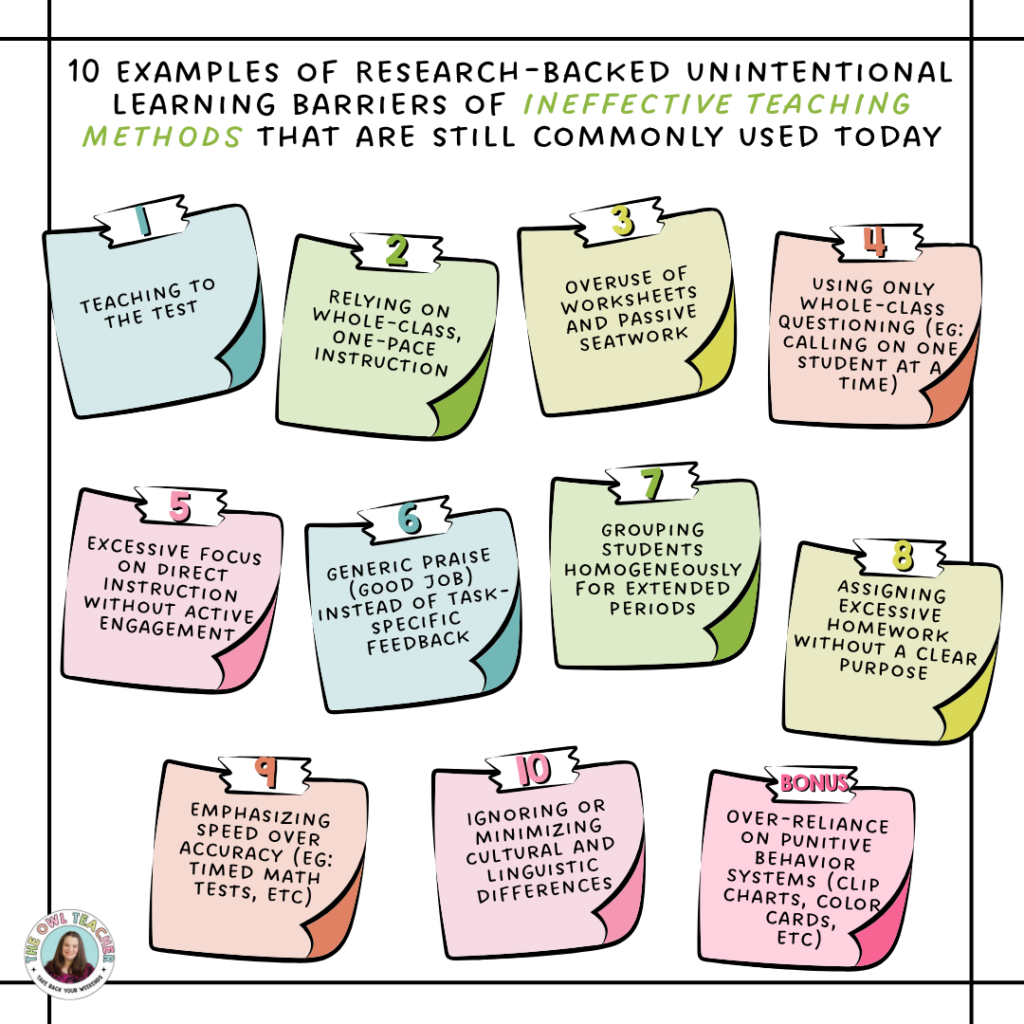
In my early years of teaching, I remember standing at the board in the front of the room, in control, regularly leading the class, asking questions, and writing notes for them to copy. I then gave worksheets I expected my students to complete in silence while I graded at my desk. Then I would assign worksheets as homework. I had no purpose for giving the homework other than it felt necessary to teach responsibility. And maybe extra practice. When the next day came, we’d check the homework together. This meant I was calling on students one at a time. (Whoops!) Probably like you, I was doing everything I saw growing up. The mentoring teachers often did it the traditional way, too.
Teaching in ways based more on tradition, familiarity, and convenience than effectiveness has long since been moved past through research. Students need opportunities to process, discuss, and apply for student growth (Freeman et al., 2014). According to Hattie (2009), methods like differentiation, feedback, and student discussion have a much higher impact on student learning than traditional, one-size-fits-all teaching. And with homework, Cooper, Robinson, & Patall (2006) found that it can lead to frustration, inequity, and minimal academic benefit in upper elementary grades. I’m sure you’ve heard that passive learning leads to low retention. Additionally, Cooper, Robinson, & Patall (2006) found that homework can lead to frustration, inequity, and minimal academic benefit in upper elementary grades.
TRY THIS INSTEAD:
If you’re doing whole-class instruction every day, try…
- Use small-group strategy rotations: same content, different entry points
- Pull 2–3 students for guided mini-lessons while others work at stations
- Ask students to “turn and teach” a concept to a partner mid-lesson
If you assign the same worksheet to everyone, try…
- Use tiered problems: same topic, three levels of challenge
- Add a reflection prompt: “Which problem stretched your brain the most?”
- Swap half the worksheet for an open-ended task with multiple entry points
If you always call on raised hands, try…
- Use equity sticks or randomizers to get every voice heard
- Try “turn-and-talks” before asking for hands to level the playing field
- Use mini whiteboards so all students respond simultaneously
If you’re teaching to the test, try…
- Backward design from the standard, not the test question
- Focus on how to think, not just what to answer
- Use authentic problems or real-world applications whenever possible
#2. Classroom Management That Hinders Learning
Poor Classroom Management
You’ve probably had a cute clip chart, color-coded behavior folders, and a consequence system that looked organized on paper in the past. Heck, I have one in my store! (Dang, this is a lot of whoops!) In my mind, classroom management meant everyone was quiet, seated, and doing exactly as told.
Yes, my students behaved. I even had multiple people observe me as an example to them. It was different then. I came from parents who strongly believed “kids were seen but not heard.” (I never felt that, but it did impact me.) It was more about control than relationships and ensuring everyone in the class knew I was about business!
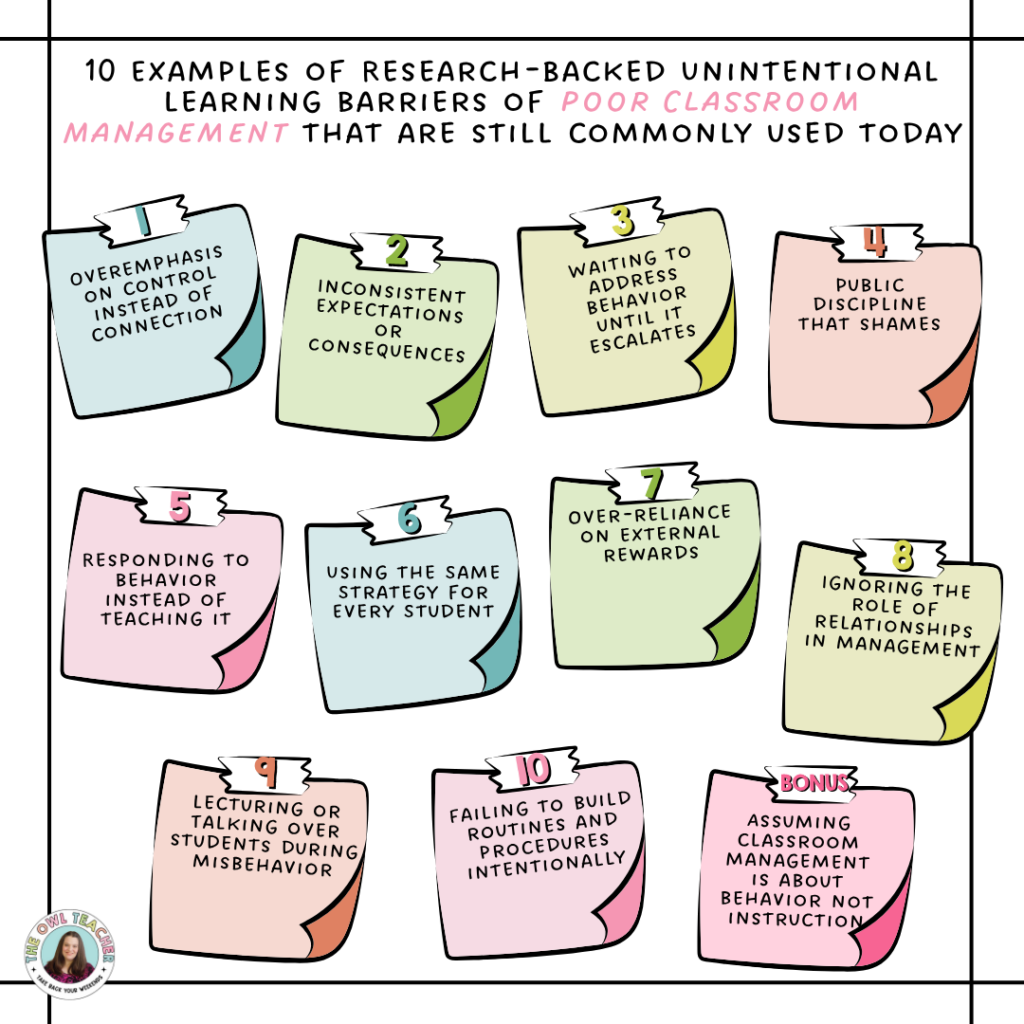
It took a while before I realized that while my classroom ran smoothly and I never had any problems (mostly), my students were likely reacting out of fear. This reflection was a hard pill to swallow for me. Good classroom management isn’t about keeping kids in line. It’s about creating a space where kids can learn. And when management is reactive, inconsistent, or, in my former years, based on fear or reward, it becomes an invisible, unintentional barrier to student growth. This happens even more for the students who struggle with self-regulation, trust, or connections. Research tells us that strong teacher-student relationships, consistency, and clear expectations are the foundation of an effective learning environment (Marzano & Marzano, 2003)
TRY THIS INSTEAD:
If your system depends on clip charts, tallies, or reward tickets, try…
- Transition to private, restorative conversations over public call-outs
- Use class meetings to set expectations together and reflect on them
- Track positive behaviors with reflection journals instead of tokens
If you’re constantly redirecting the same students, try…
- Use pre-correction: give reminders and visuals before transitions
- Teach routines explicitly and re-practice as needed (not just once in August)
- Check for unmet needs: Is it boredom? Frustration? A lack of clarity?
If you find yourself talking over behavior or escalating frustration, try…
- Use nonverbal cues (a proximity pause, a silent signal)
- Offer a reset option (“Need a break or want to try again?”)
- Reflect privately instead of in front of the whole class
If you’re managing the class instead of teaching students how to manage themselves, try…
- Teach and model self-regulation strategies (like calm-down corners or breathing cues)
- Let students help create the classroom norms—they’re more likely to own them
- Use class-wide reflections: “What worked today? What do we need to adjust?”
Low Teacher Credibility
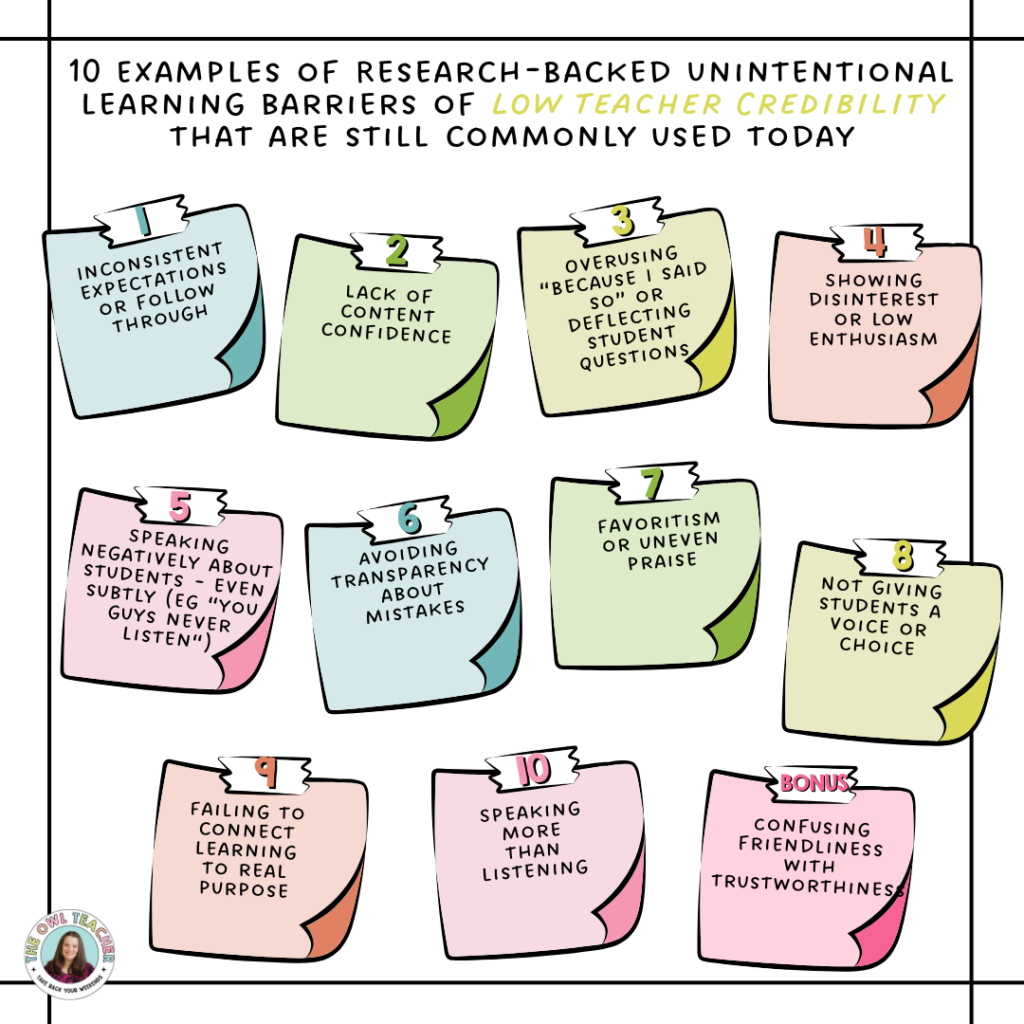
Have you ever had moments when you try to have fun with the class, give high-fives, and maybe be their buddy-buddy? That was me, my first year (before I became strict!). I wanted to be the teacher everyone loved and thought was cool. The teacher students begged to have. But that led to a lack of credibility in the eyes of most students. They were taking advantage of me because we were “friends.” They would think I was kidding or push the line. It was not good at all.
Credibility isn’t the same as likability. It’s about making sure your students believe you know your stuff, that you care about them, are consistent and fair, and genuinely think they can succeed. John Hattie’s research places teacher credibility at an effect size of 0.90, one of the highest impact factors in student achievement.
TRY THIS INSTEAD:
If students seem unclear or constantly confused during lessons, try…
- Use a daily goal slide that answers: What are we doing? Why does it matter?
- Give instructions in steps, then check in after each step
- Use sentence frames to model clear academic responses
If students challenge directions or push boundaries, try…
- Set expectations collaboratively and refer to them regularly
- Follow through—every time, even on the small stuff
- Be transparent: “Here’s why I’m doing it this way…”
If you feel the energy in your classroom slipping, try…
- Let your passion show—even if it’s for fractions or erosion
- Share why you love teaching a topic
- Use stories, connections, or quirky facts to make content come alive
If your students don’t see you as fair, try…
- Use objective systems for participation (like equity sticks or response boards)
- Watch for bias in praise, discipline, or tone
- Reflect: Whose voice am I hearing most often? Whose behavior gets more attention?
#3. Beliefs That Quietly Lower Expectations
Low Teacher Self-Efficacy
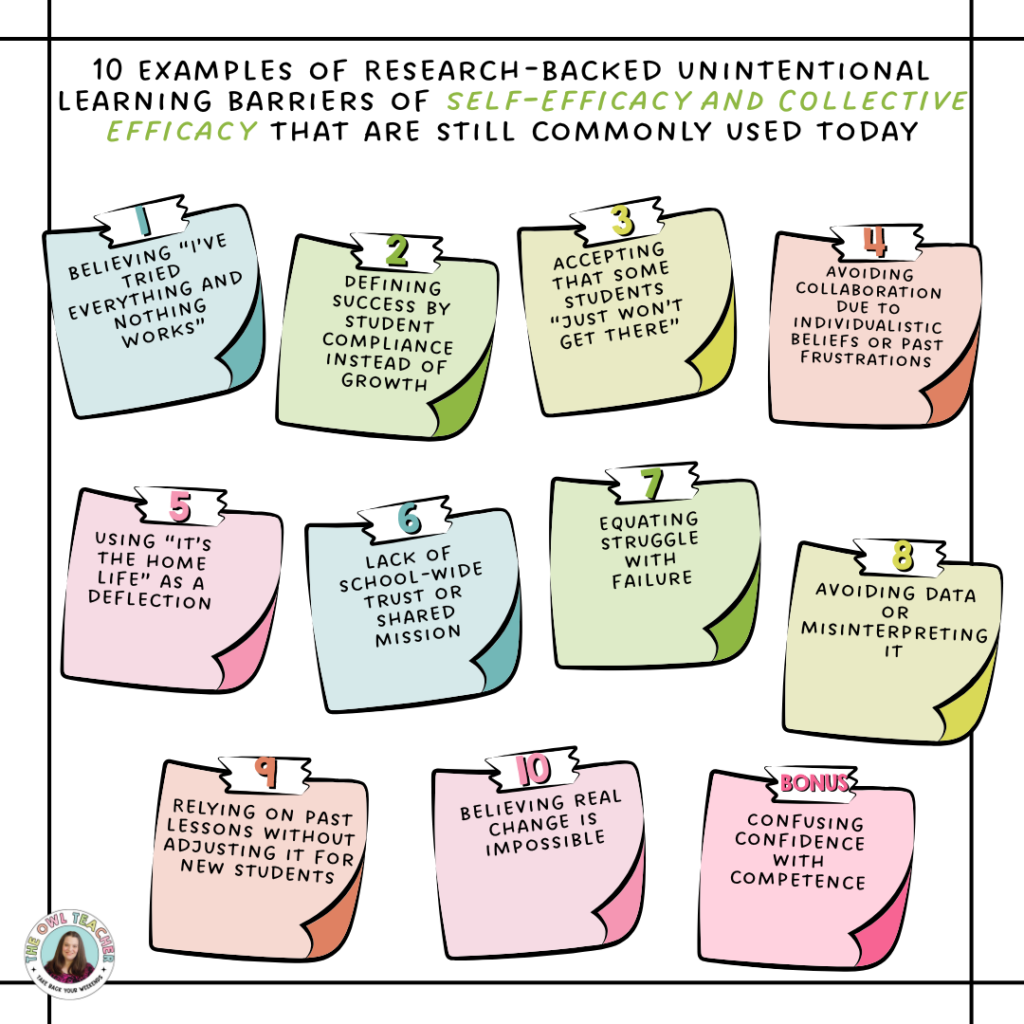
This unintentional barrier often goes unnoticed, but John Hattie’s research (2018) identifies collective teacher efficacy as the factor with the largest effect size on student achievement, greater than a student’s SES, prior achievement, or home environment.
We have all had moments of defeat. We have all wondered or even felt we weren’t making a difference. This is low teacher efficacy. When this belief spreads across a team or building, it creates low collective efficacy. It can also be lost in a toxic, overwhelmed, or under-supported school environment. I’m guessing a few teachers have unintentional barriers to student growth here. This is the number one, strongest predictor of student growth and success.
Oh, and one more thing… Low efficacy doesn’t always mean a teacher feels like giving up. It can also mean going through the motions, feeling numb, using the same materials year after year, saying “those kids” instead of “our kids,” and really, just trying to survive.
TRY THIS INSTEAD:
If you’ve ever said, “I’ve tried everything,” try…
- Reframing: “I haven’t found what works for this student… yet.”
- Talking through the challenge with a friend who pushes forward, not just vents
- Asking, “What’s one small thing I haven’t tried?” (Change the environment, task, partner, or expectation?) (Check here on my blog too!)
If you feel alone in the struggle, try…
- Starting a weekly 15-minute “Wins & What Ifs” with your team (What worked? What’s next?)
- Sharing one success with a teammate daily, even a small one
- Using “we” language instead of “I” or “they”—We’re trying… We noticed…
If your team is pessimistic or acts defeated, try…
- Bringing a short success story to a staff meeting: “Here’s one way this worked for us.”
- Offering to co-plan or co-teach a challenging lesson
- Gently pushing back on deficit language: “What strengths have we seen in this student?”
If you’ve started “playing it safe,” try…
- Experiment with one new strategy with your most responsive group. Here are some ideas for you.
- Keeping a reflection journal: What worked? Why? What was in your control?
- Focusing on effort over outcome: What actions did I take that supported growth?
Unwillingness to Change
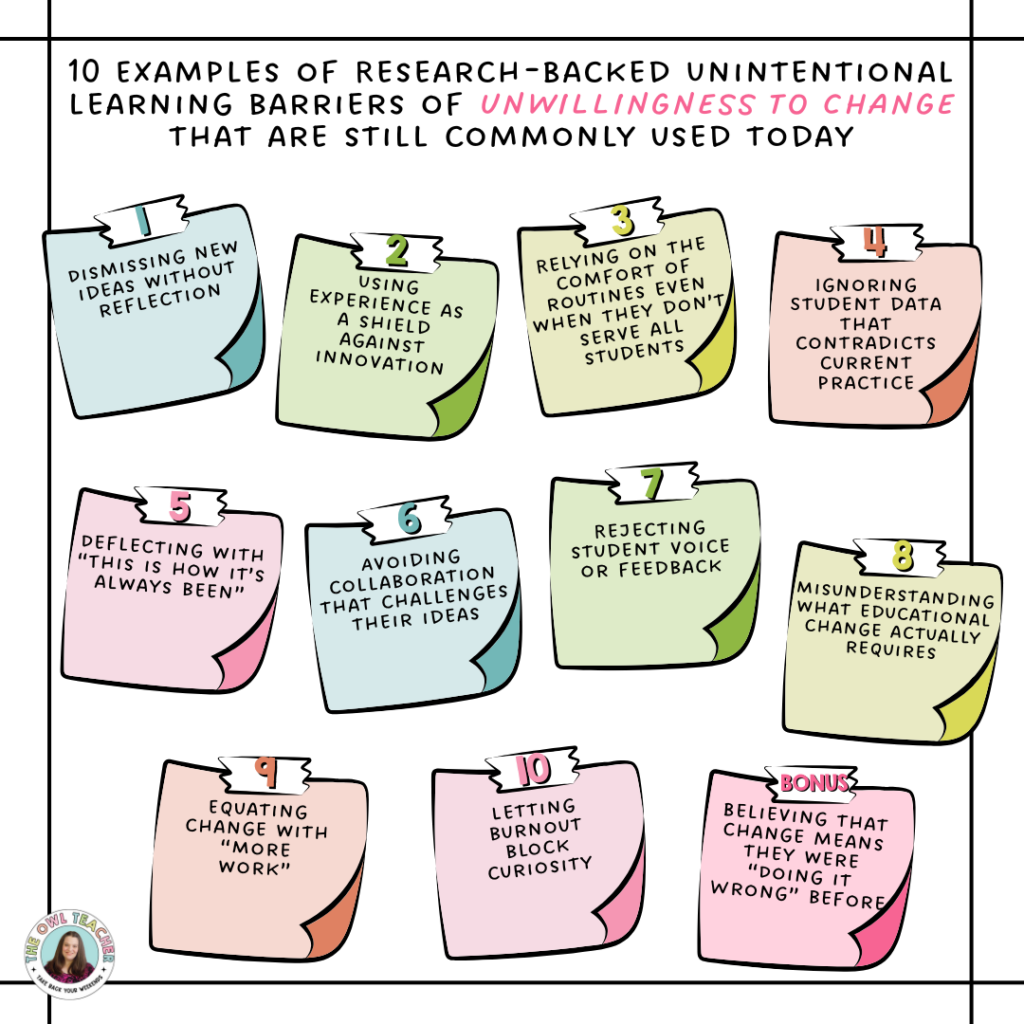
It’s hard to change from our comfortable, developed routines, especially when exhausted, unsupported, or burned by initiatives that have come and gone. It’s normal for anyone to be resistant to change. However, change is necessary when evidence suggests that current approaches aren’t working optimally and can significantly impact student growth.
When we avoid professional learning opportunities, use phrases such as “I’ve always done it this way,” dismiss new approaches without even trying them (close the door and teach), or attribute student struggles to the student factors, we show signs of resistance to change. If we stop reflecting, we stop improving.
TRY THIS INSTEAD:
If your first reaction to a new idea is, “That won’t work for my class,” try…
- Replacing “That won’t work” with “What would it take to make this work?”
- Ask a teacher friend how they’ve used a new strategy
- Try the idea with one group of students or one student, and get feedback
If you’re stuck in a familiar routine, try…
- Picking one lesson a week to remix: a different task, format, or question
- Giving your students a chance to co-create part of the lesson (this is really fun!)
- Asking yourself, “What if I taught this like it was my first year again?“
If change feels like a personal critique, try…
- Reframing feedback as a mirror, not a judgment
- Keeping a “learning log” where you track one insight or idea each week
- Reminding yourself: good teaching is responsive, not static
If your team avoids trying anything new, try…
- Being the “pilot” teacher who volunteers to try a new strategy and share results
- Asking what’s one thing we’d do if we weren’t afraid it would fail?
- Bringing a small win to each team meeting. It doesn’t need to be a finished product, just progress
Growth vs Fixed Mindset of the Teacher
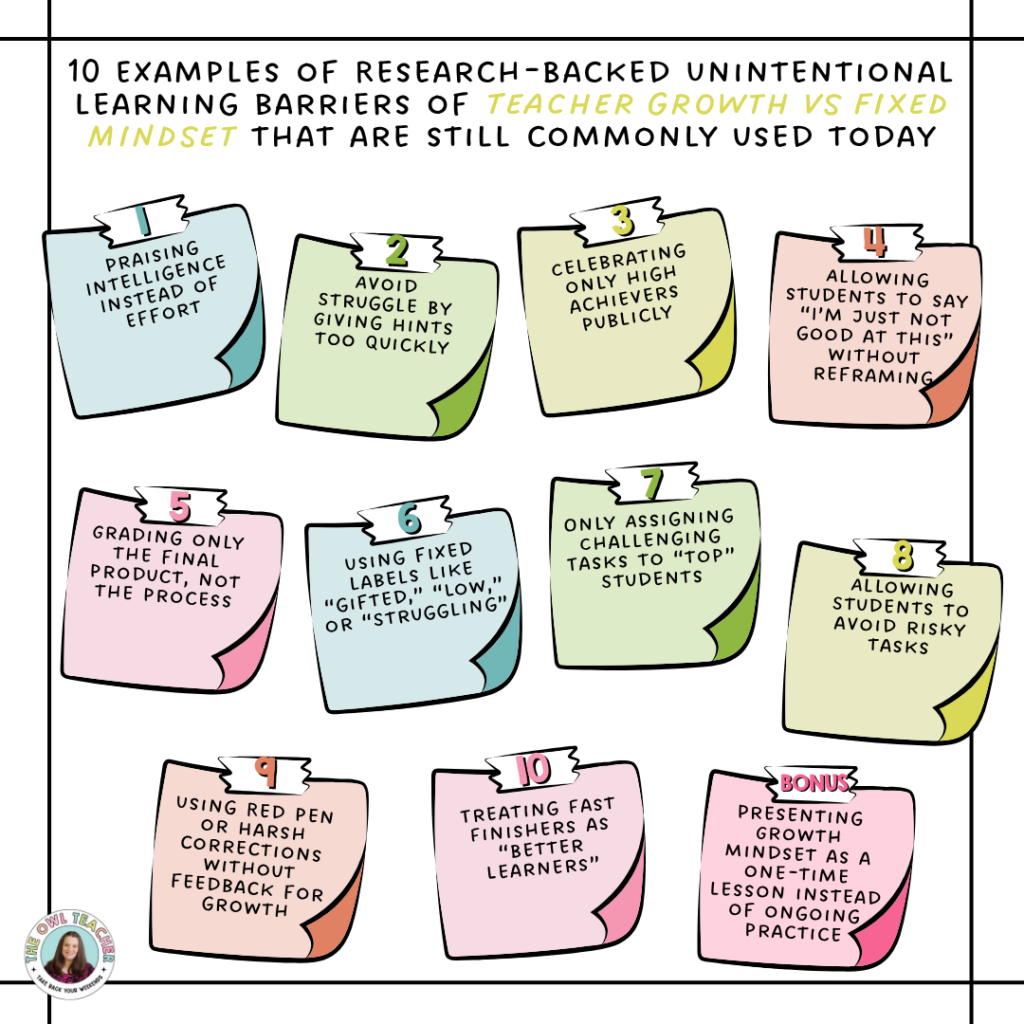
A teacher’s mindset can shape every decision. Sometimes, we think we foster a growth mindset when our words and practices quietly send the opposite message.
Even when we say we believe in growth, we can unintentionally create a classroom culture where students fear mistakes, equate speed with intelligence, and avoid challenges to protect their identity. And in upper elementary, where kids are becoming more self-aware and sensitive to peer comparison, this mindset matters more than ever.
According to Dweck’s (2006) research, it’s not ability that separates successful learners—it’s belief. The belief that effort leads to growth, that mistakes are part of learning, and that our brains aren’t fixed—they’re changeable with practice and persistence.
TRY THIS INSTEAD:
If you tend to say, “You’re so smart!” or “You’re a math whiz,” try…
- “You stuck with that strategy until it worked.”
- “You used your mistake to find a new path! That’s real thinking.”
- “I can see your brain growing from how hard you worked on this.”
If students avoid challenges or give up quickly, try…
- Normalize mistakes and struggles. “It’s not supposed to be easy. It’s supposed to stretch you.”
- Share your learning stories or classroom “oops moments,” as I did above
- Use a visual tracker for persistence, not just correctness
If you only praise students who get it right the first time, try…
- Catch and praise revisions, risk-taking, or effort on a second try
- Build reflection into the work: “What changed in your thinking?”
- Create space for student-to-student reflection: “Who showed growth today?”
If you’ve caught yourself thinking, “They’re just not good at this,” try…
- Reframe: “They haven’t mastered this… yet.”
- Ask: “What do they need from me to keep growing?”
- Plan: Scaffold effort-based strategies instead of lowering expectations
Teacher Rescuing
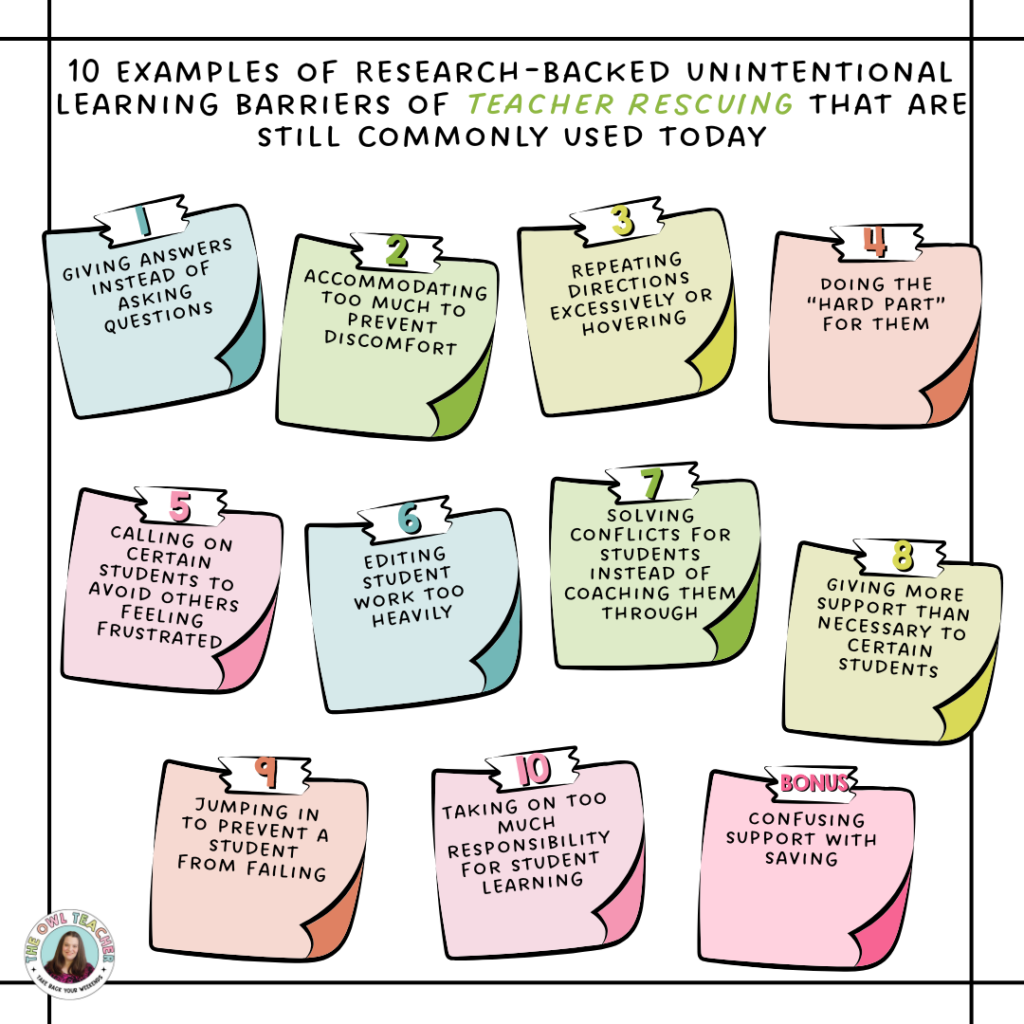
It’s natural to want to help struggling students, but sometimes we help too quickly or too much. This prevents students from developing persistence, problem-solving skills, and academic confidence. This temptation to “help” can quietly become a long-term, unintentional barrier to student growth.
Rescuing happens when we remove the struggle for students instead of scaffolding it. It can feel like kindness, but it teaches students that learning should always feel easy.
The goal isn’t to make it easy, but challenging and reachable. Students need to build resilience just as much as they build content knowledge.
TRY THIS INSTEAD:
If you’re tempted to jump in when a student says, “I don’t get it,” try…
- Respond with “What do you understand so far?”
- Give a scaffolded prompt: “Let’s look at just the first sentence—what’s it telling us?”
- Set a timer for “Try Time” before help is allowed
If you find yourself thinking for students, try…
- Use a “Coaching Card” with sentence starters: “Could it be…?” “What happens if you…?”
- Offer choices, not answers: “You could draw a diagram, make a table, or write an equation. Which will you try?”
- Reframe your role from helper to coach
If students are shutting down or constantly asking for help first, try…
- Celebrate productive struggle aloud: “You worked through that without asking for help!”
- Introduce self-check tools or reflection prompts: “What strategy did you try before asking?”
- Create anchor charts for how to persevere, not just what to solve
If you’re rescuing certain students more often (especially those who struggle), try…
- Track who you support most—look for patterns
- Use silent signals to check in without jumping in
- Give wait time and eye contact that says, “I believe you’ve got this.”
#4. Equity Gaps We Don’t Always See
Bias and Inequitable Practice
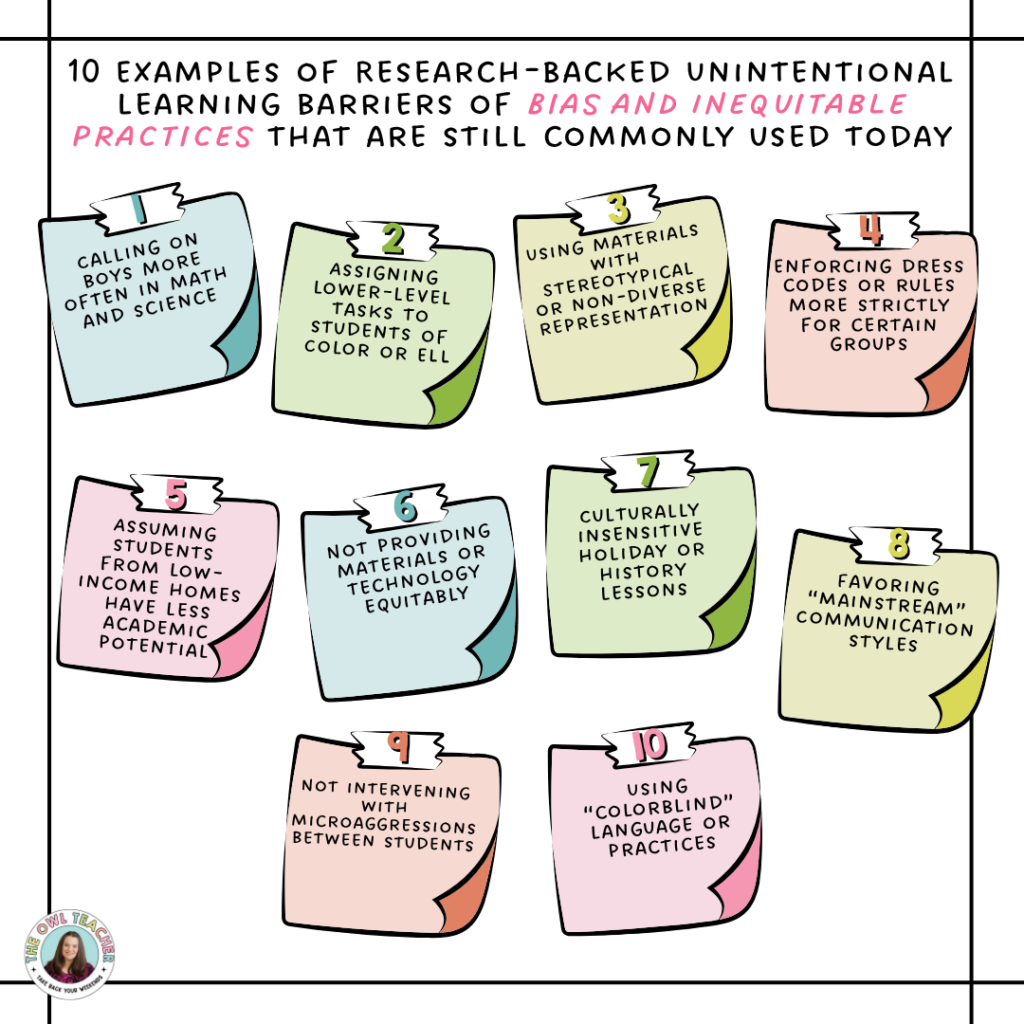
Even the most well-intentioned teachers can harbor unconscious biases that affect teaching practices and student opportunities. While these practices are often invisible to the teacher, it is deeply visible to the student.
Seth Gershenson’s (2016) research showed that teacher expectations significantly impact student growth, with teacher bias potentially limiting opportunities for particular student groups. When teachers hold high expectations for all students and implement equitable practices, achievement gaps can begin to close.
TRY THIS INSTEAD:
If you call on the same students most of the time (even unintentionally), try…
- Use popsicle sticks, randomized cards, or response boards to give all students a voice
- Track who you call on each day—you might be surprised
- Let students self-select with sentence stems: “I’m building off of…” or “I’d like to add…” This helps students learn conversational skills.
If you adjust expectations based on what they can “handle,” try…
- Ask: “What support would help this student reach the full standard?”
- Use tiered tasks where everyone accesses the same content, just at different levels
- Reflect: Am I modifying it because of student needs or my assumptions?
If your classroom materials center on one culture, voice, or perspective, try…
- Audit your classroom library and anchor charts. Determine who’s represented and who’s missing
- Include diverse names, scenarios, and contributors in word problems and examples
- Make space for students to bring their culture and experiences into your lessons
If you feel unsure or uncomfortable addressing bias, try…
- Use reflection tools like “equity audits” or student surveys
- Ask: Who participates most? Who avoids eye contact? Whose behavior do I correct most often?
- Remember: discomfort is part of growth—lean in, not away (see resistance to change above)
Neglect of Socially Marginalized Students
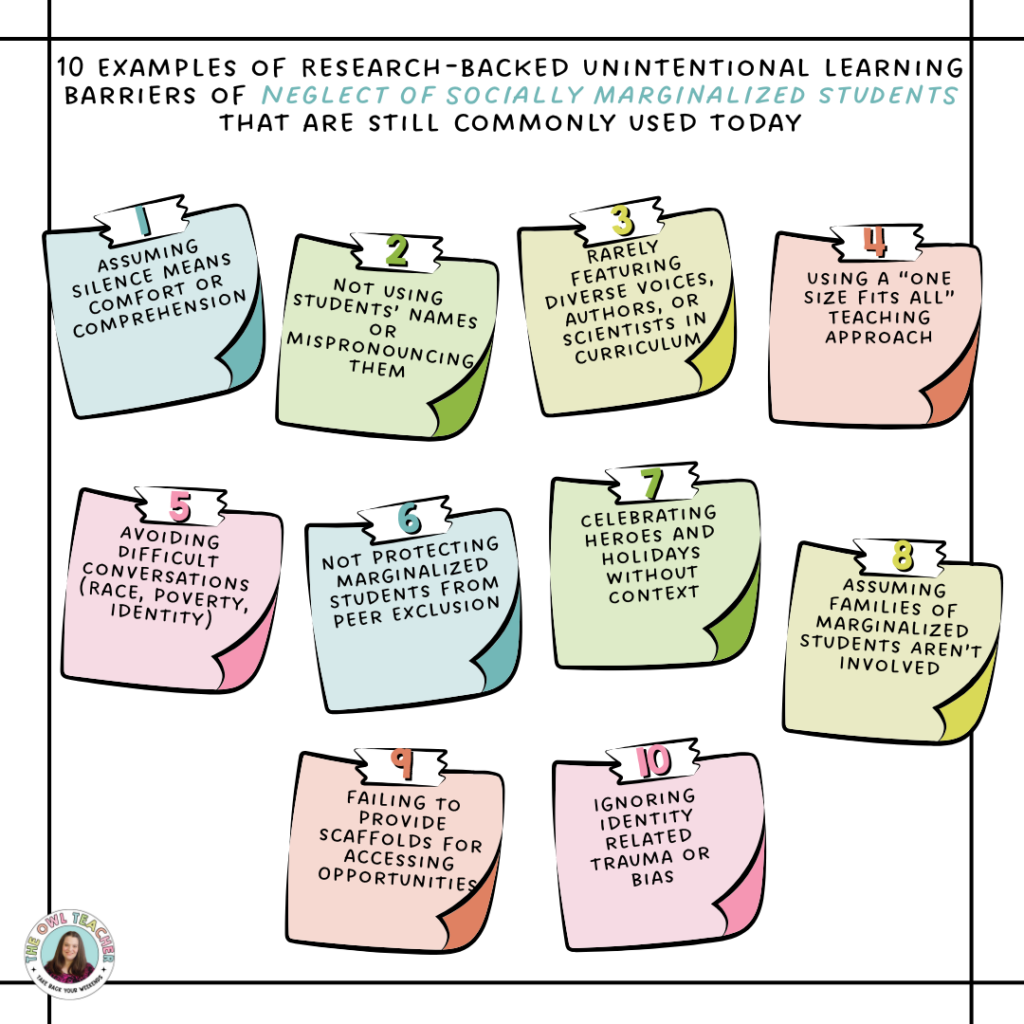
At first, this may seem like it is only about race, but it’s more. It includes students marginalized due to poverty, neurodivergence, language barriers, family structures, or a history of trauma. Marginalization is not always cruelty or exclusion. It’s unintentionally giving more attention, patience, and opportunities to students who are louder and easier, while those students slip through the cracks because of what feels and looks like invisibility.
Research shows that students who feel connected demonstrate better academic performance, higher attendance rates, and fewer behavioral problems than those who feel marginalized.
TRY THIS INSTEAD:
If you rarely interact with certain students during a lesson, try…
- Track who you’ve connected with each day (not just academically, but also personally)
- Use exit tickets or reflection slips (notice a pattern?) to hear from quieter voices
- Set a goal to greet every student by name at least once a day
If certain students never take leadership roles or participate publicly, try…
- Assign rotating roles that highlight different strengths (tech setup, timekeeper, group lead)
- Offer low-risk ways to participate (polls, whiteboards, think-pair-share)
- Reflect on why you call on certain students more—comfort? rapport? bias?
If curriculum materials don’t reflect the lives or voices of your students, try…
- Include texts and problems that feature diverse names, families, and experiences
- Invite students to contribute books, traditions, or interests to your classroom culture
- Reframe your language: Instead of “at-risk,” try “systemically underserved” or “underestimated.”
If you’ve labeled certain students as “checked out,” lazy,” or “hard to reach,” try…
- Ask: What’s this student’s story? What might I be missing?
- Assume competence: speak to them, not around them
- Connect before correcting. The relationship always comes first
#5. Emotional & Energy Barriers
Teacher Burnout
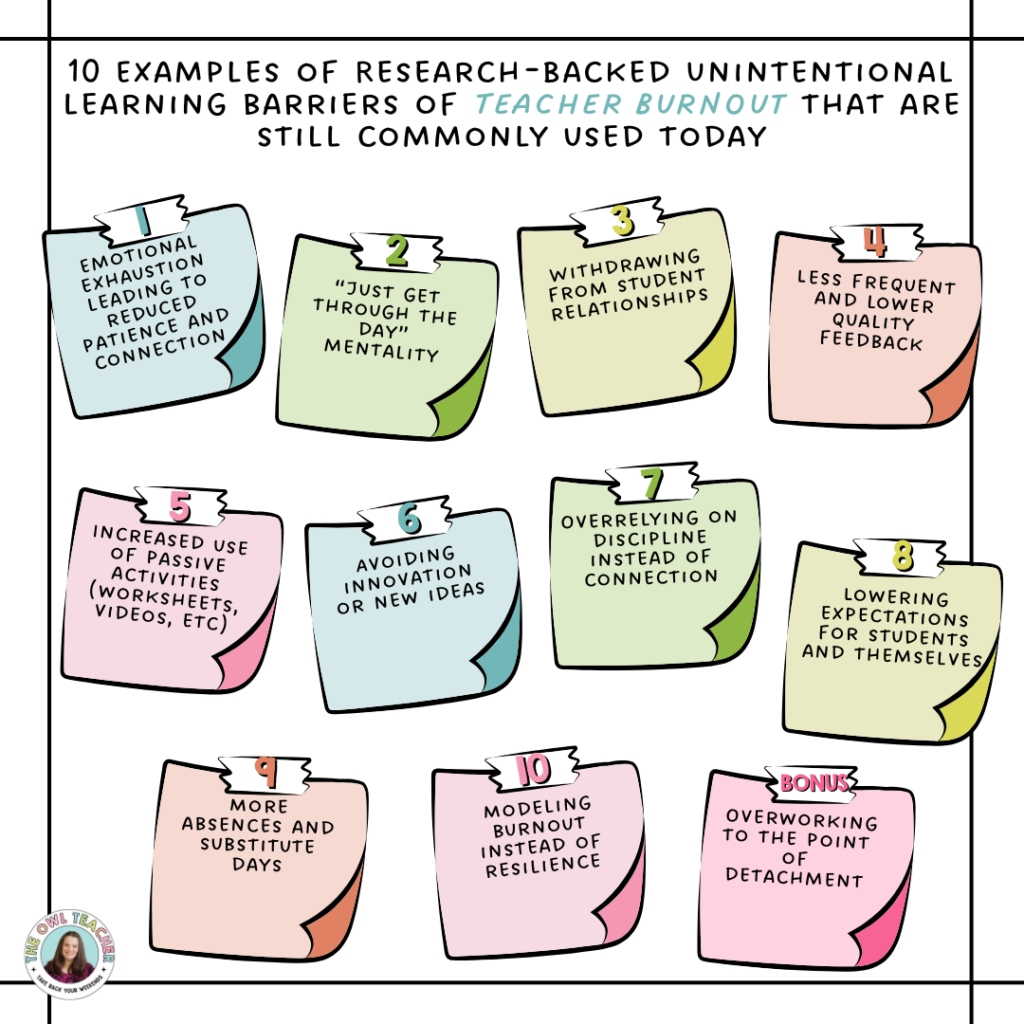
If you’ve been teaching for a while, you have likely experienced teacher burnout at some point—the feeling of having no more spark left but still showing up each day. Sometimes, we can even start to see our students as obstacles rather than students who need us.
Burnout is more than just being tired. When you pour out more without being refilled, it can create unintentional barriers to student growth. This can affect your feedback, energy, flexibility, creativity, expectations, etc. Research shows burnout reduces classroom quality and student outcomes (McLean & Connor, 2015).
I do want to remind you, though, that burnout solutions should not be more work. You need to protect your energy and refill that tank!
TRY THIS INSTEAD:
If your lessons feel flat and you’re emotionally checked out, try…
- Pick one day a week for a “spark” lesson—something creative or exploratory
- Reuse a favorite activity from last year instead of starting from scratch
- Build in moments of joy on purpose: music, movement, storytime, a silly challenge
If student behaviors are wearing you down, try…
- Use neutral language: “Let’s reset” instead of “How many times do I have to tell you?”
- Find one strength in each student, then name it out loud to them
- Tag out: Ask a teammate to take five minutes while you reset, too
If your feedback is rushed, reactive, or missing altogether, try…
- Give feedback in real time during student work, not after
- Focus on one area at a time—forget trying to correct it all
- Let students choose one thing they want feedback on
If you feel buried by planning and prep, try…
- Create flexible lesson “frameworks” that you can reuse weekly
- Use student-created materials (anchor charts, vocabulary cards, examples)
- Batch your planning on one afternoon a week instead of daily
If you feel isolated or unappreciated, try…
- Start or join a “2-Minute Win” practice with your team (end the day on a good note)
- Schedule co-planning or even co-grading sessions—it’s less lonely
- Remind yourself: Your value is not measured in how much you can push through.
Lack of Emotional Support for Students
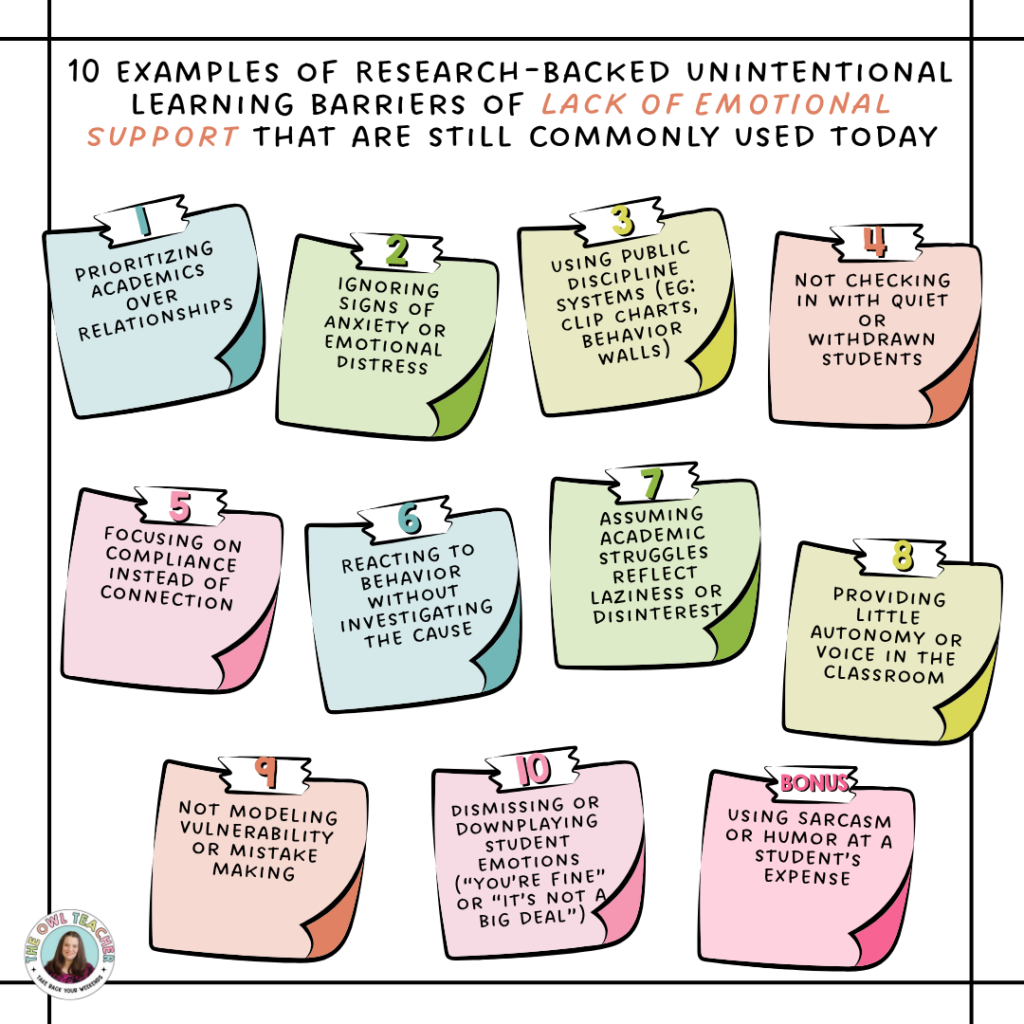
We’ve heard many times over the years that if students don’t feel safe and secure, they will struggle learning. Emotional safety is part of that, especially in upper elementary when students are starting to navigate big feelings, peer dynamics, and increasing academic demands. Lack of emotional support is an unintentional barrier to student growth when it shows up in behavior, disengagement, or silent withdrawal.
When students feel stressed, anxious, or disconnected, their ability to process and retain information diminishes significantly. Researcher Pamela Cantor’s work (2018) shows that supportive student-teacher relationships can mitigate the effects of stress and trauma on the developing brain, making them essential for learning to occur.
TRY THIS INSTEAD:
If you rarely check in emotionally with students, try…
- Start the day with a one-word mood check-in (e.g., “weather report” or “emoji board”)
- During transitions, ask, “Who needs five seconds to reset before we move on?”
- Keep sticky notes at students’ desks so they can signal how they’re feeling silently
If you’re unsure how to support quiet, withdrawn students, try…
- Pair them with a kind peer for low-stakes tasks or discussions
- Use journaling or drawing as a non-verbal outlet for connection
- Initiate a small, consistent ritual just for them (e.g., greeting, check-out, or lunch buddy)
If you struggle with emotional regulation yourself (understandably!), try…
- Narrate your self-regulation: “I’m feeling frustrated, so I’m going to take a breath.”
- Use calming transitions between activities—music, countdowns, stretch breaks
- Keep a go-to phrase that buys you time: “Let me think about how to handle this.”
If your classroom culture prioritizes behavior over belonging, try…
- Replace reward charts with community celebrations: “Who showed empathy today?”
- Use circle time or class meetings to process social/emotional issues
- Normalize asking for help, saying “I’m not okay,” or requesting space
Conclusion
You may have read a few things that made you cringe because you may be unintentionally creating a barrier to student growth in your classroom. You are not alone!
You are not a bad teacher. You’re a growing one.
All the unintentional barriers to student growth above—rescuing, burnout, bias, limited feedback, and so many more—are not signs of failure. They’re signs of survival in a system that asks too much of teachers (with little to no support). These habits are always met with good intentions.
You don’t need to overhaul everything tomorrow, check every box, or fix every habit. You need to stay open, reflective, and willing to try.
That’s where good teaching and student growth begin.

Sources and Additional Reading:
- Aloe, A. M., Amo, L. C., & Shanahan, M. E. (2014). Classroom management self-efficacy and burnout. Educational Psychology Review, 26(1), 101–126.
- Ball, D. L., Thames, M. H., & Phelps, G. (2008). Content knowledge for teaching: What makes it special? Journal of Teacher Education, 59(5), 389–407.
- Black, P., & Wiliam, D. (1998). Assessment and classroom learning. Assessment in Education, 5(1), 7–74.
- Boaler, J. (2016). Mathematical mindsets: Unleashing students’ potential through creative math, inspiring messages, and innovative teaching. Jossey-Bass.
- Brookhart, S. M. (2017). How to give effective feedback to your students (2nd ed.). ASCD.
- Butler, R. (1988). Enhancing and undermining intrinsic motivation: The effects of task-involving and ego-involving evaluation on interest and performance. British Journal of Educational Psychology, 58(1), 1–14.
- Cantor, P., Osher, D., Berg, J., Steyer, L., & Rose, T. (2018). Malleability, plasticity, and individuality: How children learn and develop in context. Applied Developmental Science, 23(4), 307-337.
- Cooper, H., Robinson, J. C., & Patall, E. A. (2006). Does homework improve academic achievement? A synthesis of research. Review of Educational Research, 76(1), 1–62. https://doi.org/10.3102/00346543076001001
- Dawson, P., & Guare, R. (2018). Executive Skills in Children and Adolescents (3rd ed.). Guilford Press.
- Donohoo, J. (2017). Collective Efficacy: How Educators’ Beliefs Impact Student Learning. Corwin Press.
- Driver, R., Asoko, H., Leach, J., Mortimer, E., & Scott, P. (1994). Constructing scientific knowledge in the classroom. Educational Researcher, 23(7), 5–12. https://doi.org/10.3102/0013189X023007005
- Dweck, C. S. (2006). Mindset: The New Psychology of Success. Random House.
- Dweck, C. S. (2007). The perils and promises of praise. Educational Leadership, 65(2), 34–39.
- Ertmer, P. A. (1999). Addressing first- and second-order barriers to change: Strategies for technology integration. Educational Technology Research and Development, 47(4), 47–61.
- Freeman, S., et al. (2014). Active learning increases student performance in science, engineering, and mathematics. Proceedings of the National Academy of Sciences, 111(23), 8410–8415. https://doi.org/10.1073/pnas.1319030111
- Fullan, M. (2007). The New Meaning of Educational Change (4th ed.). Teachers College Press.
- Gay, G. (2018). Culturally Responsive Teaching: Theory, Research, and Practice (3rd ed.). Teachers College Press.
- Gershenson, S., Holt, S. B., & Papageorge, N. W. (2016). Who believes in me? The effect of student–teacher demographic match on teacher expectations. Economics of Education Review, 52, 209–224.
- Goddard, R. D., Hoy, W. K., & Hoy, A. W. (2000). Collective teacher efficacy: Its meaning, measure, and impact on student achievement. American Educational Research Journal, 37(2), 479–507.
- Gregory, A., & Ripski, M. B. (2008). Adolescent trust in teachers. School Psychology Review, 37(3), 337–353.
- Guskey, T. R. (2002). Professional development and teacher change. Teachers and Teaching, 8(3), 381–391.
- Hall, G. E., & Hord, S. M. (2015). Implementing Change: Patterns, Principles, and Potholes (4th ed.). Pearson.
- Hamre, B. K., & Pianta, R. C. (2001). Early teacher–child relationships and the trajectory of children’s school outcomes through eighth grade. Child Development, 72(2), 625–638.
- Hattie, J. (2009). Visible Learning: A synthesis of over 800 meta-analyses relating to achievement. Routledge.
- Hattie, J. (2012). Visible Learning for Teachers: Maximizing Impact on Learning. Routledge.
- Hattie, J., & Clarke, S. (2019). Visible Learning: Feedback. Routledge.
- Hattie, J., & Timperley, H. (2007). The power of feedback. Review of Educational Research, 77(1), 81–112.
- Hattie, J., & Zierer, K. (2018). 10 Mindframes for Visible Learning: Teaching for Success. Routledge.
- Hill, H. C., Rowan, B., & Ball, D. L. (2005). Effects of teachers’ mathematical knowledge for teaching on student achievement. American Educational Research Journal, 42(2), 371–406. https://doi.org/10.3102/00028312042002371
- Howard, T. C. (2010). Why Race and Culture Matter in Schools: Closing the Achievement Gap in America’s Classrooms. Teachers College Press.
- Jennings, P. A., & Greenberg, M. T. (2009). The prosocial classroom: Teacher social and emotional competence in relation to student and classroom outcomes. Review of Educational Research, 79(1), 491–525.
- Jones, S. M., & Kahn, J. (2017). The evidence base for how we learn: Supporting students’ social, emotional, and academic development. Aspen Institute National Commission on Social, Emotional, and Academic Development.
- Kapur, M. (2008). Productive failure. Cognition and Instruction, 26(3), 379–424.
- Kohn, A. (2006). Beyond discipline: From compliance to community. ASCD.
- Knight, J. (2007). Instructional Coaching: A Partnership Approach to Improving Instruction. Corwin.
- Ladson-Billings, G. (1995). Toward a theory of culturally relevant pedagogy. American Educational Research Journal, 32(3), 465–491.
- Ma, L. (1999). Knowing and teaching elementary mathematics: Teachers’ understanding of fundamental mathematics in China and the United States. Lawrence Erlbaum.
- Marzano, R. J., & Marzano, J. S. (2003). The key to classroom management. Educational Leadership, 61(1), 6–13.
- Maslach, C., & Leiter, M. P. (2016). Understanding the burnout experience: Recent research and its implications. World Psychiatry, 15(2), 103–111.
- McLean, L., & Connor, C. M. (2015). Depressive symptoms in third-grade teachers and the quality of classroom interactions. Child Development, 86(3), 945–954.
- Milner, H. R. (2010). Start Where You Are, But Don’t Stay There: Understanding Diversity, Opportunity Gaps, and Teaching in Today’s Classrooms. Harvard Education Press.
- Mishra, P., & Koehler, M. J. (2006). Technological pedagogical content knowledge: A framework for teacher knowledge. Teachers College Record, 108(6), 1017–1054.
- Ng, W. (2012). Can we teach digital natives digital literacy? Computers & Education, 59(3), 1065–1078.
- Patrick, B. C., Hisley, J., & Kempler, T. (2000). The effects of teacher enthusiasm on student intrinsic motivation. The Journal of Experimental Education, 68(3), 217–236.
- Rattan, A., Good, C., & Dweck, C. S. (2012). “It’s ok—not everyone can be good at math”: Instructors with an entity theory comfort students in ways that undermine motivation. Journal of Experimental Social Psychology, 48(3), 731–737.
- Schonert-Reichl, K. A. (2017). Social and emotional learning and teachers. The Future of Children, 27(1), 137–155.
- Shulman, L. S. (1986). Those who understand: Knowledge growth in teaching. Educational Researcher, 15(2), 4–14. https://doi.org/10.3102/0013189X015002004
- Shute, V. J. (2008). Focus on formative feedback. Review of Educational Research, 78(1), 153–189.
- Simonsen, B., Fairbanks, S., Briesch, A., Myers, D., & Sugai, G. (2008). Evidence-based practices in classroom management: Considerations for research to practice. Education and Treatment of Children, 31(3), 351–380.
- Skaalvik, E. M., & Skaalvik, S. (2010). Teacher self-efficacy and teacher burnout. Teaching and Teacher Education, 26(4), 1059–1069.
- Tomlinson, C. A. (2014). The Differentiated Classroom: Responding to the Needs of All Learners (2nd ed.). ASCD.
- Tschannen-Moran, M., & Hoy, A. W. (2001). Teacher efficacy: Capturing an elusive construct. Teaching and Teacher Education, 17(7), 783–805.
- Vygotsky, L. S. (1978). Mind in Society: The Development of Higher Psychological Processes. Harvard University Press.
- Weinstein, R. S. (2002). Reaching Higher: The Power of Expectations in Schooling. Harvard University Press.
- Wood, D., Bruner, J. S., & Ross, G. (1976). The role of tutoring in problem solving. Journal of Child Psychology and Psychiatry, 17(2), 89–100.
- Yeager, D. S., & Dweck, C. S. (2012). Mindsets that promote resilience: When students believe that personal characteristics can be developed. Educational Psychologist, 47(4), 302–314.