


Do you remember learning how to ride a bike? I do. I pulled out the bicycle manual and read it cover to cover. Then, I climbed on that simple machine and down the hill I went. I was off like a marathon biker. That’s right. I read and learned it. Or, maybe it was more like I skipped the manual (do they actually have one?), got on that monster that knocked me off a thousand times, and manhandled it until I mastered it. Because learning isn’t about sitting still, absorbing content; it’s about the painful (ouch! The scars I have…), messy (gravel and dirt), practice (over and over), and a slight push (dad, not so fast!), we need to understand. It’s about learning by doing.
Are You Teaching Hands-On Learning or Hands-Busy Learning?
Now, I want to be clear here. I’m not going to go into theories, research, psychology, or any of that. We know that learning by doing means providing students with hands-on learning experiences. It is often argued that learning by doing can’t be achieved through reading because it is too abstract. That is entirely untrue, as you’ll see below. You aren’t going just to tell them about the concept. They are actually going to do something with it, so their brain has no choice but to remember.
But, I do want to be honest about what it is NOT. Most hands-on learning in classrooms isn’t hands-on. It’s actually “hands-busy.” These are practices we use in our classroom that don’t align with the learning objective. A worksheet disguised as a “learning center” or a science experiment in which everything is pre-measured, and students follow the steps like robots, is an example. We call it hands-on learning. Some would even say they are learning by doing. But really, are they? Or is it just another way to keep kids compliant and quiet?
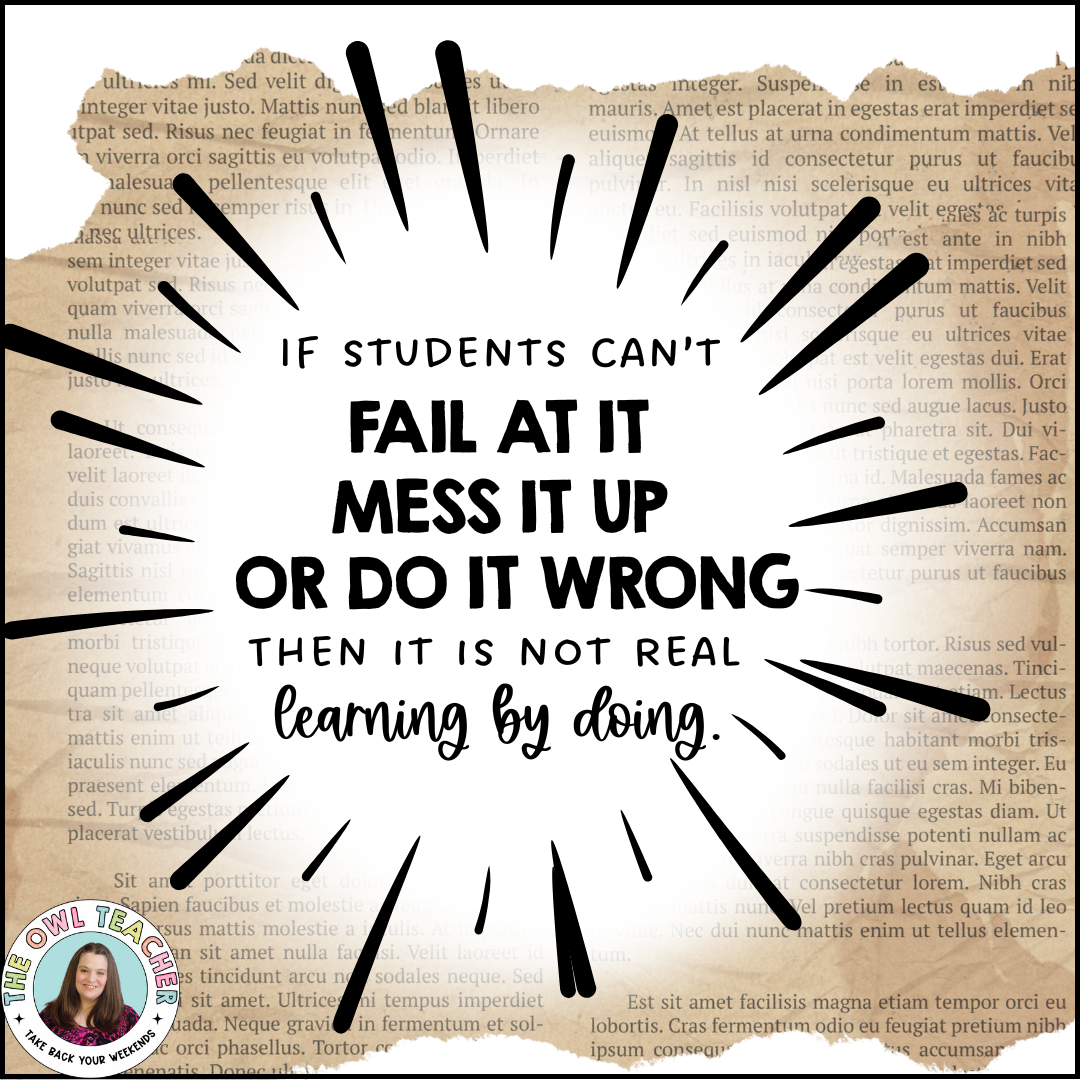
If students can’t fail at it, mess it up, or do it wrong, it is not real learning by doing.
We’ve been led to believe that hands-on learning means cute, Instagram-worthy activities that look identical to one another and to the post itself! But that’s not how real learning by doing works in the actual world.
When engineers build bridges, some of their designs will fail. When scientists run experiments, they may get unexpected results. When mathematicians solve problems, they sometimes have to start over because it doesn’t make sense. Learning happens in the struggle, the failure, and the figuring-it-out process.
Unfortunately, in our classrooms, we’ve sanitized all of that away. We give students activities with predetermined outcomes; the steps are either foolproof or provided, leaving no room for inquiry or discovery.
Hands-on Learning Activities that ARE Learning By Doing
Hands-On Learning By Doing Math
- The Classroom Redesign
This activity is very similar to my Design a House activity, in which students must calculate areas and perimeters, create scale drawings, and justify their choices using mathematical terminology. After students are provided with the dimensions of the classroom, they are tasked with designing the space to maximize learning. Unlike my PBL Activity above, you could provide students with a budget for an extension and have them measure the room dimensions as part of a measurement activity. - The Unfair Game
While probability isn’t taught often as that, probability – it’s concepts still apply in other areas like fractions. Either way, this activity is a challenge for students. Have students design a die or spinner game that looks fair but is actually mathematically rigged. They must use probability to make sure one of the players has an advantage that no one knows about. Then they play each other’s games and try to determine who had the advantage and who was scammed. Suddenly, this abstract concept is about a tool for deception and detection. Well… maybe we shouldn’t teach this… - Budget Meetings
Isn’t life annoying with all these bills and things? Especially now, when the price of a candy bar is ridiculous. I remember when they were $0.35. Of course, at that time, they were just a small, regular candy bar (Do they still make these? Are they called “baby size?”). We didn’t have the candy bars that were sharing size, group sharing size, neighborhood sharing size, and so on. The point was that sometimes I had to budget my money so I could walk to the neighborhood convenience store (without fear of a crazy, violent world) to get my Reeses. Kids need to learn this (in case they have a parent who actually makes them earn money instead of just giving it to them…).
Long, long story short (whew!), give students a monthly “salary” (Not based on grades if you want to keep your job) and real expenses such as rent, groceries, utilities, and car payment. Have them create a budget and hold weekly or monthly budget meetings to discuss it. Have students run out of money so they can problem solve- what gets cut? What are the real consequences? Watch this learning by doing hands-on activity change as the year progresses.
Hands-On Learning By Doing Science
- The Bridge Engineering Challenge
Yes, we have heard about this before. STEM would be nothing without inquiry, correct? In this hands-on learning challenge, provide students or groups with a variety of limited materials such as popsicle sticks, tape, or string. Then have them design and construct a bridge of specified length. Have them test them with weight until they break. Graph the results as a class and discuss. - Keeping it Alive! Ecosystems with Consequences
I love all ecosystem-related topics. This science activity goes beyond learning by doing to emphasize the importance of our choices. Students must design an ecosystem that could theoretically survive – imaginary or not. They must choose organisms, explain food webs, justify their choices, and more. Then have students complete a peer review – would this ecosystem actually work? What would die first? Why? - Mystery Substance Investigation
If you have seen this hands-on activity before, you likely know that students are given a variety of kitchen ingredients, such as baking soda, salt, flour, and sugar, and they must identify each one. (Additionally, why does it always have to be white ingredients? Numerous other ingredients have similar colors or materials. Just keep it safe for kids, and you’re golden!) However, remove the “busy-learning” by not providing any specific tools. You can give them in the center of the groups, but students can design their own tests to determine the identity of each substance. As long as students are testing instead of guessing, they are learning by doing. - Weather Predictions
Since I live in Michigan, we have snow 42 months out of the year. It means I’m always asking Mother Nature if she could chill on all the snow. Okay, maybe I’m lying a bit. That’s obviously why I’m a teacher rather than a meteorologist. However, let us have the students determine that as well. Meteorology is hard. Have them track the weather in your area for two weeks, then assess whether they make accurate predictions for the following week’s weather. Have them use patterns and identify any factors to consider. This could be done throughout the year to see who becomes the class “meteorologist” by being the most (average) accurate.
Hands-on Learning by Doing in Reading
- The Book Trailer Production Challenge
When I first started my blog, I wrote about having students create book trailers. While that post is very, very old, it still contains some valuable content. The videos are old, as technology advances at nearly the speed of light. The point is, instead of having students write lame, boring book reports that you know they will get plenty of in other classes, why not have them create a “movie trailer” on the book where they have to “sell” the book to their classmates. They have to identify the plot, the hook, the key conflict, and even throw in the emotional tone. However, ensure they don’t reveal the ending, as films don’t disclose all information, including the ending. Provide them with restrictions, such as time limits and inclusion and exclusion criteria. This enables them to determine what is truly important to include. - A Character Trial or Hearing
When reading stories, have students select a controversial character and put that character on trial for their choices. Have students cite specific passages, analyze motivations, and argue using evidence. You can assign roles to groups of students, such as:- Prosecution: argues the character made the wrong choice
- Witnesses: other characters who testify
- Jury: classmates who must decide based on text evidence
- Defense: argues the character made the right choice
- The Remix Challenge
To make reading hands-on learning by doing, have students take a scene, chapter, or story and “remix” it by changing one central element, such as the setting, the point of view, the time period, or the genre. For example, in the story “The Three Little Pigs,” students could retell it as a news report, place the setting in outer space (a floating pig. Ha!), or rewrite it from the antagonist’s perspective (yes, I know there’s the fractured tales. I love Jon Scieszka!). The point is that, to do this successfully, they must have a deep understanding of plot structure, character motivation, cause and effect, and theme. The remix reveal is that they genuinely understand the original. - Interactive Reading Maps
In this hands-on learning activity, students create a physical or digital “map” of the story that others can interact with. This could be a geographic map of the setting with key events marked, a relationship web where you can pull strings to see the connections between characters, a timeline they build with index cards that can be rearranged, or a “choose your own adventure” style decision tree showing how different character choices would change the plot of the story. The key is that it must be functional and teach someone else about the story through interaction, not decoration.
A Few Extras…
- Deeper Debate
I love to debate. My mom always said I could have been a lawyer. (But really, who wants to do all that schooling!) When I was teaching, I used to bring in a newspaper headline that I felt would be a real issue relevant to my content or the students. Now, I know newspapers are harder to find than time, but they are available online. Have students research, build their arguments with evidence, and defend their positions. Add an extra challenge by having appropriate “rap battles” during the debate. - A Math Hunt
Have students identify a real problem in the school or community that can be solved using mathematics. This can be something unnoticed, such as water waste, time lost during transitions, increased lunch times (optimization), lunch line flow, etc. Have students collect data, analyze it, and present solutions to the class. If desired, have students pitch their ideas and then vote on which problem to work on together. - Teach learning by doing for hands-on learning
I’m sure you’ve been told to have students teach the class a concept you’ve taught or that they have learned. But since this post is about learning by doing, students cannot simply stand at the front of the room, appear nervous, and point at their presentation (if they even made one). Instead, they must create a hands-on learning experience that helps others learn by doing. It’s a lot harder than they think to be a teacher, too!
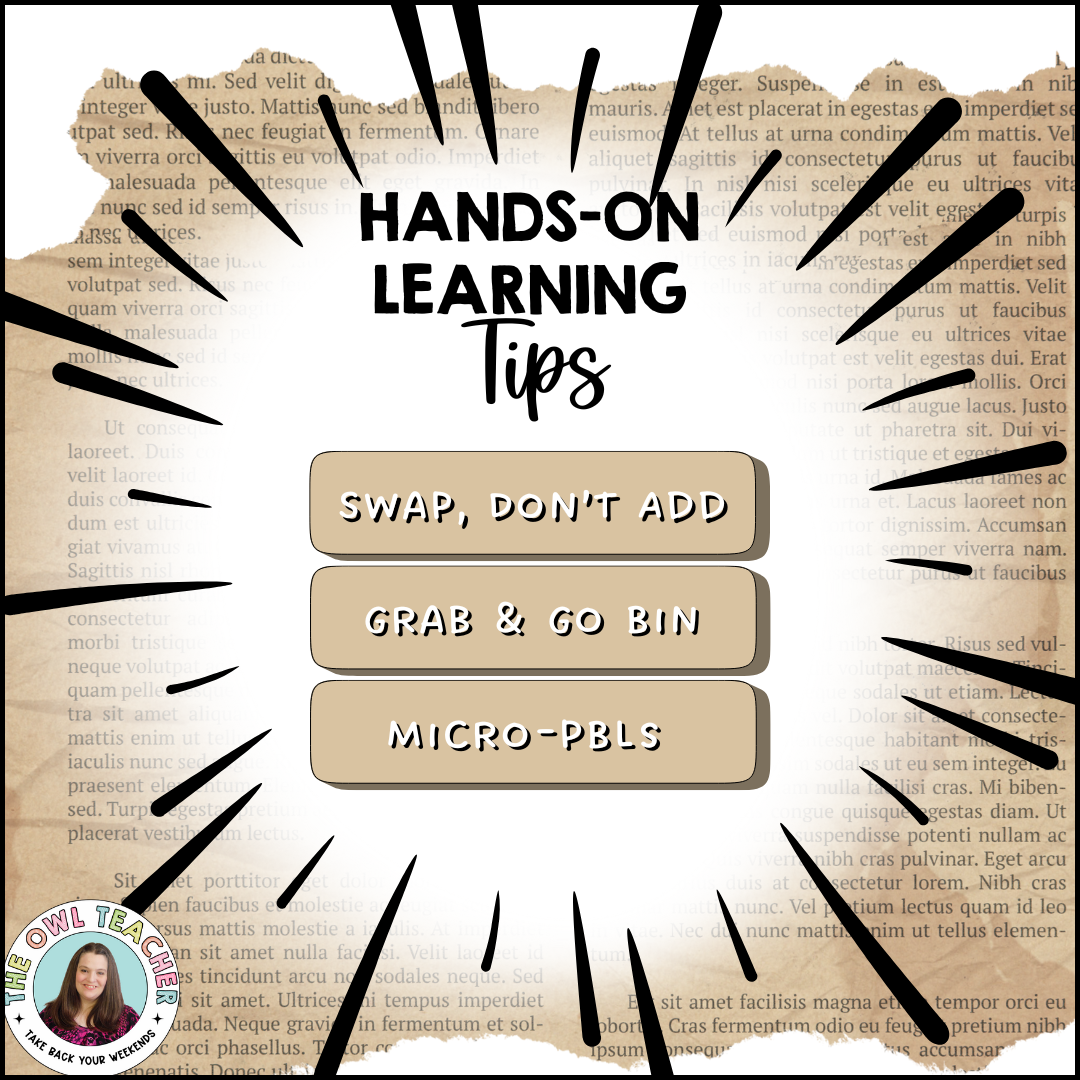
Hands-on Learning Tips (because let’s make this easier, right?)
Since you already are doing hands-on learning, I want to give a few tips to make learning by doing a bit easier. We need to make it work with your limited time instead of against it.
- Swap, don’t add.
Instead of adding materials or purchasing items, ask yourself whether there is anything you can replace. Instead of problems on a worksheet, have them complete it as a model-building challenge. Instead of giving them a graphic organizer, ask which one they think would work or create their own. - Grab & Go Hands-On Bin
If possible, ahead of time, create a hands-on bin that you have when needed. This serves as an instant learning-by-doing kit. You can have students turn problems into card sorts, build-a-model, number line creations, or sketch-and-solve moments. In this bin place:- sticky notes
- index cards
- dice
- small objects for arrays
- dry-erase boards
- fraction strips
- base-ten blocks
- paper strips for number lines or bridges
- Micro-PBLs
When PBL’s are mentioned, there’s a slight sigh overheard in the crowd. Although this is a hands-on, learning-by-doing activity, it is viewed as a prolonged process. It doesn’t need to be a three-week project. Instead, think of it as a 10-20-minute scenario in which students are given a “mini-challenge,” such as the cafeteria having misordered the lunch. We will need to help them fix the fractions. You can also consider using exemplars for morning work or your micro-PBL thought-provoking questions.
The Shift to Learning By Doing
Instead of asking yourself when planning, “What hands-on activity can I add to this lesson?” ask yourself, “What could my students actually do with this knowledge that would require them to think, struggle, and figure things out?“
This difference means everything. Real learning by doing means that:
- Students are making genuine choices instead of picking between pre-approved options
- The outcomes are uncertain, meaning not everyone will have the same result
- Failure is possible, valuable, and expected
- The work has an authentic, real-world purpose (besides just because it aligns to the standards)
- Students must problem solve independently rather than just follow steps provided
Are you ready to let your students actually learn by doing or we going to keep pretending that that hands-busy learning is the same as hands-on learning?