







Looking for ecosystem activities and project ideas that go beyond the shoebox diorama? This post covers 10 hands-on ecosystem activities and ecosystem project ideas for upper elementary science — including building real habitats, creating biome foldables, ecosystem scavenger hunts, PBL zoo design, and more. All these ecosystem activities work for grades 3–5 and align with NGSS and the updated Texas TEKS.
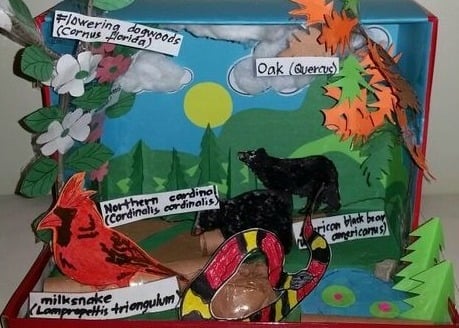
Don’t get me wrong — dioramas are great – but boring for most ecosystem activities. But if you’re like me, you want your students to express what they’ve learned in ways that actually make them think. That’s what these 10 activities do.
If you’re focusing specifically on food chains and food webs, here are 8 hands-on food chain activities that pair perfectly with these ecosystem projects.
Science Standards These Ecosystem Activities Support
NGSS (Next Generation Science Standards):
- 3-LS2-1 — Construct an argument that some animals form groups that help members survive. (Connects to food chain and community activities — #1, #3, #6)
- 3-LS4-3 — Construct an argument with evidence that in a particular habitat some organisms can survive well, some survive less well, and some cannot survive at all. (Activities #1, #3, #5, #10)
- 3-LS4-4 — Make a claim about the merit of a solution to a problem caused when the environment changes. (Activity #3 — Imaginary Ecosystem, #9 — PBL Zoo)
- 5-LS2-1 — Develop a model to describe the movement of matter among plants, animals, decomposers, and the environment. (Activities #1, #3, #9, #10)
- 3-5-ETS1-1 — Define a simple design problem reflecting a need or a want that includes criteria for success and constraints on materials. (Activity #9 — PBL Zoo Design)
Texas TEKS (updated 2024–25):
- TEKS 3.12A — Explore and describe how organisms in an ecosystem interact, including producers, consumers, and decomposers within food chains. (Activities #1, #3, #5, #6)
- TEKS 3.12B — Describe how changes in an ecosystem, such as the removal of organisms, affect the ecosystem. (Activities #3, #9)
- TEKS 4.12A — Investigate how organisms in an ecosystem interact in food webs, identifying producers, consumers, and decomposers. (Activities #6, #9, #10)
- TEKS 5.12A — Observe and describe how a variety of organisms survive by interacting with biotic and abiotic factors in a healthy ecosystem. (Activities #1, #3, #5, #9)
- TEKS 5.12B — Predict how changes in the ecosystem affect the cycling of matter and flow of energy in a food web. (Activities #3, #9)
- TEKS 5.12C — Describe a healthy ecosystem and how human activities can be beneficial or harmful to an ecosystem. (Activity #9 — PBL Zoo)
New to teaching ecosystems? Start with my quick intro lesson: Going Wild for Ecosystems — it walks you through a 1–2 day overview using a scavenger hunt and accordion booklet before diving into deeper projects.
Which Ecosystems Should You Teach in Upper Elementary?
Most upper elementary teachers cover between 6 and 10 ecosystems. Here are the ones most commonly included in science curricula for grades 3–5:
- Desert — hot and dry, low rainfall, organisms adapted to conserve water
- Grassland / Prairie / Savanna — wide open spaces, grasses dominate, large herbivores
- Tropical Rainforest — hot and wet year-round, the most biodiversity of any ecosystem
- Temperate Forest (Deciduous) — four seasons, trees that lose leaves, deer, bears, foxes
- Tundra — extremely cold, permafrost, very few trees, arctic animals
- Freshwater (Rivers, Lakes, Ponds) — flowing and still water, fish, amphibians, insects
- Ocean / Marine — saltwater, coral reefs, open ocean, tidal zones
- Wetlands / Marsh / Swamp — saturated with water, rich in biodiversity, filtering ecosystems
- Taiga / Boreal Forest — cold, coniferous trees, moose, wolves, bears
- Mountains / Alpine — high elevation, thin air, organisms adapted to steep terrain
Any of the 10 project ideas below can be used with whichever ecosystems your district requires. Most activities work best when each student or group focuses on one ecosystem and then shares with the class.
1. Build Your Own Ecosystems or Habitats
Have your students work in groups to research and then create an ecosystem together. It can be something as simple as collecting pond water, organisms, and plants. You could also have students create individual habitats instead of an entire ecosystem. We created our own habitats, and the students really enjoyed it. Together, we discussed the importance of meeting our living things’ needs and a healthy environment. We had a habitat for ants, fish, worms, and so much more.
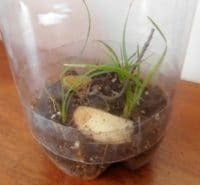
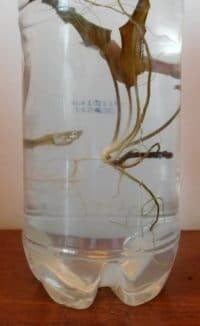
Materials Needed:
- clear containers (jars, plastic bins, 2-liter bottles)
- pond water or soil
- small plants
- small organisms (ants, worms, or fish, depending on habitat)
- gravel
- spray bottle
Once students have built their habitats, connect it to the food chain. Here are 8 hands-on activities for teaching food chains and food webs that pair perfectly with this project.
2. Ecosystem Flap Book Activity
Provide students with a 12 x 9 strip of construction paper and several index cards (one per ecosystem you are studying). Have students name, draw, and color the ecosystem on the outside of the index card, and provide valuable information about it on the inside. When you are done, it will look like this:
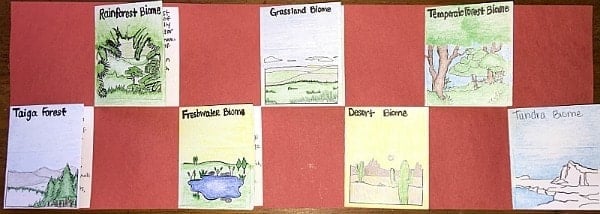
Materials Needed:
- one 12×9 strip of construction paper per student
- index cards (one per ecosystem)
- crayons or markers
- glue sticks
- scissors
3. Design an Imaginary Ecosystem Activities
Have students create their own ecosystem, but still require the characteristics of ecosystems, such as both living and nonliving factors, populations, communities, and so on. Have students determine the food chains and much more. It will definitely require some creative thinking on their part, but it will definitely be fun!
Materials Needed:
- large poster paper or butcher paper
- colored pencils or markers
- ruler (for drawing food chains)
- printable ecosystem requirement checklist (create one or use your own)
Want students to think even more critically about ecosystems? Check out my post on 12 common mistakes teachers make in ecosystem lessons — it’ll help you avoid the pitfalls before students start designing their own.
4. Ecosystem Hanging Mobile Craft
Students love creating mobiles, and they make for a cute display. If you can’t find hangers to make mobiles, you can easily use other materials such as sticks (yes, sticks from trees), dowels (found in craft stores), or paper towel rolls. When creating these ecosystem activities, you can have students again use index cards, as in the example above, to design the outside and describe the ecosystem on the inside. You could also have students get creative and design something that represents that ecosystem, such as a raindrop for the rainforest. Students will love this ecosystem project idea!
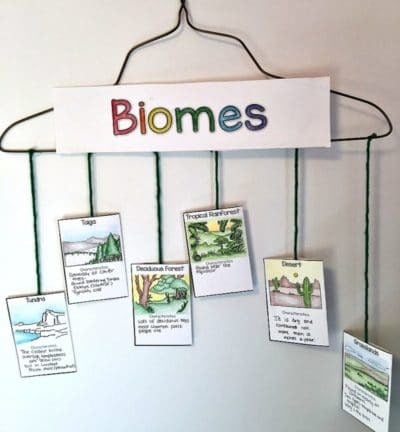
Materials Needed:
- wire hangers
- sticks
- dowels or paper towel rolls
- index cards or cardstock
- string or yarn
- hole punch
- markers or colored pencils
5. Ecosystem Read-Around-the-Room Stations
Set out many books about ecosystems around the room, and students are sure to get excited! Have different locations representing different ecosystems, and then move students around from station to station. If you want, you can have students record what they learned about that ecosystem in a chart or on a single large sheet of chart paper. There are many great books out there on ecosystems.
Materials Needed:
- 6–8 nonfiction books on different ecosystems
- chart paper or student recording sheets
- sticky notes (optional for student questions)
- clipboards
If you want to extend the reading into a collaboration project, try my ecosystem collaboration activity, where each student becomes a mini-expert on one biome and then teaches the class.
6. Ecosystem Scavenger Hunt Activity
What student doesn’t love a scavenger hunt? To create an ecosystem scavenger hunt, you would just place information about each ecosystem around your room in different locations. For instance, in one spot you may have information about deserts, and in another location, information about grasslands. Then create a few questions for students to answer regarding each ecosystem. Students move around the room reading about each ecosystem and hunt for those questions. It’s a great way to sneak in some reading and just more ecosystem activities.
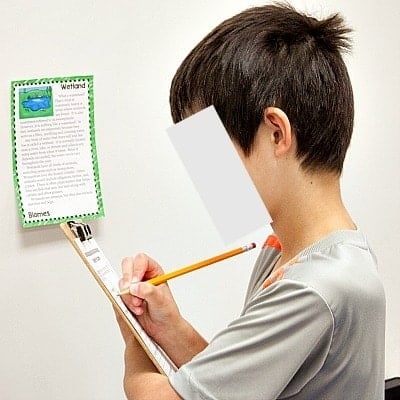
Materials Needed:
- printed ecosystem information cards (one per ecosystem, posted around the room)
- scavenger hunt question sheet per student
- pencils
- clipboards
7. Ecosystem Accordion Foldable Book
Can you tell I’m a crafty, foldable kind of gal? I just love hands-on activities and foldables. I think I wrote about this a little in my Going Wild for Ecosystems post. Drag out some construction paper or copy paper and have students fold it in half. Then have them draw the ecosystem at the top and write about its characteristics at the bottom of the half sheet. When finished, you have an ecosystem accordion foldable and more ecosystem activities to add to your toolbox! (See image below).
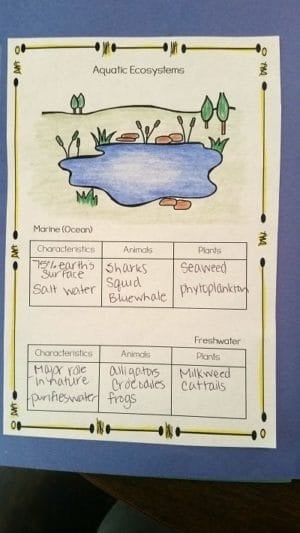
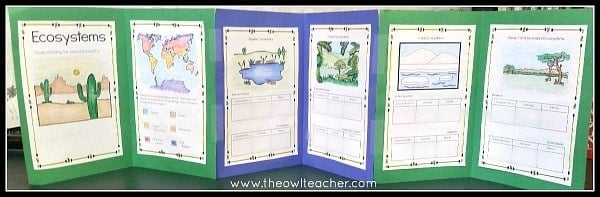
Do this with each half for however many ecosystems you are studying. Then connect them all by gluing them (or taping) side by side. (see image above).
Materials Needed:
- construction paper or copy paper (one sheet per ecosystem per student)
- crayons or markers
- glue sticks or tape for connecting sections
8. Ecosystem Circle Book Project
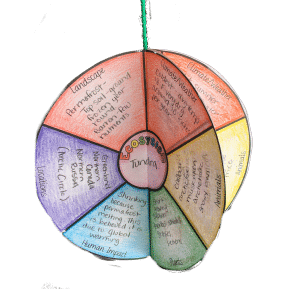
Are you looking for easy-peasy ecosystem project ideas? These circle books have been my latest obsession. I’ve even got some created that I haven’t uploaded yet! But just like any of the above, you don’t have to head to my store to purchase them; you could easily create them yourself! Provide each student with one circle for each ecosystem they would like to represent. Then, on each circle, have them illustrate the ecosystem on the top and describe its characteristics on the bottom. (Sensing a theme?) Then fold each circle in half, back-to-back, and glue them together to form your ecosystem circle book.
Materials Needed:
- circle templates (pre-cut or traced)
- scissors
- glue sticks
- markers or colored pencils
- reference materials for ecosystem characteristics
9. Ecosystem PBL – Design Your Own Zoo Ecosystem Activities
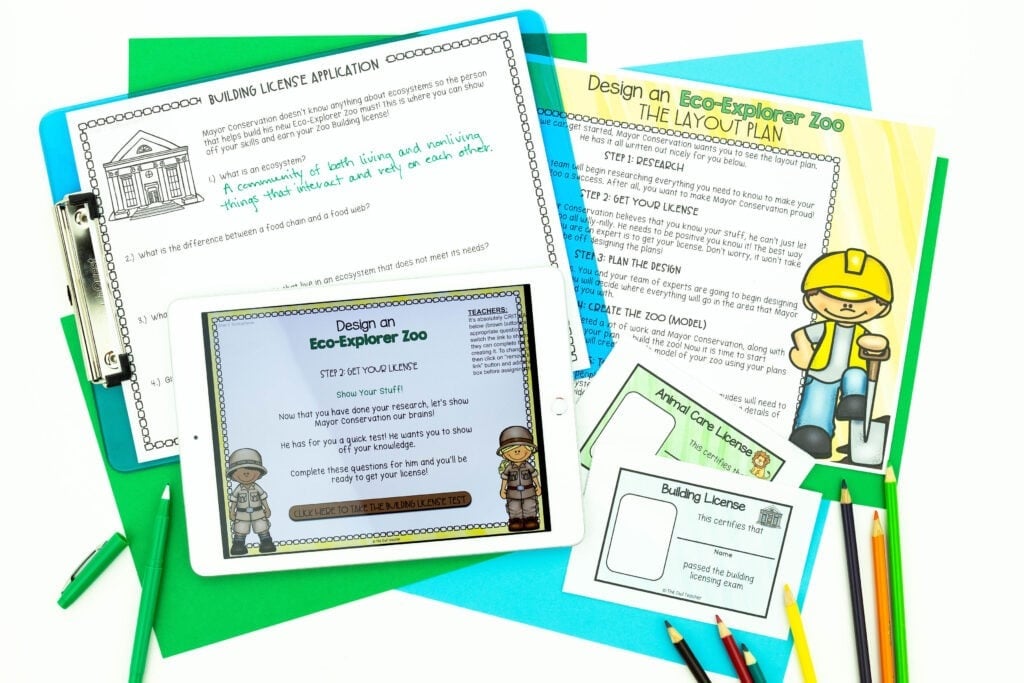
Are you looking for a way to get in a little PBL? Why not have students design their own ecosystem zoo? (This is a shameless plug!) This ecosystem project idea integrates area, perimeter, geometry, and STEM learning in your science classroom. Students work through a series of steps, including research, to design and build a model of their own ecosystem zoo! It’s differentiated and can easily be adapted!
Materials Needed:
- grid paper
- rulers
- colored pencils
- recycled materials for 3D model building (cardboard, construction paper, pipe cleaners)
- research access (books or devices)
- rubric printout
This PBL project also connects beautifully to math. Students design their zoo enclosures using area and perimeter — integrating geometry with life science. If you want more on making hands-on learning actually work (instead of just being busy work), check out my post on the truth about learning by doing.
10. Ecosystem Activities: Triboard Display (Science Fair Style)
Why not have your students create a display similar to a science fair? In this display, students would take a standard file folder (see image below) and attach pieces describing the landscape, climate, plants, animals, and the food chain/web of the ecosystem. Then have students place a world map in the middle and color all the locations in the world where their ecosystem can be found. This can also be done on a larger scale with an actual tri-board.
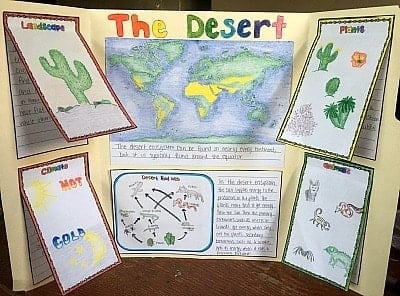
Materials Needed:
- file folders (one per student) or tri-fold boards
- printed world map (one per student)
- index cards or cardstock
- markers
- glue
- scissors
If you teach plants alongside ecosystem activities (and you should — they’re the producers that make every food chain work), grab my 10 hands-on plant activities for even more ideas.
Want to save a little money? Check out the Ecosystem Bundle! It combines many of my ecosystem activities together at a discounted price.
GRAB THE FREEBIE!
Want to grab the ecosystem tri-board display activity above for free?
This is just a small sampling of some ecosystem project ideas. If you’re looking to save time, you can find many of these items inexpensively prepared for you in my store here, though you can also create many of these ideas yourself. And if you’re looking to save money, I’ve got a great bargain with my ecosystem activities bundle—eight whole products that can easily stand alone or be chained together!