






You made a unit on ecosystems that you think is great. It has colorful worksheets on the food chain, a wall with vocabulary phrases, and maybe even a little space for plants or small animals in the ecosystem lessons. But halfway through, you see students with glazed eyes, questions that don’t make sense, and students who still don’t know the difference between a food chain and a food web. Have you heard this story before?
Looking for activities instead of advice? Here are 10 hands-on ecosystem projects you can try this week.
Ecosystems are one of those science topics that seem easy to teach, but they are full of complex ideas, oversimplifications, and chances for students to miss the big picture. The good news is that once you know what to look for, it’s not hard to avoid most of these problems.
I want to share 12 common mistakes teachers make when teaching ecosystems and, more importantly, how to fix them so your students really understand how living things interact in their habitats.
Mistake #1: Teaching vocabulary without the context of looking at things
Using words like “producer,” “consumer,” and “decomposer” right away without giving students any context doesn’t help them figure out what they mean.
I recommend starting with activities that let students touch and observe things around them to get them interested.
When you use real-life examples instead of abstract words, you build a foundation for real knowledge.
You can use a KWL chart to help students think about what they already know before you teach them something new. Take it one step further by having them draw or sort out different organisms in an ecosystem to see if they can figure out where they might go.
Take the students outside to see a local ecosystem, like a park, a playground, or even a small garden. Tell them to draw what they see and pay attention to how living things interact. Then, before you teach them the right words, have the whole class talk about what they saw.
Now, when you use words like “producer” and “consumer” in your lessons, your students will already have examples from the real world.
Mistake #2: Teaching about food chains without also teaching about food webs
When you only show linear food chains, ecosystems look easier than they are.
The Solution? Demonstrate both food chains and food webs throughout the lessons on ecosystems.
Standard 5-LS2-1 of the NGSS focuses on building models to show how matter moves among plants, animals, decomposers, and the environment. Food webs are better than simple chains at showing how these things are connected.
Activity: Give each student a card with an organism on it and pass around a yarn ball. Have them make food web models that show how different organisms eat each other in ecosystem lessons.
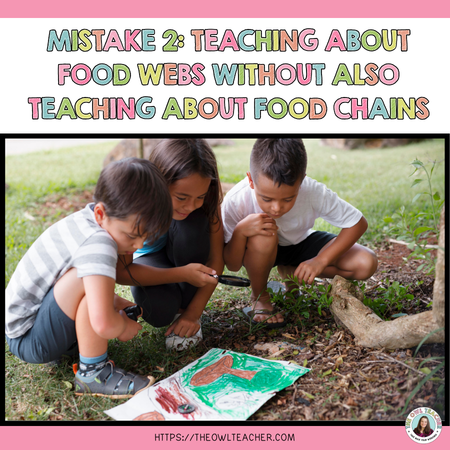
You should use examples from your own area to help students understand how ecosystems work. Students learn more when they can see ecosystems in action.
You can use the National Geographic ecosystem materials to make your lessons more interesting and visual.
For activities that avoid these mistakes, try these 8 hands-on food chain and food web activities — they build understanding through doing, not memorizing.
Mistake #3: Not paying enough attention to the decomposers
Students don’t learn how nutrients cycle if they only study “exciting” plants and animals, not decomposers.
It can be tempting to just briefly mention them as part of the food web. But it is so important that they get just as much attention as other “exciting” organisms.
Make decomposers and their role fun.
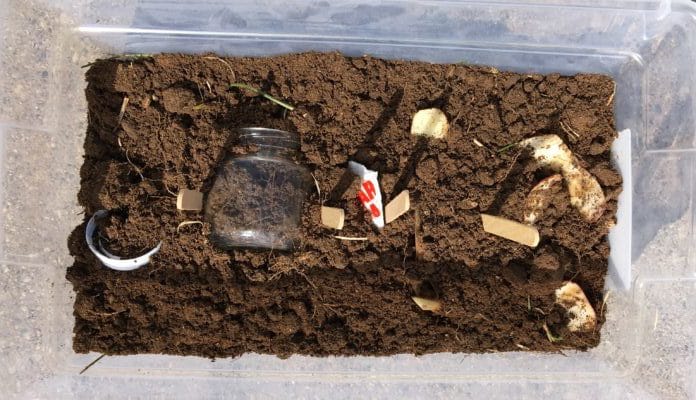
Activity: Make a place where you can watch things break down using banana peels, apple slices, and other natural things. Have the students watch and write down what happens for a few weeks. This activity makes the idea of decomposition concrete, helping you understand it.
Decomposers are very important to ecosystems because they break down dead plants and animals and return nutrients to the soil. Ecosystems would be buried under dead things and nutrients wouldn’t be able to be reused if they weren’t there.
Short on time? You can find plenty of videos of things breaking down over time to make it look faster. Here’s one fun one you can share.
Mistake #4: Skipping conversations about energy flow
Make sure your students don’t just learn “what eats what,” but also how energy moves through ecosystems.
Make it clear what the 10% rule and energy pyramids are.
Use examples from your own life to explain the “10% rule.” For example, if the sun gives grass 1,000 units of energy, the grasshopper that eats it only gets 100 units. The mouse that eats the grasshopper only gets 10 units, and the hawk that eats the mouse only gets 1 unit. This math helps students in school figure out why there are more producers than top predators.
Have students build energy pyramids out of blocks or paper. The bottom layer (producers) should be much bigger than the top layer (apex predators). Using the 10% rule, they can see how much energy is at each level.
Mistake #5: Skipping the abiotic factors
When you teach about ecosystems, if you don’t include non-living things, students won’t see how important they are.
From the beginning, add non-living parts to every part of your unit.
The soil, temperature, water, sunlight, and air all affect how living things interact with one another. These subjects are not separate; they all help us understand ecosystems.
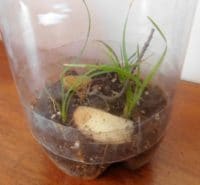
One activity that has always been a student favorite is “Create Your Own Habitat.“ It shows how living things are affected by sunlight, water, and soil. Students may understand how the elimination of a single abiotic factor, such as light, can transform the entire system.
It might be helpful to look at charts that show how biotic and abiotic factors differ across ecosystems. Students can learn how trees and other living things might look different in places.
Mistake #6: Only using worksheets for Ecosystem Lessons
I get it. Worksheets are simple. They often have good pictures and examples. And they take zero prep.
I’ve used my fair share of them! However, we can’t just rely on them, and ecosystem lessons are so much fun to use hands-on activities! You can certainly do a mix of both.
Worksheets are great for practicing and testing. But you shouldn’t rely solely on worksheets as your main way to teach concepts like how ecosystems work together.
Ideas: Get students moving and thinking by using digital simulations, role-playing games, or ecosystem modeling.
Activity: Let students pretend to be different parts of the ecosystem and show how they eat each other. There are groups of grass (the people who grow it), grasshoppers (the people who eat it), and so on. Then remove one group and let the students see how the ecosystem changes in real life.
Have you tried using dramatic movement and kinesthetic learning? This is a simple way to make your lessons engaging and help reinforce concepts.
Mistake #7: Only focusing on one ecosystem
When you are teaching about ecosystems, I always recommend starting with what your students are most familiar with. But if you don’t include other ecosystems and biomes, students won’t make those connections.
Activity: Have students make Venn diagrams or charts that show how ecosystems are the same and different. For instance, deserts and tundras don’t get much rain, but the temperatures and the types of animals that live there are very different.
Tip: Use virtual field trips to teach students about how different ecosystems work. You can “visit” coral reefs, jungles, and arctic tundras without ever leaving school, thanks to technology.
Mistake #8: Not thinking about how people change things
Please, please, please don’t teach ecosystems as separate, unaffected systems from us! The fact is that we (people) change every ecosystem on Earth.
During your lessons, make sure to connect the principles you are teaching to real-world environmental problems.
Use examples of ecosystems that have been broken and then restored. Learn about a local ecosystem that has been harmed by people and what is being done to fix it.
Keep the conversations honest but appropriate for students’ age. Don’t ignore the hard conversations. Instead, you can ask your students for real examples they have seen in their community and in their surroundings.
If you have the time or student interest, you can even start (or find) a conservation project at the school or in the community to get involved.
Even simple ideas can help students use what they know about ecosystems to help the environment. Picking up trash, planting a pollinator garden, or cleaning up a park are just a few examples.
Mistake #9: Not using models the right way
The issue is that some models are too simple. They don’t show how complicated ecosystems are. On the other hand, some models can get too complicated too quickly and easily overwhelm some students who need support to understand the concepts better.
The solution is to use scaffolded modeling to bridge what they do understand to the concepts they still need to learn.
Begin with simple models of concepts they are familiar with, and add more difficult ones as students learn more.
Let the students make their own ecosystems. They can make anything in 3D, either as a diorama or as a digital copy. As they learn more concepts, they can add to their ecosystem.
The Ecosystem Activity Circle Book Craftivity from TpT is a fun and organized way for students to show what they know about ecosystems by making things and collaborating with this easy ecosystem activity.
Mistake #10: Not showing how things are related to each other
Sometimes students don’t see organisms as parts of a system connected to one another.
One thing you can do to help is to stress connections and balance throughout your teaching.
It’s important to know how to see and think about systems. Students learn to think critically about problems that extend beyond ecosystems when they discover that changes in one part of a system affect all the others.
Activity: Create “What happens if…?” scenarios in which you remove one organism from an ecosystem. Let the students guess what will happen next, then follow the food web to see what happens.
Students can see how different parts of an ecosystem interact by also trying out interactive simulation games, either online or in person. They can pretend to be different organisms and see how changes in population affect them.
Mistake #11: Not making the lessons relevant to the students’ lives
I’ve mentioned this a few times already, but make teaching connections that are close to home and relevant to their lives! Please don’t just focus on ecosystems and biomes far away. (or even worse, don’t teach the ecosystems around them as if they were far away!)
Every day, students are part of ecosystems. Their yards, parks, and even towns are all ecosystems where producers, consumers, and decomposers all live and work together.
As an activity, look into the schoolyard’s environment. Teach students about the plants and animals that live in and around their school. Have them create food webs based on what they find, and discuss how people have changed this area.
When you ask students, “Where do you see producers in your neighborhood?” they start to notice the ecosystems around them.
It can be helpful to have field guides about the ecosystems in your area. In many places, park agencies, nature centers, and conservation groups give away free stuff.
Mistake #12: Only checking for memory
The issue is that tests that only check vocabulary, or use simple yes/no or multiple-choice questions, only assess memory and don’t really show how well someone understands ecosystem ideas.
The best solution is to use project-based assessments. However, sometimes that’s not possible. If you use a regular pen-to-paper test, be sure to include a variety of assessment questions that allow them to demonstrate their understanding and application of ecosystem concepts.
Are students able to use what they know in new situations? Can they figure out what would happen if you changed something in an ecosystem? Can they explain why ecosystems have an impact on one another? These questions show that you really do understand.
Have students build their own food webs for the ecosystems they study, work on a project about how to keep an ecosystem in balance, or give speeches about how energy moves through a certain ecosystem.
Activity: Have the students make an ecosystem with some rules. Students need to include the appropriate biotic and abiotic components, a complete food web with at least 3 trophic levels, and a full explanation of how energy flows through their ecosystem.
Use rubrics that assess understanding rather than just memory. Look for evidence that the person can use ideas, think in systems, and clearly explain how things are connected.
Are you ready to change how you teach about ecosystems?
It doesn’t have to be hard to teach about ecosystems. Your students will really learn if you avoid these common mistakes and focus on hands-on learning, systems thinking, and linking what they learn to the real world.