


Do you have students who can confidently say, “12 inches = 1 foot,” but who struggle to answer when asked how many inches are in 3 feet? I’ve got some simple ideas to help you teach measurement conversions that actually stick for your students.
Let’s get rid of the “memorize and drill” method that makes students blank on test day and use methods that really help them learn instead. The Common Core State Standards also support this by placing greater emphasis on understanding how units relate to one another than on memorizing them.
Teach Measurement Conversions by Understanding Student Struggles
Students can remember things; it’s just that they’re learning things that don’t seem to go together. When we skip the conceptual foundation and go straight to algorithms, we get students who:
- Think that larger units usually represent larger numbers
- Struggle with conversions that go beyond the base unit (they can tell you inches in 1 foot, but struggle with inches in any other amount of feet).
- Are unsure what units really mean in real life
The NCTM Principles and Standards remind us that measurement is a process, not just a thing to remember. Research on learning from concrete to abstract concepts shows that students need real-world experience before they can master abstract algorithms.
The CRA Sequence: Begin with Hands-On
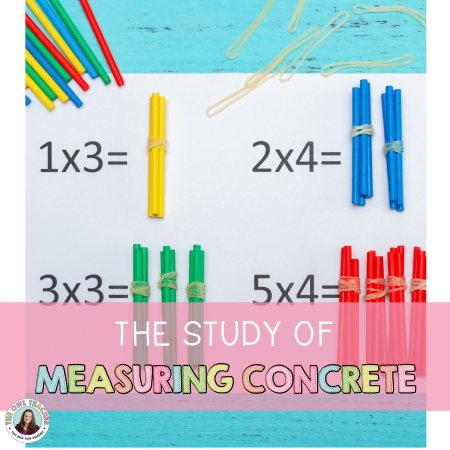
Before teaching students to “divide when going small to large,” we must help them see why. One great method I like is CRA. Concrete-Representational-Abstract. When we help bridge real, tangible examples with representational models and eventually abstract concepts as we teach measurement conversions, students are more likely to make it stick.
The Study of Measuring Concrete
Give students measuring tapes, yardsticks, rulers, and meter sticks. Have them use inches, feet, and yards to measure the same thing, then record their findings in a chart. They’ll find out the patterns on their own: “The desk was 36 inches OR 3 feet.” When we utilized larger units (feet), we got a smaller number!
You could ask, “Why do you think we get a smaller amount of feet, even though it’s the larger unit?” and “What do you notice when you measure with smaller units instead of larger ones?” Let them work things out on their own instead of telling them what to do. Starting with concrete is always a good tool in math, especially when you teach measurement conversions.
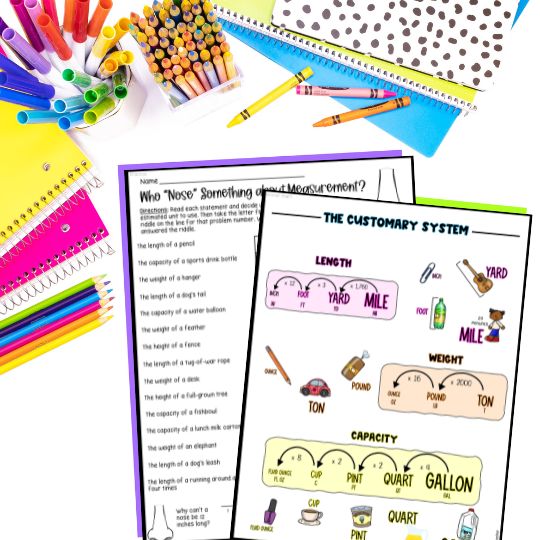
Representational models are visual tools that illustrate concepts through pictures.
After students have worked with the material, move on to visual models. Make bar models that show how units are related (for example, 12-inch bars equal 1 foot). Number lines can illustrate how measurements are equivalent, or infographics can depict the hierarchical relationships between objects. My Guided Math Workshop unit on measurements are a great resource for lessons that have these concepts. These units clearly illustrate the connections within measurement concepts through explicit visual models.
Abstract: Guidelines and Procedures
Upon completion of practical and visual tasks, students can then engage with conversion charts and algorithms. The underlying principle is now clearly visible, and when you introduce algorithms, they know why it works now that they’ve seen it happen.
Teach measurement conversions ideas:
Scavenger Hunt for Measurements
Things to find on a scavenger hunt: something that is 6 inches long, something that is 1 foot long, and something that is 1 yard long. Students use measuring equipment to walk around the classroom or school, measure items in different units, and record their findings. “The whiteboard is 72 inches long, which is 6 feet or 2 yards!” They’re imagining what each unit looks like in real life.
This is also a great activity for practicing conversions between metric and customary units. Just make sure students are recording and finding lengths in each system so they can begin comparing.
The Number Line for people
Use painter’s tape to draw a line across the room on the floor, and either mark the inches yourself or have students mark them. Have students practice by calling out lengths, such as 24 inches. Then have them walk the same distance in feet. Students walk the conversions. Kinesthetic learning uses movement to make things that are hard to understand more real. It’s a lot more fun than a worksheet!
Before you solve, make an estimate
Before you start completing any conversion math, ask the children to guess, “I’m changing 48 inches to feet. I believe it’s about ___ feet since…” Students can think to themselves, “I know that 10 inches is almost one foot, and since 48 is a little more than 40, or 4 times ten, it should be about four or five feet.” Estimation helps students better understand numbers and catch mistakes, such as saying 48 inches equals 576 feet instead of 4 feet.
Real-Life Measurement Projects when you move onto area and perimeter
Give students real-world tasks, such as measuring the classroom’s perimeter and area in different units, making a scale model of their dream bedroom with all the measurements changed, making a school map that shows distances in both metric and customary units, or measuring long jump distances in PE and writing them down in different units.
Research shows that students who use math to solve real-world problems remember what they’ve studied significantly longer than those who merely do worksheets. Do you need project ideas to help teach measurement conversions that are ready to go? My project-based learning activities include real-life examples of how to teach measurement conversions that are important to the students.
Tests for Weight and Volume
Set up measuring stations so students can pour water from one container into another labeled with cups, pints, quarts, and gallons. Provide instructions for using a balanced scale to weigh, specifying that measurements must be recorded in pounds and ounces. Touching and experiencing how many cups fit into a quart converts conversion factors that aren’t real into real ones. You could also have the students adjust the measurements of a small dinner in the kitchen.
How to Make It Stick: Practice and Review
Traditional worksheets focus on testing memory rather than understanding. Instead, give students real problems to solve using conversions, watch them complete hands-on activities, ask them to explain how they converted 3 yards to inches and why they multiplied, and have them find and fix common math mistakes in sample work.
You may keep practice fresh and fun with small groups by using the measurement conversion exercises, games, and task cards from my Math Workshop series.
Differentiation That Works
- If your students are having problems, keep the concrete tools out longer, let them look at conversion charts, and work on one system at a time before combining the customary and metric systems.
- For students who are ready, combine both methods, add word problems to solve, and include conversions with more than one step.
- For more advanced students, teach them dimensional analysis (using fraction multiplication to cancel units) and how to solve challenging problems with more than one step, how to compare the metric and customary systems, and why there are different ways to measure things. Check out my page on mastering personalized learning for more ways to help students learn a range of concepts across all areas of math.
The Bottom Line
You can’t merely study charts to understand how to convert measurements; you have to do things to learn how units operate together. Students learn concepts so that they can apply them in different situations, measure objects, create drawings of them, and then transform those relationships into algorithms.
Start with real-life experiences, use visual models to help you understand, use interactive activities to practice, connect what you’re learning to real-life situations, and test your understanding rather than just memory. Using a variety of representations is key. The study shows that students who learn to measure by doing so themselves perform better than those who just memorize conversions.
Want to make it even easier? Get my project-based math activities, which include hands-on exercises, visual representations, and practice tailored to each student. It provides everything you need to start teaching conversions that work!