









Your admin just announced another “data-driven initiative,” and you felt your soul leave your body for a solid ten seconds. More data-driven instruction? Ugh. Can we just teach?
I get it. When administrators talk about data-driven instruction, they often picture spreadsheets, color-coded trackers, and benchmark assessments every other Friday. You know, about 47 hours of your planning time. How are you supposed to teach the content on which they are tested when you are testing so much?
But you already know your kids. Little Joaquin struggles with word problems but crushes computation. Sophia (and half the class!) shuts down the second she sees a fraction. You know this stuff because you’re there. In the trenches. Every. Single. Day.
So let’s see what data-driven teaching strategies should really look like and make them work for us, rather than burying us alive.
The Problem With How We’re Told to Use Data
Most PD on data looks like this: Collect data. Enter it into three different systems. Analyze it during your lunch break (ha!). Create intervention groups. Rinse and repeat until you burn out. No wonder we roll our eyes.
Research supports what you already know (and heard a dozen times). John Hattie’s work shows that teacher estimates of student achievement have an effect size of 1.29. That’s massive. That means your observations are critical, even when they may be overlooked and undervalued. We need to align our observations with our measurements.
What Data-Driven Should Actually Mean
Data-driven instruction is about knowing exactly where your kiddos are stuck and then coming up with a plan to unstick them. That’s it! You don’t need fancy dashboards or color-coded nightmare spreadsheets. Just valuable, data-driven teaching strategies that help you teach better.
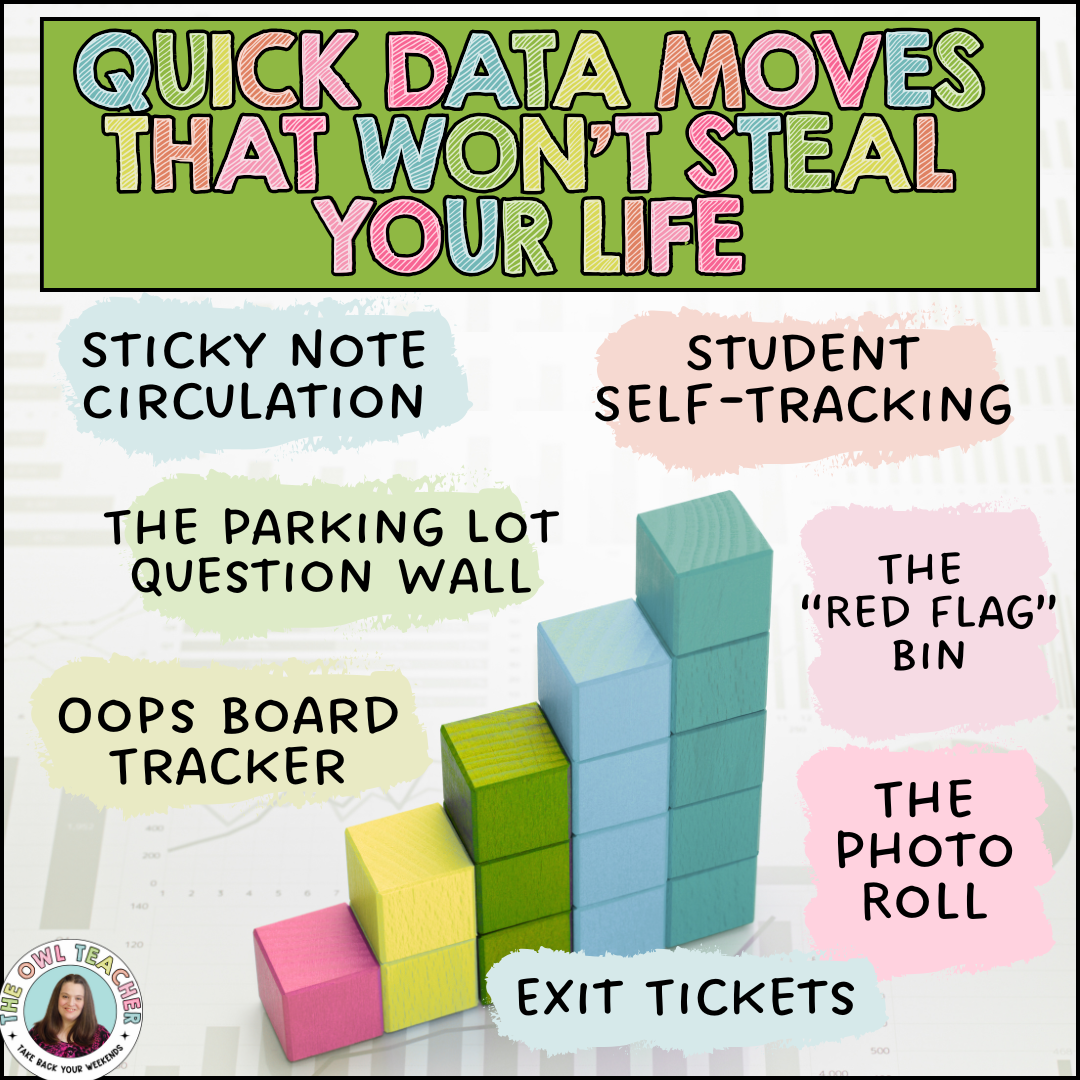
Quick Data Moves That Won’t Steal Your Life (Data-Driven Teaching Strategies)
1. Exit Tickets That Actually Tell You Something
Forget the “rate your understanding 1-5” nonsense. Kids will lie straight to your face with those thumbs.
Try this instead: one problem that hits the day’s core skill. That’s it. One problem. Scan 24 papers in about four minutes while they’re packing up.
Instead of checking the answer to see if it’s correct, look for the same mistake recurring. Then, it becomes tomorrow’s warm-up. If only a few are making the mistake, pull them into small groups. This is a data-driven teaching strategy that doesn’t take much time.
2. The Sticky Note Circulation
Keep a pack of sticky notes on your clipboard. When you’re circulating during independent work, jot quick notes. For example, you may write, “Jayden – still adding denominators.” “Emma – ready for challenge work.”
At the end of the week, sort them. Look for patterns that jump out at you. No computer required. This takes maybe five minutes total for the week. Maybe.
3. Student Self-Tracking (That They Actually Care About)
We’ve heard of giving students self-trackers before, and after a while, it may fade into the background as the year progresses. However, this is valuable information. Have students create bar graphs they color, line graphs they plot, etc. When they track their own progress on multiplication facts or reading fluency, two things happen. First, they take ownership; second, you’re no longer the only one collecting data. It really is a win-win.
Research backs this up, by the way. Visible Learning research shows student self-reporting has an effect size of 1.33. When kids know where they’re going and where they are right now, growth happens faster. So, try hard not to let this one fade into the background.
4. The Oops Board Tracker
Keep a small whiteboard or poster in your classroom that is visible only to you. When you are teaching and notice a common mistake, misconception, or have a “teachable moment,” record it and then tally it.
Let me provide an example to clarify this data-driven teaching strategy. Let’s say you are teaching fractions. Each time you notice someone struggling to add denominators, place a tally mark under it. But during the same lesson, you see students forgetting to regroup. You would record that and start tallying how many students are doing the same. By the end of the week, you know exactly what concepts are tripping up your class.
5. The Photo Roll Method
When I was in the classroom, I often moved around the room with my iPad, taking notes on students as I conferred with them in the Evernote app. I created a folder for each subject and each student. Then, within those folders, I would add notes for each student. (Alternatively, you can do voice notes on your phone and label each note.)
But one thing I really liked doing was taking photos —not for administration or parents, but for my own reference. I would take quick pictures of student work that showed interesting thinking, such as solving a problem differently or a mistake with brilliant reasoning, even if it was applied incorrectly. Review them each day, including commercials if you want, and note any patterns. Look to see why something worked or didn’t.
6. The “Red Flag” Bin System
When grading or reviewing work, if something catches your attention, place it in a designated bin or basket. For instance, it could be work that shows confusion, work that shows they are thinking way ahead, or something that shows you may have been unclear.
Later, empty the bin and sort the papers into three piles: intervention needed, extension needed, and reteach more clearly. Instead of doing this in the moment, you can focus on the grading papers and come back to this data-driven teaching strategy when you can focus on it.
7. The Parking Lot Question Wall
This activity is one of my favorites for data-driven instruction. In your classroom, put up a “questions I still have” poster or bulletin board. Have kids add questions throughout units using sticky notes, scrap paper, index cards, or whatever works.
This activity helps you identify what students don’t know, where the gaps are, and what they are curious about. This enables you to pinpoint where the confusion lies and where you need to focus more time.
Making Data Actually Useful (Not Just Collected)
We collect mountains of data and then do nothing with it. I maintained a file for each student containing their scores for ITBS, CogAT, state and district tests, and some classroom tests. I had the color-coded sheets. Instead, let’s talk about what to do with that data so that your data-driven instruction is proper.
Traditionally, you are advised to create three groups: “I got it, I’m ready to fly,” “I’m getting there, I just need some practice,” and “I’m still building the foundations” based on the data you collect. These are the groups we tend to enrich or extend, provide structured practice to, and reteach with a different approach depending on which group they are in.
But let’s see if we can go beyond that and develop additional data-driven teaching strategies to support your instruction.
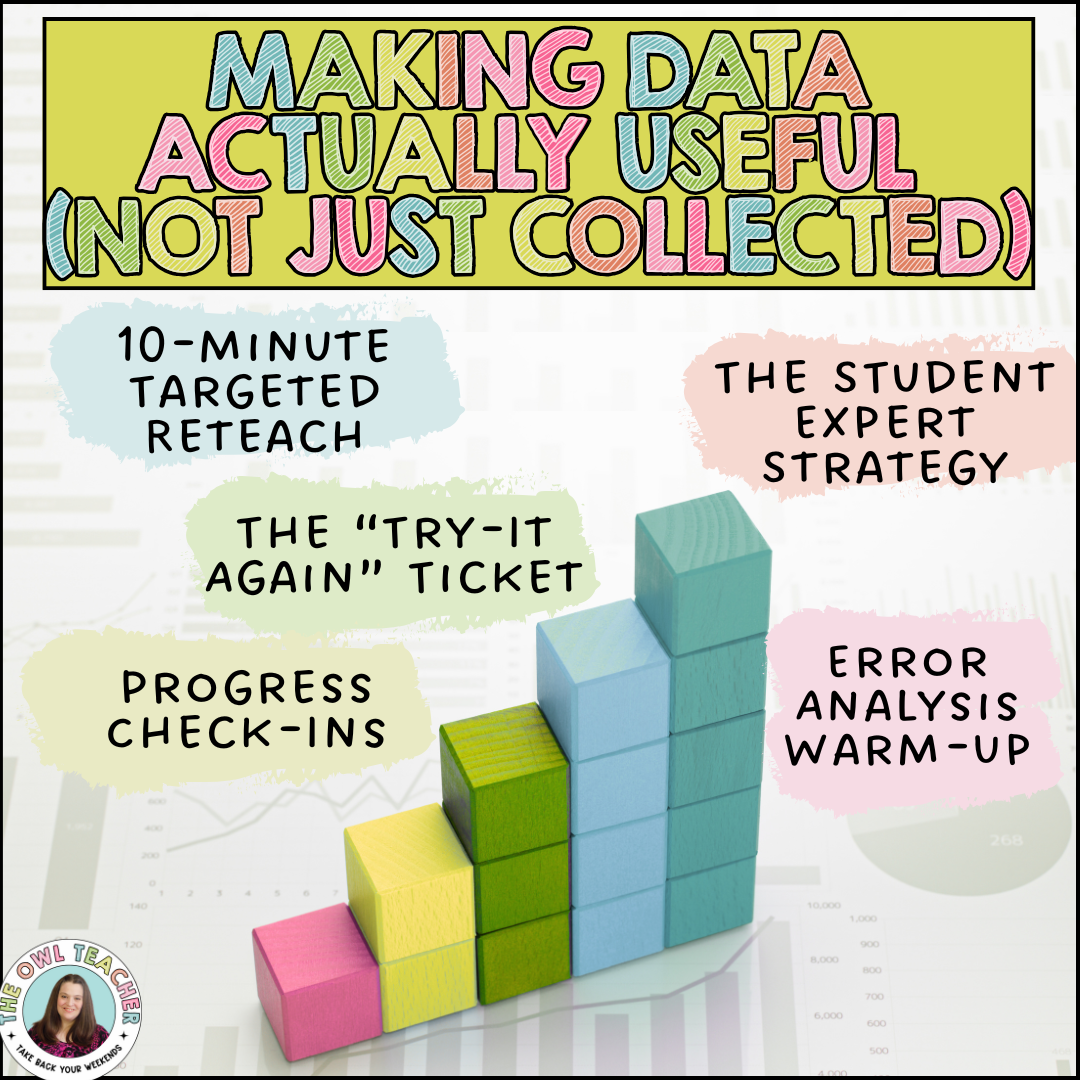
1. The 10-Minute Targeted Reteach
Alright, so I lied. In this approach, you’d still use groups, but with a 10-min max. You’d reteach the concept in a completely different way than the first time you taught it to the whole group or at any other time. After 10 minutes, send them off to practice and move to the next group.
I think that often, when we reteach a concept, we do it exactly as before, using different problems, writing out the steps, or slowing down a little. While these interventions are significant, they aren’t helping the students make connections. If they didn’t learn the first time, try a different method. Think of it this way: if you can’t unlock your bathroom door by twisting the knob (I guess if you’re Hercules you could), you don’t just keep trying. You grab a hairpin, a butter knife, or whatever. You switch it up, and so should you when reteaching.
2. The Error Analysis Warm-Up
Do you remember how you track the things you find interesting, mistakes, and so on? Use them as examples for the class to evaluate. Now, I know, someone in the crowd right now is shouting at me. I’m NOT saying to use a student’s work in a way that makes it identifiable. (It’s sad that anyone would even think that someone would do that. By now, I’m certain everyone knows this, but I’m avoiding hate mail.) Be careful with handwriting, as some students recognize others’ handwriting. Instead of using a specific student’s work, you can:
- Copy the problem on the board as an error analysis problem (an incorrectly completed problem)
- Only show the problem with the work. If necessary, state that the work is from previous years that you have been collecting. I know, lying is bad.
- Give students the problem on an exit ticket so no student knows it is a problem from other students; it is one you created.
- If possible, follow up with one or two examples of sound thinking. Focus more on the quality of work so students can see strong examples. Just as with other papers, students should never be identified.
3. The Student Expert Strategy
Instead of you always being the one students go to, have your students be the experts. When someone is stuck, have them ask the student expert before you. What’s different about this version compared to others is the idea that, like C3B4, you will need multiple experts so students can get confirmation. No confirmation? Research it. Could they get confused? Sure. Couldn’t they get confused with C3B4 me? What’s the difference? They are already confused when they started. Going to another student could boost both students’ confidence and potentially create friendships.
Rules and expectations must be set in advance. Have students complete an application to be an expert, explaining the areas in which they believe they would excel. Once students are approved, have them complete a “help wanted” sign to encourage others to visit them when help is needed.
4. The “Try It Again” Ticket
When students make mistakes and fail, have them retry. Place a Post-it note over the wrong answer (or the problem altogether, after it is rewritten on top of it), and have students do it again. Encourage the student to try again after studying the correct answers. This helps the child notice that you were paying attention to them and that you want to give them a chance for a “redo.” I mean, after all, how many redos did Einstein have to do?
5. Progress Check-Ins
I know these titles may sound familiar. The difference is that I’ve tweaked them slightly to save you time while still helping you understand what’s happening in your students’ heads.
With Progress check-ins, you quickly pull a few students aside each day (to get through all students by the end of the week) and ask them a quick question, such as “Show me how you’d start this problem” or “Explain this concept to me real quick.” If that is too frequent, you can rotate through all students once a month.
The Data Conversation We Need to Have
The push for constant data collection often comes from people who haven’t taught in years. These are the people who insist on accountability, evidence, and proof. But you and I both know that is not what teaching is about. It isn’t something you can measure with numbers. This kind of data is qualitative. Noticing a kid who doesn’t usually participate light up when you bring out a severe weather STEM project, a student shutting down when you start reading about myths, or a student completely opening up in journal entries are things you can’t record to show what students know and don’t on some graph.
This Week’s Plan – Getting Started
- Pick ONE idea from above
- Try it for one subject area that you feel very comfortable teaching
- See if it actually helps you teach better and know your students deeper
- Use that data to use one of the useful data-intervention teaching strategies above
- Notice if it makes a difference. If not, adjust.
- Keep what works, ditch what doesn’t
- Trust your observations as much as your assessments
- Remember you’re a professional, not a data entry clerk
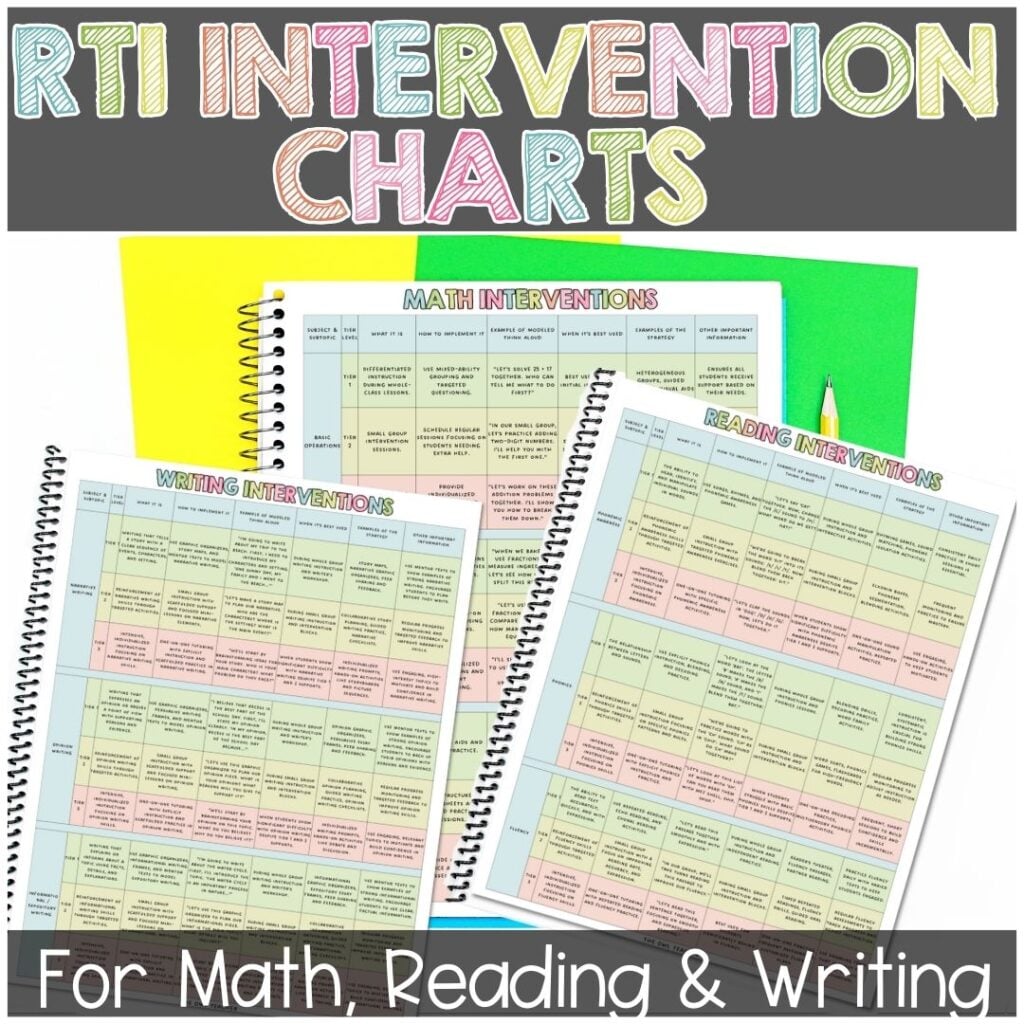
These data-driven teaching strategies should make your job easier and save you time in the long run when you have to move up to tier two in RTI.
The Bottom Line
Data-driven instruction should help you reach your students, not bury you in paperwork you’ll never look at again. You already know your students. You already notice the patterns. You’re collecting data every single day without even realizing it.
It’s time someone announces a new data initiative, takes what’s useful, and leaves the rest. Because at the end of the day, the best data is the kid in front of you telling you exactly what they need.