






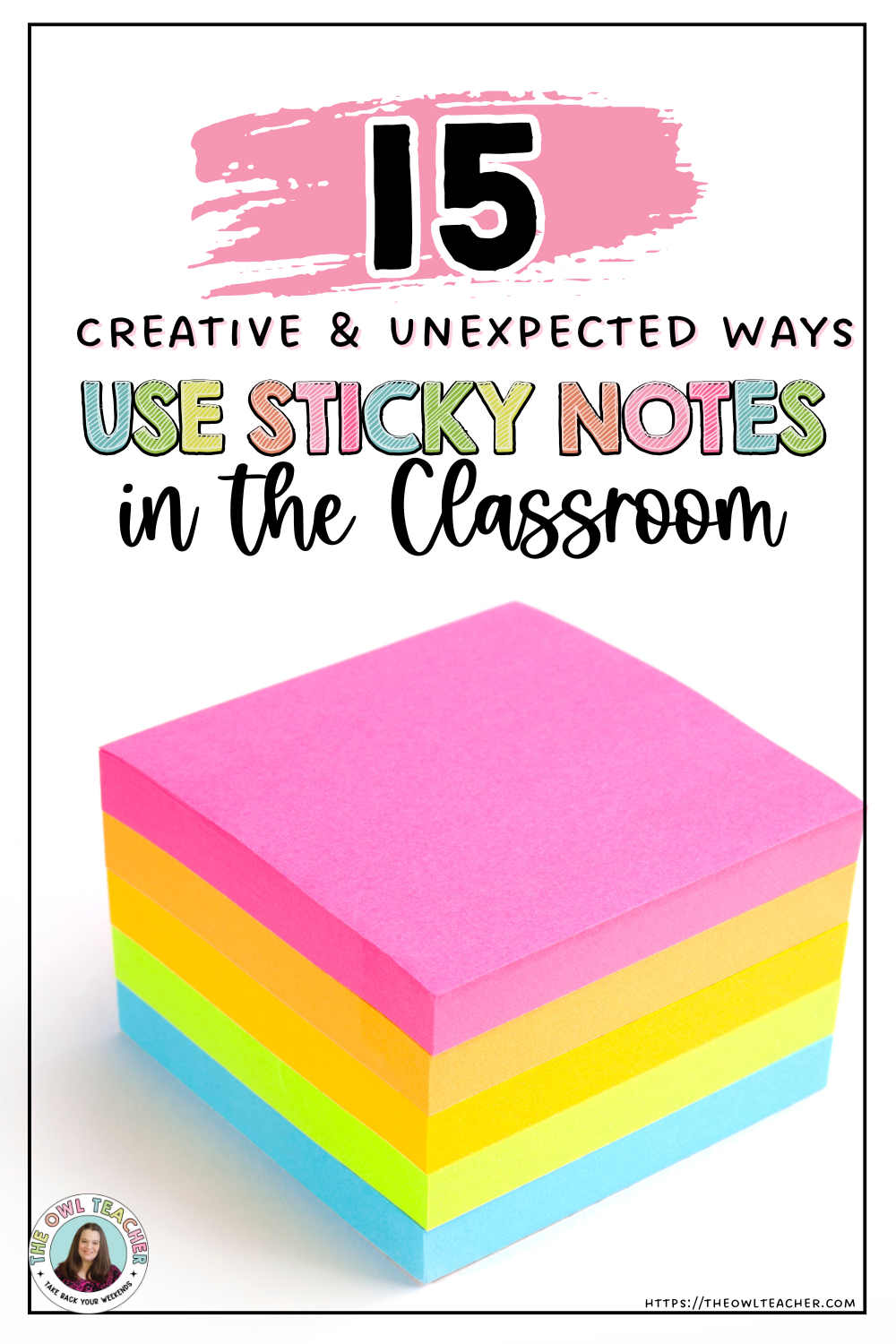
We have all used sticky notes in the classroom. It’s a classroom supply that is not only for the teacher, but for the students. You’ve likely used sticky notes for reminders, exit tickets, or annotating in reading, but there is so much more we can use them for! When we reimagine them as tools, they turn into instant engagement, scaffolds, and interactive manipulatives for math and science. Let’s look at some fresh, out-of-the-box, unique sticky note hacks to help you the next time you reach for the sticky notes in the classroom.
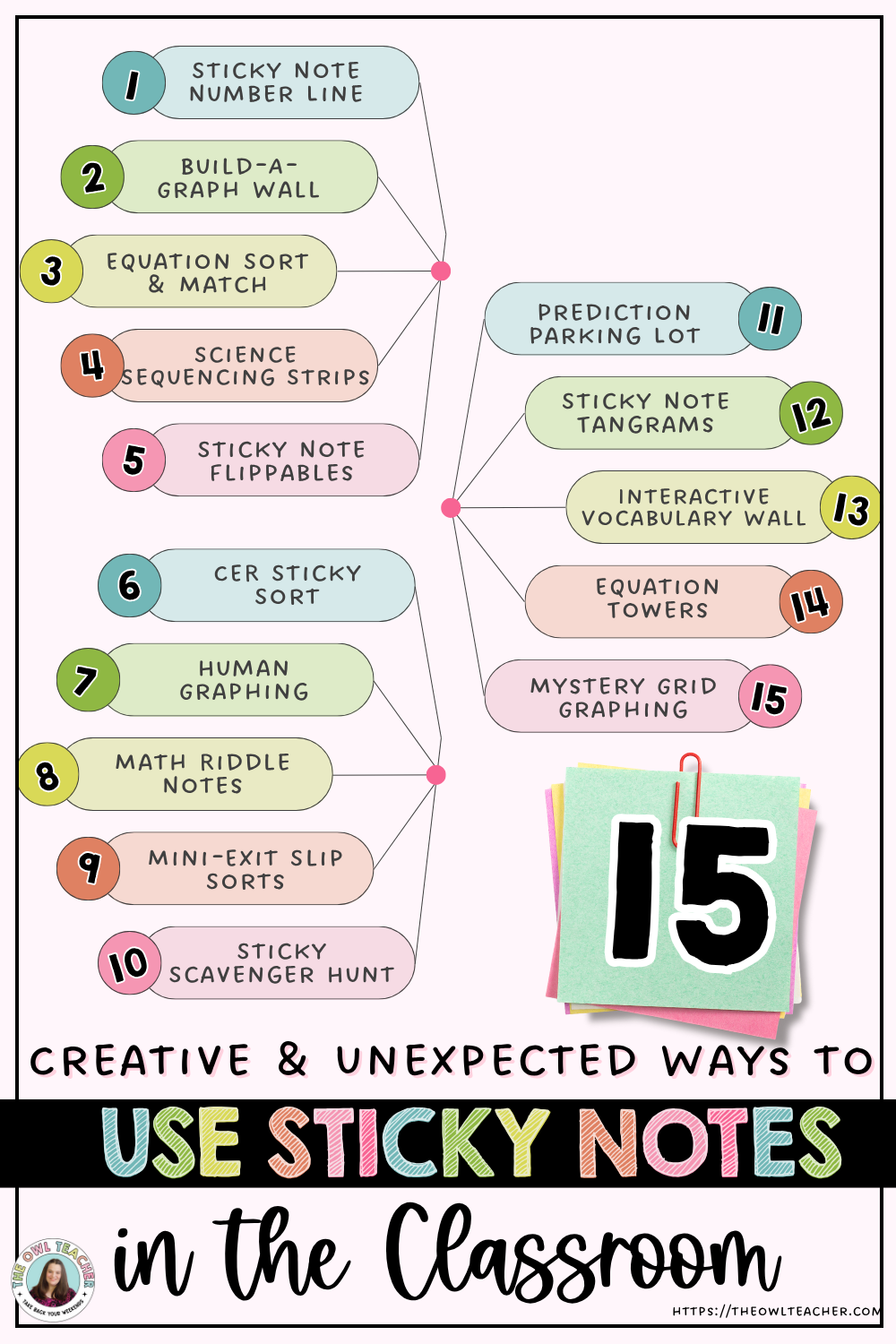
1. Sticky Note Number Line
- Give each student a sticky note with a fraction, decimal, or percent written on it. Alternatively, you can have students write the numbers themselves on the sticky notes, or you can print them, too. (Here is a tutorial)
- Twist: Color-code sticky notes so students can visually see equivalence and connections. Here is an example:
- pink = fractions
- yellow = decimals
- green = percents.
2. Build-a-Graph Wall
- Hand each student a sticky note as a “data point”
- example: favorite ice cream flavor, number of pets, or results of a science experiment
- Students post their sticky note in the correct column to build a class bar graph.
- Bonus: Use different sticky note sizes to sneak in multiplication and scaling practice.
- mini for 1
- standard for 5
- jumbo for 10
3. Equation Sort & Match
- Write math expressions on half the sticky notes and answers on the other half.
- Example: like 2 × 3, ½ ÷ ¼
- Students stick them together around the room to “match” problems and solutions.
- Add a few impostors to spark discussion: Why doesn’t this one belong?
4. Science Process Sequencer
- Use sticky notes to break down processes
- Examples: photosynthesis, the rock cycle, or the water cycle.
- Give students a scrambled set of sticky notes with steps or vocabulary terms.
- They physically rearrange them on their desk or wall into the correct order.
- Then, add arrows with markers on the wall to create a big class flowchart.
5. Sticky Note “Flippables”
- Use sticky notes as Flippables to reference later.
- Fold a sticky note in half, then stick the bottom half to a notebook page, and leave the top half as a flap.
- On the outside: write the problem (like 345 ÷ 7).
- Inside: write the steps and solution.
- Students create their interactive reference book of math problems or science definitions.
6. Prediction Parking Lot (Science Labs)
- Before a lab, each student writes their prediction on a sticky note
- Then the student posts it on a class “prediction parking lot” chart.
- After the lab, they revisit, move their sticky note to “proved” or “disproved” columns, and revise.
- Helps reinforce the scientific method with low prep and high visibility.
7. Sticky Note Tangrams
- Cut sticky notes into halves, fourths, or triangles.
- Challenge students to build shapes or solve fraction puzzles by rearranging their sticky note “tangrams.”
- Example: Can you make ¾ out of these sticky note pieces?
8. Layered Science Vocabulary Wall
- To create a layered Science Vocabulary Wall with sticky notes in the classroom
- Write vocabulary terms on the sticky note flap.
- Lift the flap to reveal a kid-friendly definition or example underneath.
- Students can add their illustrations or connections over time.
- It’s interactive and way more engaging than a static word wall.
9. Equation Towers
- Equation towers are perfect for modeling the process of problem-solving in a scaffolded way:
- Stack sticky notes vertically like “Lego bricks.”
- Each note is a step in solving a multi-step problem
- Example: area of a triangle, then perimeter of the whole figure.
- Students peel back each step as they explain their reasoning.
10. “Mystery Grid” Graphing Challenge
- Cooperative learning is critical for students to learn. This idea for sticky notes in the classroom is a great way to do that.
- On a poster board, create a large coordinate plane.
- Hide sticky notes with ordered pairs under bigger sticky notes marked with “?”
- Students peel one sticky note at a time, plot the point, and try to guess what picture the points will create (mystery picture graphing).
11. Sticky Note Hypothesis & Claim-Evidence-Reasoning (CER)
- If you are looking for sticky note use in science that includes cooperative learning, use this method.
- Give each group a different sticky note color:
- Pink = Claim
- Blue = Evidence
- Green = Reasoning
- After an experiment, they fill in their notes and stick them to a poster.
- The wall instantly becomes a visual CER chart comparing multiple groups’ thinking.
- Give each group a different sticky note color:
12. Human Graphing with Sticky Notes
- This kinesthetic activity works well for probability, classification, or measurement comparisons.
- Give each student a sticky note with a number, fraction, or scientific measurement.
- Instead of posting it on the wall, they become the data by physically standing in order or grouped categories.
13. Sticky Note Riddles (Math Twist)
- If you have a lot of early finishers, this activity can help them still practice while having a little fun. In this sticky note in the classroom activity, it will go a little like this:
- Write riddles on sticky notes where the answer is a number
- Example: “I am a multiple of 6 but not of 12”.
- If you’re looking for place value riddles, grab these task cards.
- Students solve and then stick their note onto the correct “answer poster” around the room.
- Write riddles on sticky notes where the answer is a number
14. Mini Exit Slip Sorts
- This may seem like something you have already done in the past, but it has a slight twist. In this one, teachers get instant formative assessment and insight into confidence levels.
- Instead of a boring exit ticket, have three sticky note “bins” on the wall:
- “Got it!” (confident)
- “Almost there” (needs more practice)
- “Help, please!” (confused)
- Students post their sticky note with their answer AND self-assessment in the correct spot.
- Instead of a boring exit ticket, have three sticky note “bins” on the wall:
15. Periodic Table Sticky Hunt
- This activity works like a mini scavenger hunt and is a super-engaging review game. While I give the example of using sticky notes in the classroom with the periodic table in science (which many teachers in grades 3-5 don’t teach, you can still apply the concept to other areas in math and science.)
- Cover random elements on a classroom periodic table with sticky notes.
- Write properties, atomic numbers, or uses in the notes.
- Students have to figure out which hidden element matches the description.
Sticky notes may seem fundamental and practical for just a few things in the classroom, but as you can see, the 15 ideas above can help turn sticky notes in the school into a versatile tool. Sticky notes are low-prep, visual, tactile, and highly flexible. Plus, students love creating, moving, and posting them. I remember several classes where students would “play” with sticky notes by making the flipping “animation” of things moving. With just a stack of sticky notes in the classroom, you can turn everyday lessons into hands-on learning adventures.