









You can talk about the circulatory system until you’re blue in the face, or you can let kids squeeze fake blood through tubes and make heartbeat sounds. Which one do you think they’ll remember next week? That’s right, gross human body activities!
Here’s something that teacher prep programs don’t tell you: kids are already obsessed with their bodies. They just cover it up with laughter and “ewww” sounds. But what about that interest? Every time we skip the “gross” parts to stay “professional,” we’re leaving behind pure educational gold.
I’m here to tell you to embrace the gross. It’s not just okay; it’s great teaching.
Why “Disgusting” Is Your Secret Weapon
You know how you still remember that science experiment from fifth grade? The one that made everyone scream? That’s not a coincidence.
Research supports this: disgust is a strong emotion that helps us learn. When something makes us feel “eww,” our brains mark it as important and memorable. Kids remember things that make them sick much better than things that bore them. It’s the same reason they can remember every little thing about that video game boss battle but “forget” the multiplication facts you made them learn for weeks.
The disgust response makes people feel more emotional, which helps them remember things better. What does that mean? A picture of fake vomit teaches digestion better than anything else.
And here’s the best part: kids are naturally curious about how their bodies work. Why does snot change color? What gives farts their smell? Why do scabs get hard? These questions aren’t random; they’re intrinsic motivation covered in mucus and methane. When we don’t talk about these things, we’re actually ignoring the questions kids are already asking.
(For more ideas on how to make science interesting besides experiments, read my blog post about Creative Ways to Make Science Engaging & Memorable.)
The “Gross But Educational” Sweet Spot
I know what you’re thinking now. “Great, so my classroom is now a free-for-all for bodily fluids?”
Nope. There is a huge difference between gross-for-shock-value and gross-for-understanding. The secret is to combine the “eww” factor with the “ohhhh” moment.
There should always be a “why” question with all gross human body activities:
- What makes your body make snot? (Not just “Look at this booger!”)
- Why does throwing up really help you? (Not just “haha, barf!”)
- Why do bruises change color? (Not just “cool, it’s yellow now!”)
You’re not just letting kids be silly when you frame it this way. You’re using their natural disgust response to help them understand real science. And to be honest? That’s what makes good teaching different from controlling a crowd with slime.
The Gross Human Body Activities Your Students Can’t Wait to Do
Okay, let’s get down to business. Here are the activities that work, along with the learning goals that will make your principal happy and the gross factor that will drive your students crazy.
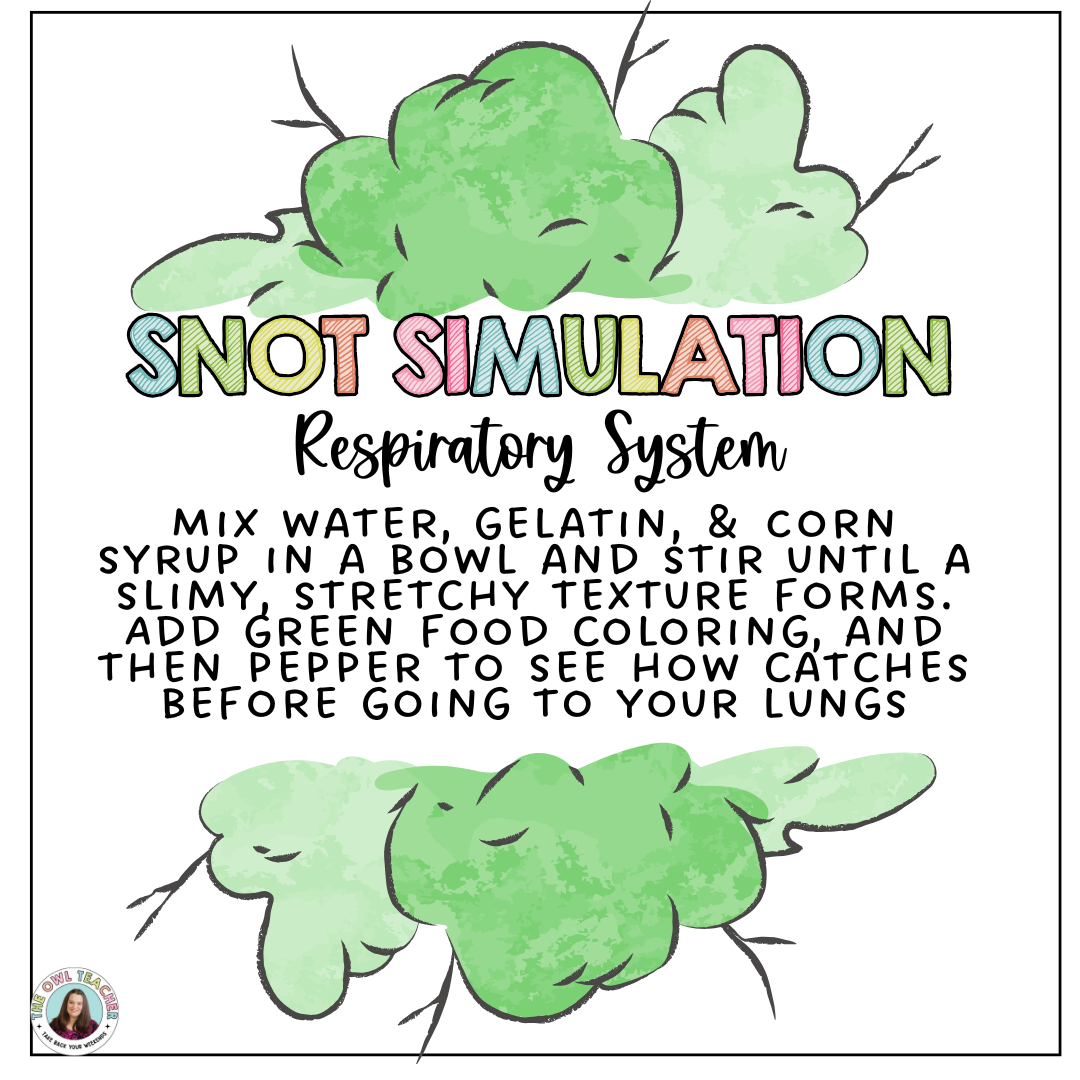
1. Snot Simulation (Respiratory System)
For this, you’ll need unflavored gelatin packets, corn syrup, water, green food coloring, bowls, and some “dirt” like pepper or glitter.
Put the water, gelatin, and corn syrup in a bowl and stir them together until you get the right slimy, stretchy texture. Put in the green food coloring because, let’s face it, real snot is green. Students can touch, stretch, and most importantly, test their mucus mixture once they have it. Add some pepper or glitter to see how much catches in your mucus before it reaches your lungs.
The “why” conversation: How does your body use mucus to protect itself? What makes it sticky? What happens if you don’t have enough mucus?
What they’ll remember: Mucus isn’t just gross; it’s actually stopping germs from making you sick. Also, the exact feel of boogers, which we’ll call an extra learning outcome.
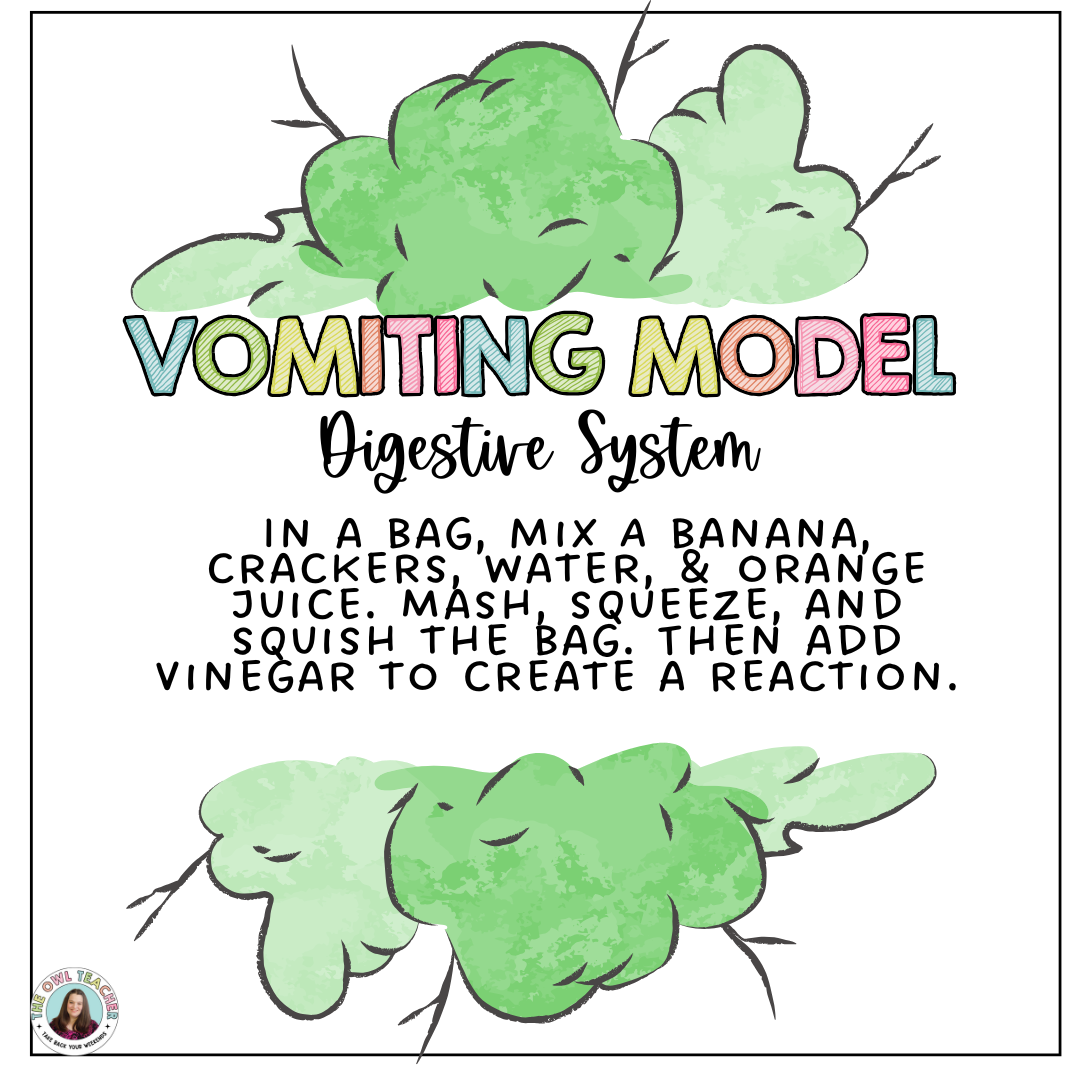
2. Model for Vomiting (Digestive System)
You’ll need big ziplock bags, bananas, crackers, orange juice, water, and vinegar.
The students put a banana, some crackers, water, and orange juice in the bag. Then the fun begins: they mash, squish, and squeeze the bag for a few minutes to simulate both the mechanical churning of the stomach and the chemical breakdown that happens when stomach acid hits food. To show what real stomach acid does, add a few drops of vinegar and watch the reaction happen in real time.
The “why” conversation: Why does your stomach need to churn and add acid at the same time? What would happen if it only did one? Why does throwing up sometimes keep you from getting food poisoning?
What they will remember is that their bodies are doing violent, messy work right now. They’ll also never see bananas the same way again.
3. Poop Formation Station (Digestive and Excretory System)
Get some knee-high stockings or pantyhose, instant oatmeal, chocolate syrup, water, bowls, and newspaper for cleaning up after this activity.
Put wet oatmeal, chocolate syrup, and water in the stocking to show how food moves through the intestines. Students put the stocking over a bowl and squeeze it. They watch as the liquid drains out while the solid remains. This shows exactly how the large intestine takes water from waste and leaves behind… You know what I mean.
The “why” conversation: Why does your body need to get rid of water in waste? What happens when you don’t drink enough water? Why is diarrhea watery?
What they will remember: Their intestines are doing the same thing with the food they ate yesterday. Right now. You’re welcome.
4. Fake Scabs (Integumentary and Circulatory System)
You’ll need cocoa powder, red and brown food coloring, unflavored gelatin, water, small cups, and popsicle sticks to mix everything together. Always check for allergies first.
Add red and brown food coloring, a little cocoa powder, and a little water to the gelatin powder. This will give you the real crusty texture. Students can apply the mixture to their arms and watch it dry into a scab-like texture. Talk about platelets, clotting factors, and how the body literally seals wounds to protect itself while it dries.
The “why” conversation: Why do scabs happen? What happens under the surface as it heals? Why shouldn’t you pick at scabs? (They won’t listen, but at least they’ll know why you told them not to.)
What they will remember: Blood clotting is like your body’s emergency repair team, and scabs are like walls that keep germs out.
5. Experiment with Burping and Farting (Digestive System)
You will need small plastic bottles, baking soda, vinegar, balloons, and funnels.
Put baking soda in the bottle (which stands for food in the stomach) and then vinegar (which stands for stomach acid). Put a balloon over the top of the bottle quickly and watch it fill with carbon dioxide gas, just like gas builds up in the digestive system.
The “why” conversation: Why do some foods make you gassy? What causes burps and farts? Why does your body need to let gas out?
What they’ll remember: Their stomach is like a chemistry lab, and gas is the result. They also have permission from scientists to talk about farts.
6. Blood Circulation Pump (Circulatory System)
Get some plastic squeeze bottles, clear aquarium tubing, red food coloring, water, tape, straws, and bowls to catch spills.
Fill a squeeze bottle with red water and connect the tubing to form a loop for circulation. Students squeeze at the same time with their hearts to move “blood” through the tubes and back. To show how heart valves prevent blood from flowing back, tape straws into the tubing to create one-way valves. Count how many squeezes you get per minute, then compare that to your resting and active heart rates.
The “why” conversation: Why does your heart need to keep beating? What do valves do? Why does your heart rate change when you work out?
What they’ll remember: Their heart is pumping blood through their body right now, and it never stops. Also, pumping by hand is tiring after 30 seconds—their heart does this more than 70 times a minute for the rest of their lives.
7. Test for Stomach Acid (Digestive System)
You’ll need clear cups, vinegar, lemon juice, water, soda, various foods like bread or crackers, timers, and sheets to record what you see.
Set up stations with liquids representing different pH levels: water (neutral), vinegar (acidic), lemon juice (more acidic), and soda (mildly acidic). Put the same food in each liquid and watch for 20 to 30 minutes, or check the next day. The acidic solutions break down food much faster, which is exactly why stomachs need acid.
The “why” conversation: Why don’t our stomachs digest food on their own? What is heartburn really? How do antacids work?
What they’ll remember: Their stomach has acid that can break down food, and mucus protects it from digesting itself. Crazy.
The Discomfort with Gross Human Body Activities
I understand. You didn’t become a teacher so you could spend your afternoons digging through fake vomit. And maybe you’re concerned that parents will call or that the administration will raise concerns.
This is how to keep it from being a mess and still be educational:
- Start by framing it. When you begin these activities, use scientific terms and concepts first. “Today we’re looking into how mechanical and chemical digestion work together” sounds a lot better than “today we’re making barf.”
- Bring everything back to health and working order. It’s not “gross for gross’s sake.” It’s about knowing how their bodies keep them safe, heal them, and keep them alive. You should never say “because it’s fun” when a kid asks, “Why are we doing this?” (even though it is). It’s “because knowing how your digestive system works can help you make better food choices and tell when something might be wrong.”
- Make sure everyone knows what to expect before the materials come out. The structure around these activities makes them work, not the other way around. Make it very clear: use polite language when discussing bodily functions, follow safety rules, and clean up thoroughly. The gross factor gets people involved, but you decide if that involvement leads to learning or just a mess. Here is where classroom management is critical.
- Write down what you learn. After each activity, have the students write down their thoughts, draw labeled diagrams, or answer questions about what they learned. When parents or administrators see that the “gross” part is paired with academic rigor and engagement, it becomes a great way to teach instead of a problem.
(For more ways to get kids interested in class, see 7 Ways to Captivate Classroom Engagement in Upper Elementary.)
Resources that are already made to make teaching human body activities easier
I understand if you’re thinking, “Teaching gross human body activities sounds great, but I don’t have time to make everything from scratch.” It’s hard enough to be a teacher without having to generate new ideas or collect materials.
I’ve made a number of tools that will help you teach body system activities in a fun way without needing to spend hours getting ready:
The Human Body Systems Activity Foldable Booklet is a printable and digital resource that covers all the main systems. It has interesting reading passages that students can fold into an accordion-style booklet or add to their interactive notebooks. Great for doing messy science experiments and then writing about what they learned in the booklet.
Human Body Systems Wheel: An interactive wheel that helps kids learn about how systems work and what they look like. You can get it in both 6-system and 8-system versions, with different options for each. This works for both teaching the basics and going into great detail about all the systems. Students turn the wheel to review what they learned from their gross experiments.
Your students make an “iPad” with “app” flaps for each body system in the Human Body iPad Craftivity. They write what each system does under each flap. It’s a fun way to review what you’ve learned after doing the hands-on activities, and it makes a great bulletin board display (because yes, the admin will notice, and yes, it counts as documentation).
The Human Body Systems Circle Book is another interactive option that makes a great final project after you’ve done many gross experiments. Students create a circle book that explores the structures and functions of each system. It is available in both print and digital formats.
Writing prompts for human body science: At some point, you need to find out what they’ve learned beyond “that was so cool!” These prompts cover all the major systems and are great follow-up assignments after hands-on activities. Through writing that conveys information, students demonstrate what they know about the circulatory, respiratory, and digestive systems, among others.
You can get all of these things (and more!) from my Teachers Pay Teachers store or from my website.
More Ideas and Tools for Teaching Human Body Systems
Want more ideas for teaching gross human body activities effectively? I’ve got you covered:
Check out my long blog post, A Collection of Ideas for Teaching the Human Body Systems. In it, I’ve compiled a list of great websites, activities, and resources from around the internet, including some free options and suggestions from other great teachers.
If you want to start your science year off right (because let’s face it, a good start sets the tone for everything), check out my post on Beginning of the Year Science Activities for some ideas. Getting kids excited about science early on makes learning and completing human body activities even easier.
What This Really Means
This is what I want you to remember: using gross human body activities and lessons isn’t a trick. It’s good teaching.
You are meeting kids where they are, who are naturally curious about their bodies. You’re using emotional arousal to help you remember things. You’re turning ideas that are hard to understand, like digestion, circulation, and the immune system, into things that can be seen and touched. You’re showing that science isn’t just something that happens in books; it happens in their bodies every second of every day.
And maybe the most important thing? You’re teaching kids that learning can be interesting, memorable, and even fun without making it too easy. The science is still strong. The words are still academic. The understanding is still deep. It just happens to contain fake snot.
So, go ahead. Love the nasty. Let them make fake scabs, fake boogers, and fake stomach acid. Use real science to answer their “why” questions. Instead of groaning when you tell them the next unit is coming up, watch them beg for more lessons like those gross human body activities.
You did a great job if they remember that mucus traps germs, stomach acid breaks down food, and their heart is a pump that never stops. They will remember it for slime, squeezable bottles, and stockings filled with oatmeal.