





Test anxiety and student testing struggles are real, and if you’ve seen it happen, you know exactly what I’m talking about. That student who crushed the group discussion yesterday? Now they’re staring at their test like it’s written in ancient hieroglyphics. Who explained the concept perfectly during stations? Suddenly, they can’t remember their own name, let alone the water cycle.
The blank stare. The frantic erasing. The “I forgot everything” panic.
And here’s the kicker: you know they know this. You watched them demonstrate mastery literally two days ago. So what gives?
The Test-Day Moment Every Teacher Recognizes
It’s March. Testing season is breathing down your neck. You’ve prepped, reviewed, spiraled, and scaffolded within an inch of your life. Your students seem ready. Then the test day arrives, and it’s like someone hit the reset button on their brains.
Some students freeze completely, pencil hovering, eyes glazed, minutes ticking by with nothing on the page. Others rush through so fast they’re done in ten minutes, skipping half the questions and misreading the ones they attempt. And a whole bunch raise their hands with that panicked whisper: “I forgot everything we learned.”
If you’ve ever felt that mix of frustration and heartbreak watching a capable student bomb a test they should ace, you’re not alone. And more importantly, this isn’t about them not trying hard enough, not studying enough, or not caring enough.
This is about how anxiety hijacks the brain.
Why Smart Students Suddenly Can’t Think
Here’s what’s actually happening in their heads when they freeze:
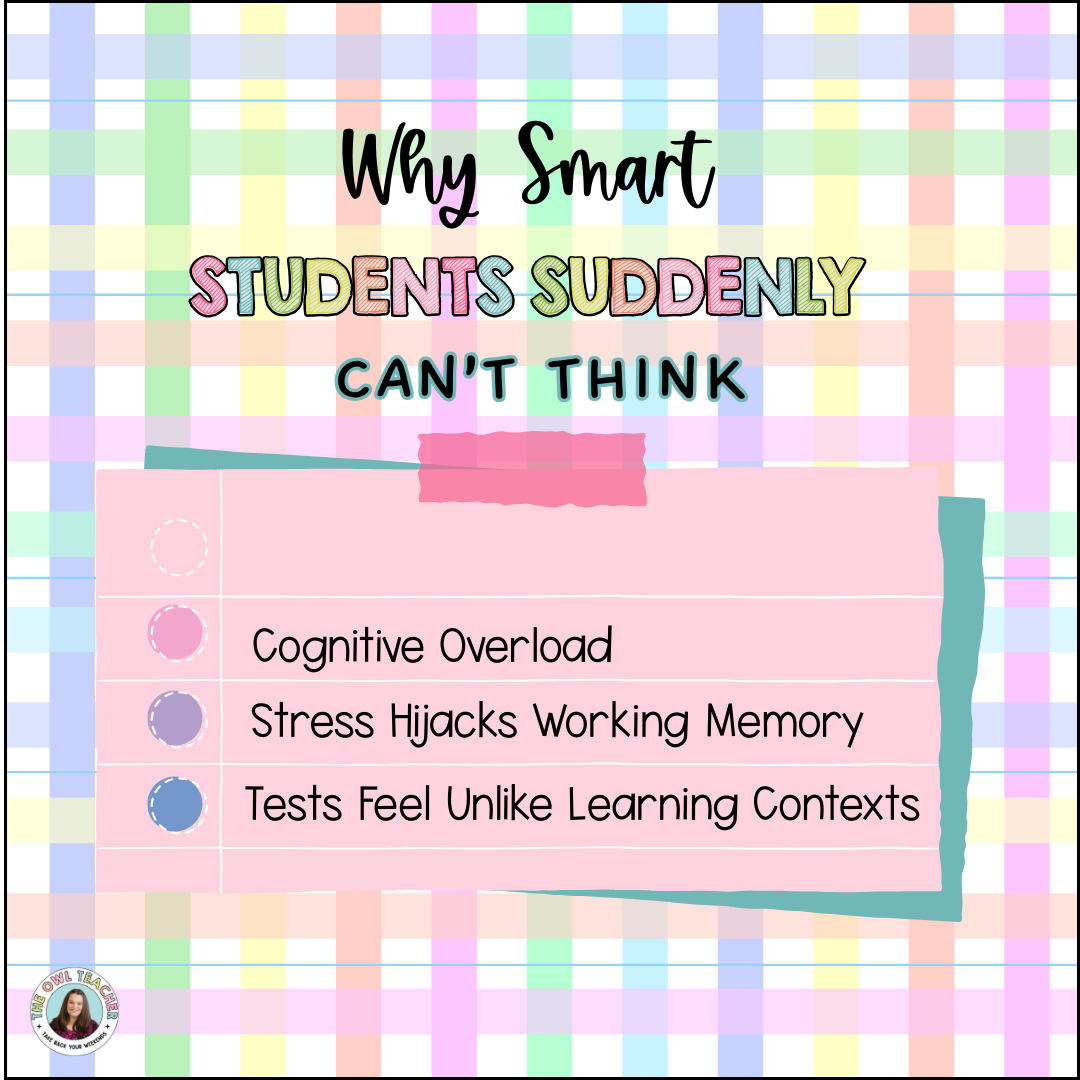
Cognitive Overload
Research shows that anxiety and stress directly interfere with working memory, the mental workspace we use to hold and manipulate information. When students are anxious, their working memory capacity shrinks. It’s like trying to solve a math problem while someone’s yelling at you, your phone is ringing, and the fire alarm is going off. The mental resources they need to think are being hijacked by worry.
Studies on test anxiety and working memory consistently demonstrate that worry and cognitive self-concern, all that internal “I’m going to fail” chatter, literally occupy space in the working memory system that should be available for solving problems. It’s not that students don’t know the content. It’s that anxiety is taking up so much mental bandwidth that they can’t access what they know.
Stress Hijacks Working Memory
When students are stressed, their brains shift attention to the perceived threat (in this case, the test and fear of failure) rather than to the task itself. Research on test anxiety shows that the cognitive components of test anxiety, worry, negative self-talk, and catastrophic thinking, interfere with the mental processes needed for test performance.
Think about it: working memory is already limited in capacity. When part of that capacity is constantly running scripts like “I’m going to fail,” “Everyone else is smarter than me,” or “I can’t do this,” there’s literally less room left to retrieve information and solve problems.
Tests Feel Unlike Learning Contexts
Here’s the thing nobody talks about: the environment where students learned the material looks nothing like the environment where they’re being tested on it.
During learning:
- They can talk to peers
- They can ask questions
- They can look at their notes
- There’s no time limit
- Mistakes feel like learning opportunities
- The stakes feel low
During testing:
- Complete silence
- No help available
- Everything from memory
- Time pressure everywhere
- Mistakes feel like failures
- The stakes feel enormous
It’s no wonder students’ brains don’t automatically transfer what they learned in one context to another. The cognitive load of managing test anxiety while trying to perform under pressure is genuinely overwhelming.
What Doesn’t Actually Help (But We Keep Doing Anyway)
Let’s talk about what doesn’t work, because we’ve all tried these and watched them fail:
More Practice Packets
Giving anxious test-takers more worksheets doesn’t address the problem. They don’t need more exposure to content; they need strategies to manage cognitive load and access what they already know under pressure.
Telling Students to “Just Slow Down”
“Make sure you read carefully!” “Take your time!” “Don’t rush!”
Yeah, okay. But when your brain is screaming that you’re running out of time, everyone else is already done, and you’re definitely failing, “slow down” is about as useful as “just relax” is to someone having a panic attack.
We’re asking students to employ executive function skills (self-regulation, metacognition, impulse control) exactly when anxiety has compromised them. It’s not that they don’t want to slow down; it’s that their anxious brain has hijacked the controls.
More Content Review Right Before the Test
Cramming more facts into their heads the day before the test doesn’t help if the problem is that anxiety is blocking access to what’s already there. In fact, adding more last-minute content can increase cognitive load and worsen the freeze response.
What Actually Helps: Building Mental Scaffolding
So what does work? The answer is building thinking structures that become automatic, so automatic that students can lean on them even when anxiety is trying to shut everything down.
1. Familiar Thinking Structures
Students need thinking frameworks they’ve practiced so many times that they become muscle memory. When the test anxiety hits, these structures become the mental handholds they can grab onto.
This means:
- Use the same question stems consistently: if your test asks “What evidence supports…?” then your daily work should regularly use “What evidence supports…?” Not similar language, the exact same language.
- Predictable formats: If your test has a chart to analyze, they should analyze charts in the same format every week, not just once before the test.
- Routine problem-solving steps: “Circle the question. Underline key information. Cross out distractors.” Whatever your steps are, practice them until they’re automatic.
The goal is that when anxiety makes their brain go blank, the structure is still there. They might not immediately recall the content, but they can recall “Okay, first I circle the question,” and that action alone can start breaking through the freeze.
2. Low-Stakes Retrieval Practice
This is where the research gets really interesting. Studies on retrieval practice consistently show that the act of retrieving information from memory, actually having to recall it, not just review it, strengthens learning and makes that information more accessible later, especially under pressure.
But here’s the critical part: it needs to be low-stakes. Research on test-enhanced learning shows that frequent, low-stakes quizzes improve performance on high-stakes tests, but the key is that students aren’t graded or judged during practice. The point is retrieval, not evaluation.
What this looks like in practice:
- Quick daily retrieval warm-ups: Three questions at the start of class. Students write answers, check with a partner, and correct misconceptions. No grade. No judgment.
- Brain dumps: “Write everything you remember about photosynthesis for two minutes. Go!” Then they compare notes with their table and fill in gaps.
- No-stakes quizzes: Give them a practice quiz that looks exactly like tomorrow’s quiz. Let them work together, use notes, whatever. The point is to practice retrieving information in a quiz format without the anxiety of it counting.
The research is clear: retrieval practice doesn’t just help students remember content, it specifically helps them access that content under pressure, which is exactly what they struggle with during high-stakes tests.
3. Strategy Rehearsal, Not Content Review
Stop spending the day before the test re-teaching content. Instead, spend it rehearsing strategies for what to do when they don’t immediately know something.
Practice scenarios like:
- “I don’t know this answer. What do I do?” (Skip it, mark it, move to the next one, come back later)
- “I’m running out of time. What do I do?” (Answer what I can, make educated guesses on the rest, breathe)
- “I’m starting to panic. What do I do?” (Close my eyes, take three deep breaths, read just one question at a time)
Literally roleplay these situations. Have students practice skipping a question and then coming back. Practice taking a breath break in the middle of a practice test. Make strategy rehearsal as routine as content review.
Classroom Moves That Reduce Test-Day Freezing
Okay, let’s get practical. Here are specific, do-this-tomorrow strategies that actually work:
“What Do I Do First?” Routines
Create a test-taking routine that’s so automatic that students with test anxiety can do it on autopilot:
Step 1: Flip through and preview “Before you start, flip through every page. Count how many questions there are. Notice which ones look easy and which look hard.”
Step 2: Name something you know. “Look at the first question. Even if you don’t know the full answer, what’s one thing you do know about this topic?”
Step 3: Start with confidence. “Find one question you’re confident about and start there. Get a win first.”
Practice this exact routine every single time they take any test-like, unit quizzes, exit tickets, or review activities. When test day comes, they’ll have done this routine literally dozens of times. Their anxious brain might freeze, but their body knows: flip through, count, find something you know, start with confidence.
Annotation Habits
Teach students with testing anxiety to physically interact with the test to keep their brains engaged:
- Circle the question being asked (so they don’t answer the wrong thing)
- Underline key numbers or facts (so they don’t miss important details)
- Cross out obvious wrong answers (so they narrow choices before thinking)
- Draw quick diagrams or visuals (so they externalize their thinking)
Again, the key is making this habitual. If they only annotate on test day, they’ll forget under pressure. But if they’ve been circling questions on every warmup for three months? That becomes automatic when student testing occurs.
Self-Talk Modeling
Students’ internal dialogue during student testing is often catastrophic: “I’m so stupid. I’m going to fail. Everyone else is smarter than me.”
We need to explicitly teach them different self-talk. Not toxic positivity (“I’m amazing at tests!”) but realistic, helpful self-talk:
- Instead of: “I don’t know this. I’m going to fail.” Try: “I don’t know this yet. Let me skip it and come back.”
- Instead of: “I’m taking too long. Everyone else is done.” Try: “I’m working at my own pace. Their speed doesn’t affect my score.”
- Instead of: “I studied so hard and I still can’t remember.” Try: “The information is in there. Sometimes it takes a minute to find it.”
Model this out loud during class: “Hmm, I’m not immediately sure about this one. Let me see… what do I know about this topic? Oh, right, I remember we talked about…” Make your thinking process visible so they hear what productive self-talk actually sounds like.
Teacher Relief: This Isn’t About Effort
Here’s what I need you to hear: When a student freezes on a test, it’s not because they didn’t try hard enough.
It’s not because they didn’t care. It’s not because they’re lazy, unmotivated, or “just need to focus.” It’s not even always because they didn’t study (though sometimes that’s true too).
It’s because their brain is experiencing genuine cognitive overload. Research confirms that anxiety occupies working memory capacity that would otherwise be available for problem-solving and recall. This is neuroscience, not a character flaw.
When you truly understand this, it changes how you approach test prep and testing anxiety. You stop thinking, “I need to make sure they know more content,” and start thinking, “I need to build systems that help them access what they already know.”
That’s a completely different (and much more effective) approach.
Practical Tools You Can Use Tomorrow
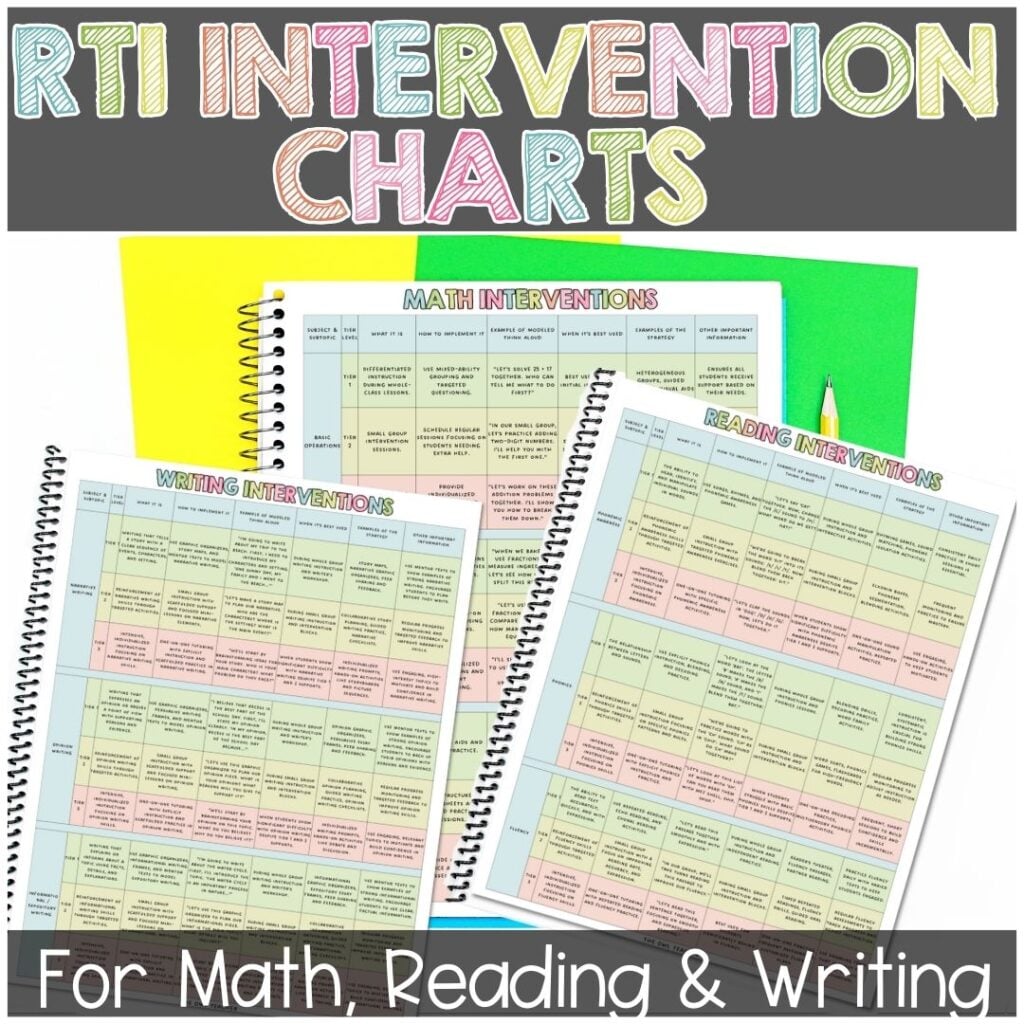
Want to start implementing these strategies right away? I’ve got resources to help:
Test-Taking Strategies Poster – Visual reminders of the exact steps students should follow when they encounter a challenging question. This works well as anchor charts or as printed desk references for test days.
Multiplication Guided Math Workshop Bundle – Comprehensive math workshop units with detailed lesson plans, engaging activities, and strategies to help students master multiplication skills and build math confidence.
Growth Mindset Poster Quotes – Help students reframe test anxiety and develop the self-talk strategies that reduce cognitive overload during testing.
And if you’re looking for ways to build those low-stakes retrieval practice routines, check out these Engaging Test Prep Ideas that make test preparation more engaging and effective without the pressure.
You can find all of these resources (and more!) in my Teachers Pay Teachers store or right here on my website.
And don’t forget, you need to take a breath during this busy, tiring season to get you through testing season.
Building Better Test-Takers Through Better Routines
The solution to test anxiety isn’t more content review or more practice tests. It’s building thinking structures that become so automatic that students can access them even when their anxious brain is screaming.
It’s practicing retrieval regularly in low-stakes ways so that recall becomes easier, even under pressure.
It’s rehearsing test-taking strategies so that when panic hits, students have a clear “what do I do next?” answer.
And most importantly, it’s understanding that test anxiety is a real neurological phenomenon, not a motivation problem. When we approach it with that understanding, we can actually help.
Your students aren’t lazy. They’re not unmotivated. They’re not “bad test-takers.” Their brains are experiencing cognitive overload, and they need explicit strategies and repeated practice to build the mental scaffolding that helps them perform under pressure.
You’re not looking for a magic fix; you’re building systems. And systems take time, consistency, and patience. But they work.
So next time you see that student staring blankly at a test you know they studied for? Take a breath. Remember it’s brain load, not effort. And keep building those structures, one routine at a time.
They’ll get there. And so will you.