








Let’s establish the most important part right away: lab safety is serious business.
As adults, it’s easy for us to understand that statement immediately and with no further questions. We know the significance of lab safety throughout all the steps of the scientific method. However, our students simply don’t have the decades of life experience that we do, so it’s up to us to impart our wisdom onto them.
Like many aspects of life, though, teaching our students about lab safety is much easier said than done! How can we communicate to students just how significant and serious lab safety is while still maintaining an engaging learning environment that will keep their attention?
I can guarantee you that standing at the front of the room, droning on about each safety rule one-by-one, is a sure way to lose your classroom’s attention… And for a subject as serious as lab safety, we can’t afford for our kiddos to zone out.
So what can we do? As I mentioned above, we can raise the excitement level, but how? Well, exciting hands-on activities are a good start! Between gloves, goggles, and games, is there any better way to keep students engaged while learning about lab safety?
Tie your hair back, put on your lab coats, and wash your hands–it’s time to get started!
Introducing Lab Safety: A Quick Note
Unfortunately, there’s really no way around it: you’ll have to go over all of the rules at some point. I know it’s not ideal to stand at the front of the room and read off lab safety rules and introduce all the equipment like a bored college professor. However, it is important that you communicate the rules before beginning any fun activities. Students need to know what is expected and be introduced to the guidelines before they can participate in games or other activities covering lab safety!
Of course, it doesn’t need to be boring. Every classroom is different, and as an educator, I’m sure you’re able to feel out what your classroom does and does not respond well to. However you choose to go over things, the important part is that you do make the time to communicate each safety rule and go over the proper use of equipment before launching into the fun!
Once you’ve gone over the “boring” part, it’s time to engage your class! Here’s a list of ten ideas to get you started.
1. Stage a Concert
Okay, it doesn’t have to be a concert, necessarily. But the gist of it is to group students up into groups of three, four, or five (unless you have some solo artists!) and have them create a rap, song, or chant! Give your groups around fifteen minutes to come up with a flashy jingle before having them “perform” for the rest of the class. You can even have students jazz it up with beats and silly dance moves! After all, it’s a proven fact that music and memory go hand-in-hand, and we don’t want students forgetting those lab safety rules any time soon.
2. Create an Infographic
Illustrations and posters are a tried-and-true engaging, hands-on activity that fit in well with just about any topic, and lab safety is no exception! That being said, another method of covering lab safety is to create an infographic. Give each student (or group!) a large piece of poster board or bulletin board paper. Set a time limit (I usually go for fifteen minutes) for your classroom to make a dedicated poster showcasing summaries of the important lab safety rules. It needs to share the significant guidelines as well as being creative and eye-catching!
The best part? You can then hang them around the room as a handy reminder of the lab safety rules!
3. Form the Safety Police
One of the best ways to check for understanding is to have students point out mistakes. It’s engaging, too–kiddos love to be right! For this tip, you can give students an image of a situation that has gone wrong or somehow broken the lab safety rules. You can include multiple issues, too, and have students count how many different violations are occurring.
Then, take it a step further: enlist them to become “safety police!” Students can create “offense tickets” that detail the offense (which rule was broken), explain why it’s an offense (the consequence of breaking the rule), and what the fine will be (what will happen now that the rule is broken). It’s like being a hall monitor… But for science!
4. Put on a Play
More group activities? You know it! I love offering opportunities for collaboration and cooperation in my classroom, such as having students work in groups to create a skit! This skit should teach the audience a set number of lab safety rules. As the teacher, you have jurisdiction over the guidelines: should each group get an assigned rule to demonstrate, or can each group pick their own rule? How long should their skit be? What vocabulary should they include?
Ultimately, the skit should introduce the rule, act out the rule being broken, explore the consequence of breaking the rule, and finally resolve with a solution to the broken rule. Then, give students time to create their skits, rehearse, and then act them out!
Looking for more role-playing skits? Check out my store! Here’s one for photosynthesis!
5. Set Up a Scavenger Hunt
It’s no secret that I widely endorse scavenger hunts, especially as an active learning strategy! They’re easy to set up, and students absolutely love them. Simply provide your kiddos with a checklist or set of clues to locate and identify various safety items, symbols, and precautions throughout your classroom. And, of course, if you need any inspiration or want an example for your scavenger hunt… You can always check out mine!
6. Make Cause and Effect Chains
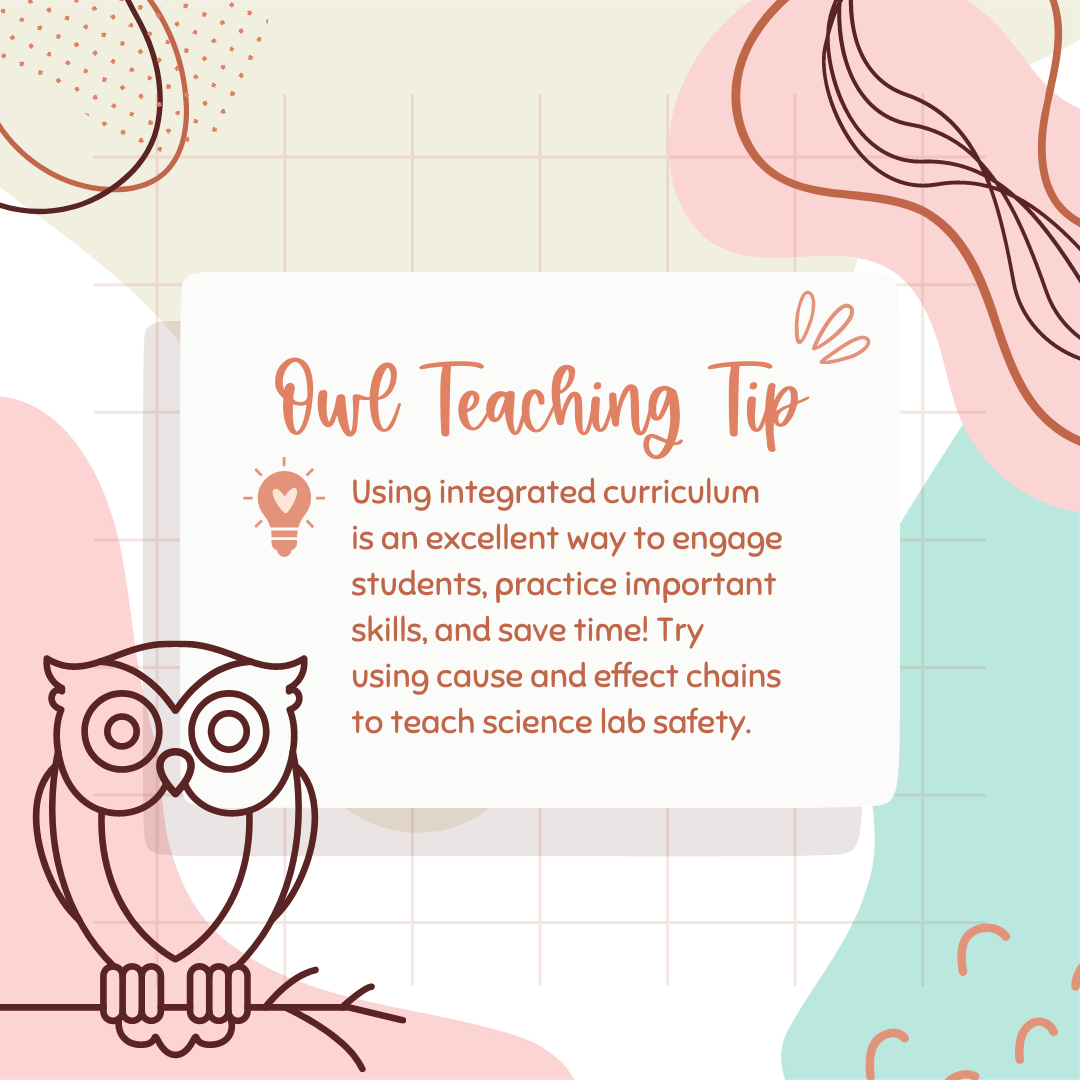
Since I’m always looking for new ways to create an integrated curriculum, let’s use this time to polish our reading skills as well! For this tip, we’re going to create cause and effect chains–who couldn’t use a bit more practice with cause and effect, anyway? 🙂
Using the cause and effect chains I outline in this blog post, students will list the causes (breaking various safety rules) and effects (the consequences) and discuss them either in groups or as a class. For extra excitement, have students get creative with how they create their chains!
7. Enlist Student Detectives
I’ll be honest–this activity requires a small bit of setup, but it’s totally worthwhile! Once again, we’re going to break students up into groups and provide each with a “case file” that contains different lab scenarios. It’s up to you how many situations to include in your case files, based on how much time you have and how much practice your kiddos need, but I generally aim for three to five scenes.
Then, have students be detectives and identify any and all potential safety hazards or violations in the scenarios. To take it a step further, have the groups propose solutions to the broken lab safety rules to ensure things go smoothly!
8. Rotate Through Stations
I use centers and stations just about everywhere in my classroom, and it’s totally easy to set them up for an interactive experience with lab safety rules, too! To implement safety stations in your classroom, you can set up different safety-related tasks–or task card questions–at various centers around the room. For example, one station may demonstrate proper equipment usage, while another may encourage students to identify safety symbols. You can even set up a center all about organizing a lab station properly!
Of course, if you need any advice on making centers work, I’ve got you covered!
9. Film a Commercial
I’m sure your students are familiar with pesky advertisements popping up when they’re trying to watch their favorite YouTube videos, but trust me, these commercials are going to be a lot more fun!
Break students up into groups and have them create a lab safety commercial. Go over general guidelines with your classroom, such as which rules need to be advertised (either assigned or chosen), what needs to be included in the commercial, how long it should be, and so on. Then, have students record their commercials and have a viewing party!
10. Play Charades
When was the last time you played a game of charades? What about your students? No matter the age group, charades are always a hit–and for good reason! Charades is an easy way to introduce kinetic energy into your classroom, which instantly translates to excitement!
For your classroom, create slips of paper with different safety rules (or equipment uses!) and place them in a bag, hat, cup, or other blind container. Divide students into teams and have them take turns drawing a slip. Then, have students act out the slip while their team guesses the action being portrayed. Whichever team guesses correctly the most times (or quickest) wins!

Lab safety is certainly a serious topic that deserves respect, but that doesn’t mean it has to be boring for your kiddos to learn. In fact, if we can make lab safety engaging, your classroom is much more likely to remember the safety rules and proper equipment usage in the long run!
With these ten tips, you can rest assured knowing your students are sure to be mindful of lab safety. Your classroom is already a positive, engaging environment–now it’s an extra safe one, too, no matter what science labs you have on the agenda. From introductory labs such as those to teach scientific process skills, or creating habitats for fragile plants, or doing something a bit more high-tech like creating electric vests, your students will be able to easily recall their lab safety rules thanks to your engaging activities.
Now, you can plan exciting science labs to your heart’s content. Have fun, and stay safe!