







One of my students was a bright kid who had done well on all the area and perimeter worksheets I had given him. He was arranging the layout of his house and needed to decide whether his square living room or his rectangular family room needed more baseboards.
The two rooms were about the same size. He sat there for fifteen minutes with a calculator in his hand, looking completely lost.
And that’s when I got it. This kid was excellent at finding the area and the perimeter. He knew the formulas by memory. He could enter numbers and obtain the right answers. But he didn’t truly understand area and perimeter meant.
The truth is that most of our assessments screen for math skills, not comprehension. And that’s a HUGE problem.
What is wrong with the tests that check the area and the perimeter?
Think about the normal way to find the area and perimeter. It looks like this:
- Determine the area of a rectangle that is 8 cm long and 6 cm wide.
- Determine the length of a rectangle whose sides are 8 cm and 6 cm.
- This is a shape that was sketched on graph paper. Determine its area and perimeter.
Even if they don’t know what area and perimeter are or how they’re related, students who know “multiply for area, add for perimeter” can answer these questions correctly.
Robert Kaplinsky calls them “fake contexts,” which means puzzles that use vocabulary phrases without requiring comprehension of what they mean. Students merely have to match the pattern to the formula they’ve learned and hope they picked the right one.
And this is crazy: it doesn’t just hurt students in elementary school. Studies show that 72% of teachers who have graduated think that the perimeter and area “vary together.” This means they think that a shape with a bigger perimeter must also have a bigger area.
Think about that for a second. Almost three-quarters of adults who are about to become teachers still believe this.
Students think that a larger perimeter means a bigger area.
This misunderstanding lingers with students into adulthood because traditional schooling never directly questions it. We always prevent students from thinking about the connection between these two measurements.
I taught this way, too. We start with hands-on activities using candy boxes, then move on to perimeter activities, complete some practice worksheets for both, and that concludes the lesson.
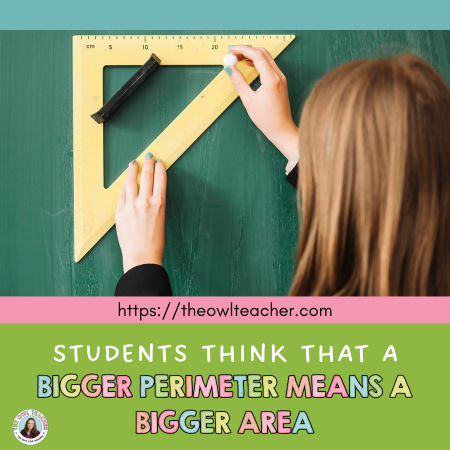
But students left my lecture with the idea that area and perimeter were related in some way. If you make a rectangle bigger, both measures get bigger, right? It makes sense that they would go together.
But they don’t. Not all the time. And that’s exactly what students need to know.
The One Question That Matters
Are you ready for the test that will show you exactly what your students know (or don’t know) about area and perimeter? Can two shapes have the same perimeter but different areas? “Show it.”
That’s all. That one question will let you know if the kids really understand these ideas or if they just remembered some rules.
From what they said, I learned everything I needed to know about how well they understood. And to be honest? Most of them didn’t get how area and perimeter are related at all.
The Brilliant Fix: The Problem with Guessing
Instead of just telling students that shapes can have the same perimeter but different areas (or the other way around), I now use what I call the “Conjecture Challenge.”
I tell the students, “A rectangle with a larger perimeter ALWAYS has a larger area.”
Then I ask them to check to see if this statement is true or false and give me a reason for their answer.
Why This Works (Research Supports It!)
Research from Yale’s Teachers Institute shows that students will find a number of examples that seem to support this.
Students can find proof to support their claims all day long. But they have a hard time discovering examples that don’t suit the idea.
But what about the battle? That’s where the real learning happens.
How to Help with the Guessing Game
I don’t just give this challenge to students for no reason. This is how I made it simple to grasp, but still cognitively hard:
Start with Pentominoes
I start with pentominoes, which are shapes made up of five squares that are connected at their edges. The area of all pentominoes is the same (5 square units), but their edges are different.
This is fantastic because kids can touch the forms, count the squares to get the area, and count the edges to find the perimeter. Because it is both visual and tactile, it is easier for kids who have problems with abstract thinking to use.
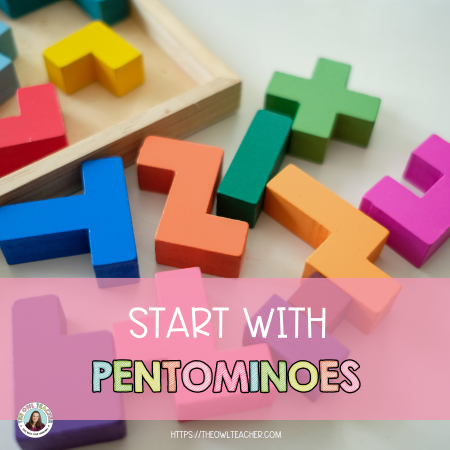
I give the kids square tiles and tell them to make different shapes with them. Then we fill up a table that shows the area and perimeter of each one. Students start to grasp when they see that all the pentominoes have an area of 5 but a perimeter between 10 and 12. “Wait… they’re all in the same area but have different boundaries?” How could that be?
Yay!. Now they’re thinking about it.
Go to Rectangles
After the students get the idea of pentominoes, I move on to rectangles. This is the point at which the “aha” moment really happens.
I advise the kids to look for all the rectangles that have a perimeter of 24 units. They draw them on graph paper, measure them, and write down what they find.
They learn that the area of a 1×11 rectangle is 11 and the perimeter is 24. But a 6×6 square also has a perimeter of 24 and an area of 36!
Boom. I’m amazed.
Then we turn it over. Look for rectangles that have an area of 24 square units. How wide are their borders?
A 1×24 rectangle has an area of 24 and a perimeter of 50. But a 4×6 rectangle only has a perimeter of 20 and an area of 24!
Students may witness for themselves that the perimeter and area don’t change at the same time. A form can have a big perimeter and a small area, as a rectangle that is very long and thin. A square is the optimum shape for this because it has a small area and a short perimeter.
The Best Counterexample
I show students this contrast after they have played with pentominoes and different rectangles:
A rectangle having a perimeter of 22 and an area of 10 is A.
Rectangle B: 5×5 (Area = 25, Perimeter = 20)
Rectangle B is smaller than Rectangle A. This completely disproves the concept that a bigger area means a bigger perimeter.
And what if kids figure this out on their own by digging into it instead of me informing them? They will never stop thinking about it.
Why This Method Is So Strict
Some teachers worry that these kinds of activities take too long or aren’t demanding enough. But here’s the thing: this is tough. It’s actually stricter than typical worksheet practice.
During the Conjecture Challenge, this is what students are really doing:
- Logical thinking: They’re trying to figure out if a statement is always true.
- They’re taught that you just need one counterexample to illustrate a point.
- Proof skills: They’re learning how to do simple algebra and how to think logically about math.
- Pattern recognition: They’re learning how perimeter, area, and dimensions are all connected.
- Problem solving: They’re utilizing productive struggle to understand what things mean.
This is exactly the kind of math abilities we want our students to develop. They aren’t just utilizing calculators to conduct math; they’re also thinking like mathematicians.
Also, when you teach this way, students remember what they learn better. They don’t need to learn the same thing over and over again since they really understand the ideas instead of merely memorizing steps that don’t make sense.
Things to Do to Help You Remember What You’ve Learned
After the Conjecture Challenge, I do a few follow-up activities to clear up frequent misunderstandings and assist students learn better:
Connections to the Real World
Now that they realize that area and perimeter don’t alter at the same time, I give them real problems to tackle. For instance,
- “You’re putting up a fence around your garden.” What do you need to know?
- You’re putting down carpet in your bedroom. What measurement is important?
- You are placing lights on a string around your window. What is the area or perimeter?
This is where math problems that are practical in the real world really shine. Students aren’t just completing math anymore; they’re also choosing which math to use and why.
The Hard Part of Optimization (Area and Perimeter)
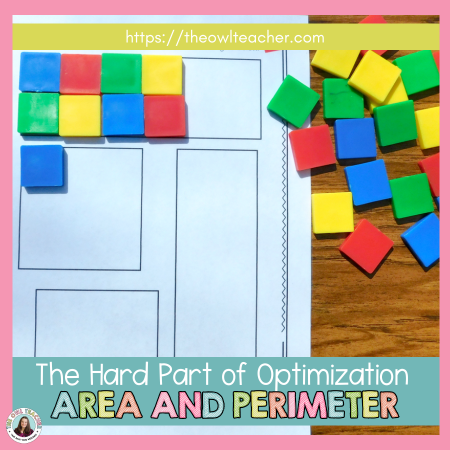
After students understand the relationship (or lack of one), I give them challenges to optimize things, such as “Build a dog pen with exactly 40 feet of fencing.” “How can you make the space your dog has to play in better?” Make a garden that is 36 square feet. How can you use less material for the border?
To get over these problems, students need to use what they know in a thoughtful way. These strategies align perfectly with the concept of learning by doing.
Different kinds of misunderstandings
I prepare cards with different claims about area and perimeter, and the kids sort them into “Always True,” “Sometimes True,” or “Never True.”
Some people say things like:
- “A rectangle with a larger area will always have a larger perimeter” (never true) and
- “Two shapes with the same area have the same perimeter.” “Two shapes with the same area do not necessarily have the same perimeter.”
- “A square has a smaller perimeter than any other rectangle with the same area” (Always True!)
This activity requires students to think critically about the relationship and explain why they believe what they do.
Change the unit for area and perimeter
You don’t need to keep going over the area and boundary over and over again. Teaching kids to consider the connections between these ideas, rather than merely memorizing formulas, results in learning that truly sticks.
The Conjecture Challenge only takes two or three class periods, but it saves you weeks of having to teach the same material over and again. You’re also learning how to think mathematically, which will help you in other areas.
With my complete area and perimeter unit, which has mini-lessons, activities, and tests, you can teach these concepts in even more hands-on ways. Everything is set up to assist students in learning about subjects in a manner appropriate for their level through the use of scaffolding techniques.
You might also be interested in these articles:
- A Collection of Area and Perimeter Ideas
- 10 Methods for Successful Scaffolding in Area and Perimeter
- Teaching Area using Applied Math
Final Thought
“Can two shapes have different areas but the same perimeter?” is a simple question that indicates how well kids understand. The following step, the Conjecture Challenge, changes people who only memorize formulas into people who think about math.
Try it out with your students. I assure you that what you learn about your kids’ knowledge will shock you.
Have you offered your students the Conjecture Challenge? What are some erroneous notions you’ve seen in your classroom? I’d love to hear about your experiences, so please leave a comment below.