








This post contains Amazon Affiliate Links.
You just finished teaching your plant unit, but something seems amiss.
Sure, the kids labeled their plant diagrams correctly. They filled out their observation logs. They can pass the test.
But ask them a week later what makes plants different from animals, and you’ll get blank stares. Show them a weed growing through a crack in the sidewalk, and they won’t even notice it’s there. Mention photosynthesis, and watch their eyes glaze over.
Here’s the thing nobody talks about at those professional development sessions: most traditional plant units don’t actually work. Not in the way that matters. Not in the way that builds genuine scientific understanding or lasting curiosity about the living world.
And it’s not your fault. The issue runs way deeper than lesson planning or teaching techniques. We’re working against some serious biological and educational forces here, things like plant blindness, backward sequencing, and activities that look great but teach almost nothing.
But here’s the good news: once you understand what’s going wrong, the fixes are surprisingly straightforward. And they often take less time than what you’re already doing.
So let’s talk about the five reasons why your plant unit isn’t working and what actually works instead.
Reason #1: Your Students Have Plant Blindness (And Nobody’s Told You About it)
Okay, this first one is going to sound weird, but stay with me.
There’s a scientifically documented phenomenon called plant blindness, and it’s exactly what it sounds like: humans have a natural tendency to literally not see plants. Our brains register them as background scenery, not living organisms worth paying attention to.
Don’t believe me? Try this quick experiment: Ask your fourth or fifth-graders to name five living things. Go ahead, do it tomorrow. See what happens.
Here’s what researchers consistently find: most upper elementary students list 1-2 plants (tree, flower, grass). Some list zero. They’ll rattle off dogs, cats, fish, birds, spiders, humans, maybe bacteria if they’re feeling ambitious, and completely forget that plants are alive at all.
This isn’t because kids are dumb or not paying attention. It’s because our brains evolved to notice things that move, make noise, or might eat us. Plants don’t do any of those things, so we unconsciously categorize them as “background stuff” along with rocks and water.
And here’s where it gets worse: traditional “parts of a plant” lessons actually exacerbate plant blindness. When we begin by teaching structure (roots anchor the plant, stems transport water, leaves make food), we reinforce the idea that plants are static objects to memorize rather than dynamic organisms to investigate.
The Fix: Start with Plant Behavior, Not Plant Structure
The fix for plant blindness isn’t just “take kids outside more” (though that doesn’t hurt). It’s about fundamentally changing how we introduce plants.
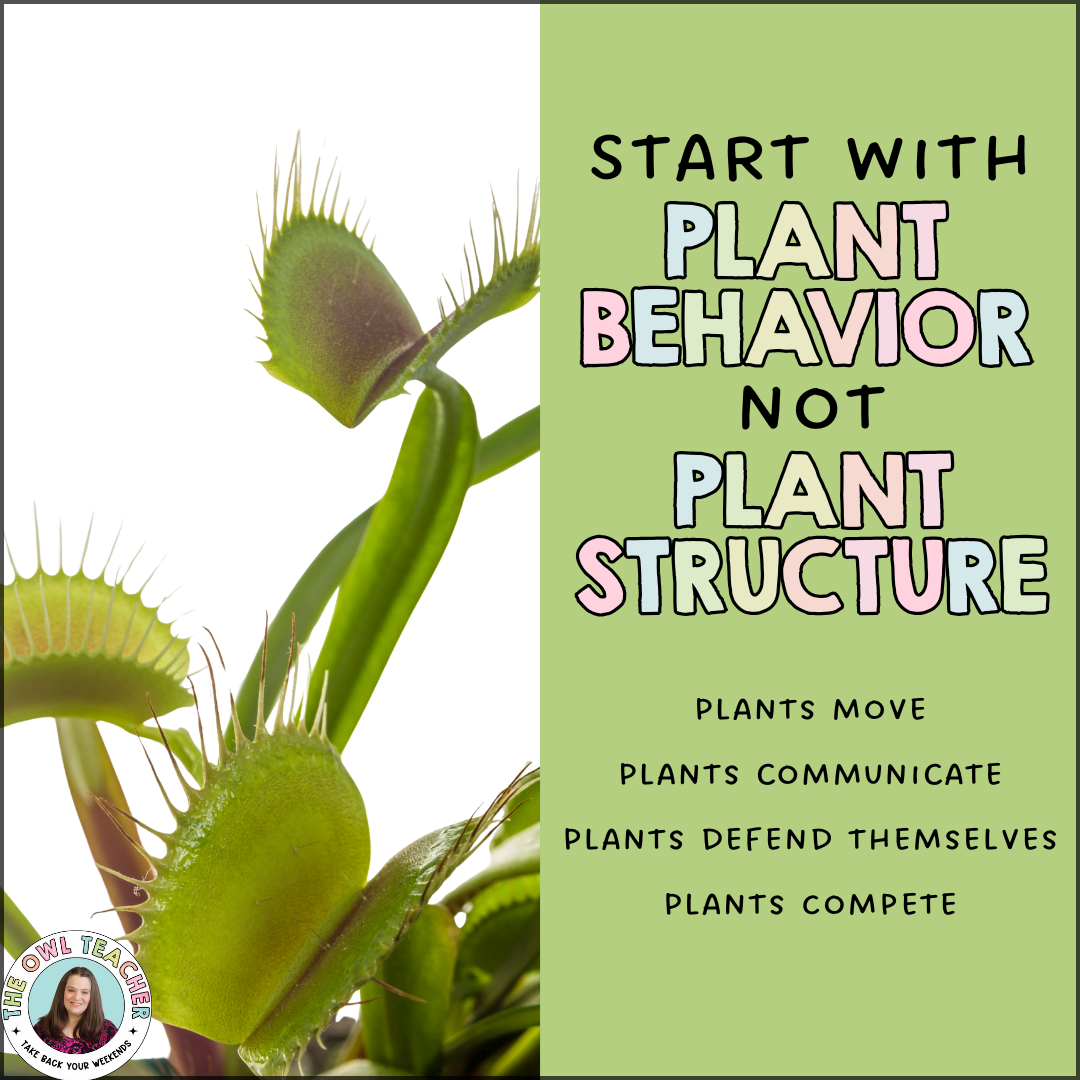
Start with plant behavior, not plant structure.
Show students that plants do things. Active, observable, sometimes shocking things.
- Plants move. Not as fast as animals, but they definitely move. Sunflowers track the sun across the sky every single day. Venus flytraps snap shut in under a second. Touch a Mimosa pudica plant and watch its leaves fold up right before your eyes. Time-lapse videos of bean plants growing look like something from a sci-fi thriller.
- Plants communicate. This one blows kids’ minds every time. When certain plants get attacked by insects, they release chemical signals into the air that warn neighboring plants. Those neighboring plants then begin producing defensive chemicals before the insects even arrive. That’s plant-to-plant messaging happening in real time.
- Plants defend themselves. Cacti have spines. Nettles have stingers. Poison ivy has, well, poison. Some plants taste horrible. Others grow faster than animals can eat them. Some even recruit insects to defend them.
When you start your plant unit with these behaviors, with plant “superpowers,” as some teachers call them, suddenly, students see plants as worth paying attention to. As living things doing interesting things, not just green stuff in the background.
Activities That Actually Cure Plant Blindness
- The Plant Spy Camera Challenge: Set up time-lapse cameras (or tablets with time-lapse apps) focused on plants responding to different conditions. Students watch hours of plant movement compressed into seconds. Bean sprouts climbing toward light. Roots growing downward. Leaves opening in the morning and closing at night. Make sure you’re teaching plant science with investigations that show plants as active organisms.
- The Plant Communication Experiment: Put bean seeds in two different containers. When they sprout, gently tear some leaves off one container to simulate an “insect attack.” Over the next few days, students observe if the undamaged plants in the second container show any defensive responses. It’s hands-on science that builds critical thinking.
- The Carnivorous Plant Investigation: If you can get your hands on a Venus flytrap, sundew, or pitcher plant (many garden centers carry them), do it. Nothing cures plant blindness faster than watching a plant catch and digest a fly.
Here’s something worth noting: research shows that urban students have significantly higher rates of plant blindness than students in suburban or rural areas. This matters because plant literacy is linked to environmental literacy, which in turn supports understanding of climate change, food systems, and ecosystem health.
Reason #2: You’re Spending Two Weeks on Content, One Activity Could Teach
Let’s talk about time. Specifically, wasted time.
Here’s what most plant units look like: Week 1 focuses on plant parts (introducing vocabulary, labeling diagrams, reading about plant parts, additional labeling activities, and a quiz). Week 2 covers what plants need with a similar pattern of worksheets and minimal hands-on work.
Ask students a month later what they remember, and you’ll get vague answers about “plants needing water and sunlight.” The detailed knowledge? Gone.
Research on hands-on learning in science consistently shows students remember what they discover through investigation, not what they copy from diagrams or read in textbooks.
The Solution: The Plant Autopsy Investigation
Here’s a single activity that teaches almost every plant concept you need to cover in less time and with better retention.
The Setup: Send students (or their parents) to the grocery store with this mission: Buy one vegetable that still has multiple visible plant parts. Carrots with green tops still attached. Radishes. Beets. Green onions. Celery with leaves. Anything where you can see roots, stems, and leaves in one package.
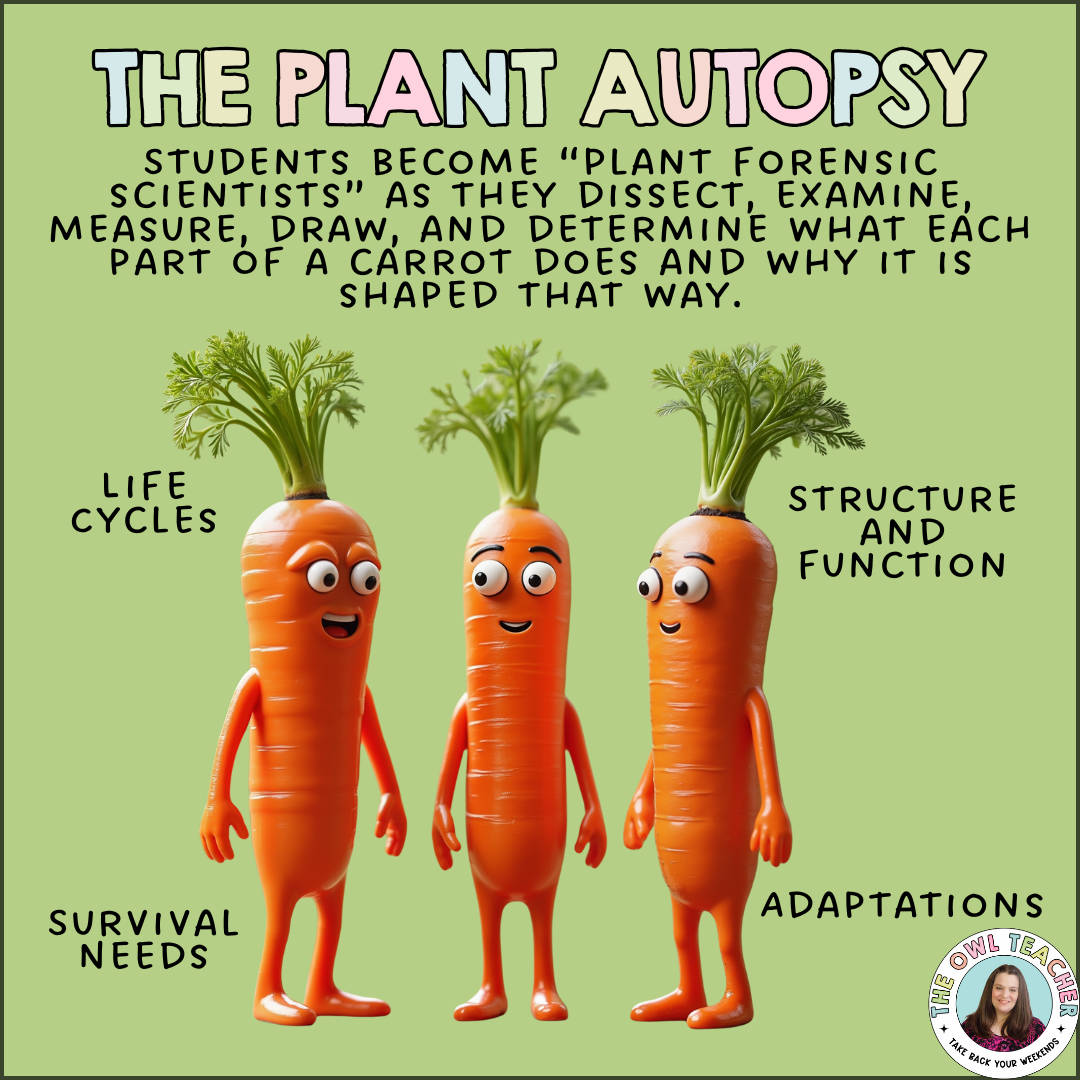
The Investigation: In class, students become “plant forensic scientists.” They dissect, examine, measure, draw, and figure out what each part does and why it’s shaped that way.
What ONE Carrot Actually Teaches:
- Structure and Function: Students see and touch the different parts. The thick orange root (modified for storage), the thin green stems, the delicate leaves. They examine the characteristics of each part to determine its function.
- Adaptations: Why is the carrot root orange? Why is it thick? (Stored nutrients for reproduction next year.) Why are the leaves thin and flat? (Maximum surface area for sunlight absorption.) Students develop hypotheses based on observation.
- Life Cycles: What stage is this plant in? If we planted it, what would happen next? How does this plant reproduce? Students can trace the life cycle from the actual organism in front of them.
- Survival Needs: What does each part need to function? How does the plant get water, nutrients, sunlight, and air? The answers become obvious when you’re holding the actual plant parts.
One activity. One or two class periods. Replaces at least five separate worksheet-based lessons.
Why This Works for ALL Levels
The Plant Autopsy Investigation is naturally differentiated:
- For students working below grade level: Focus on observation and basic labeling. Draw what you see. Describe textures, colors, and sizes. Label the parts.
- For on-level students: Add the “why” questions. Why is this part shaped this way? What does this indicate about the part’s function?
- For advanced students: Design experiments based on observations. What would happen if you removed different parts? How would this plant adapt to different environments?
Instead of five days of vocabulary, labeling, reading, worksheets, and quizzes, you get two days of deep, meaningful investigation. That’s three days saved, and students actually remember what they learned because they discovered it themselves.
This connects perfectly with making science engaging while maintaining rigor.
Reason #3: You’re Teaching Plants in Completely the Wrong Order
The traditional plant unit sequence is as follows: structure (the parts of a plant), function (what each part does), life cycle (plants grow from seeds to adult plants), and photosynthesis (plants synthesize food from sunlight).
This sequence seems logical. It builds from concrete to abstract. Simple to complex. It’s how textbooks are organized.
And it’s backward.
Here’s what research on student engagement consistently shows: students learn better when you start with phenomena that hook their interest first, then circle back to the underlying structures and processes that explain those phenomena.
Think about how you’d teach the human body. You don’t start with “Here’s your skeletal system; now label the bones.” You start with “What happens when you break a bone?” or “Why do your muscles get sore after exercise?” The engaging question drives the learning. The structure follows.
What the Better Sequence Looks Like
Instead of starting with “parts of a plant,” start with urgent, compelling questions:
- “How do desert plants survive months without rain?” Now students want to know about root systems. Understanding roots isn’t just memorizing vocabulary; it’s understanding survival. When you eventually circle back to “let’s look at different types of root systems,” students already know why it matters.
- “Why don’t deer eat poison ivy even though they’re starving?” Suddenly, students care about plant defenses and chemical compounds. Later, when you teach about plant adaptations, they have context.
- “How do plants ‘know’ which way is up when they’re growing underground?” Now they’re interested in plant hormones and gravitropism. The boring biology becomes the answer to a mystery.
- “Why do some plants eat insects?” Students become interested in how plants get nutrients, digest food, and adapt over time when they see carnivorous plants.
Why This Order Works Better
Immediate engagement: The question is interesting from day one, not just because it’s required curriculum.
Context for the boring stuff: Students won’t ask “Why do we need to know this?” when you finally teach root structure because they’ve already been wondering about it.
Built-in critical thinking: By starting with phenomena, students practice scientific thinking from the start. They’re not just memorizing; they’re observing, questioning, and problem-solving.
Natural differentiation: All students can engage with a compelling question, regardless of their reading level. Differentiation happens naturally when the entry point is inquiry rather than text.
The sequence is: hook with a compelling phenomenon, student observation and hypothesis, investigation or research, elucidation of underlying structure/function as an explanation, and application to new situations.
Same content. Same standards. Better sequence. Better retention.
Reason #4: Your Students Think Plants Are Dead (Seriously)
Here’s the research finding that should fundamentally change how we teach plants: most third through fifth graders don’t classify plants as truly living things.
I’m not exaggerating. Give students pictures to sort into “living” and “non-living,” and watch where plants end up. With rocks. With water. With clouds and soil and other non-living things.
Sure, students know the “right answer” for tests. They’ll dutifully write “plants are living things” on worksheets because that’s what teachers want to hear. But when given freedom to sort based on their actual understanding, their true beliefs come out: they don’t genuinely believe plants are alive.
Why Students Think This Way
It makes sense when you think about it. Students’ concept of “alive” is based on animals:
- Alive things move around → Plants don’t (obviously)
- Alive things make sounds → Plants don’t
- Alive things eat food → Plants just sit there in dirt
- Alive things respond quickly → Plants don’t react when you poke them
- Alive things have babies → Seeds don’t look like baby plants
By every criterion of childhood “alive,” plants fail the test.
The Fix: Make “Is It Alive?” Your FIRST Lesson
Don’t assume students understand plants are living. Make this the very first thing you teach. Not the last. Not the middle. The first.
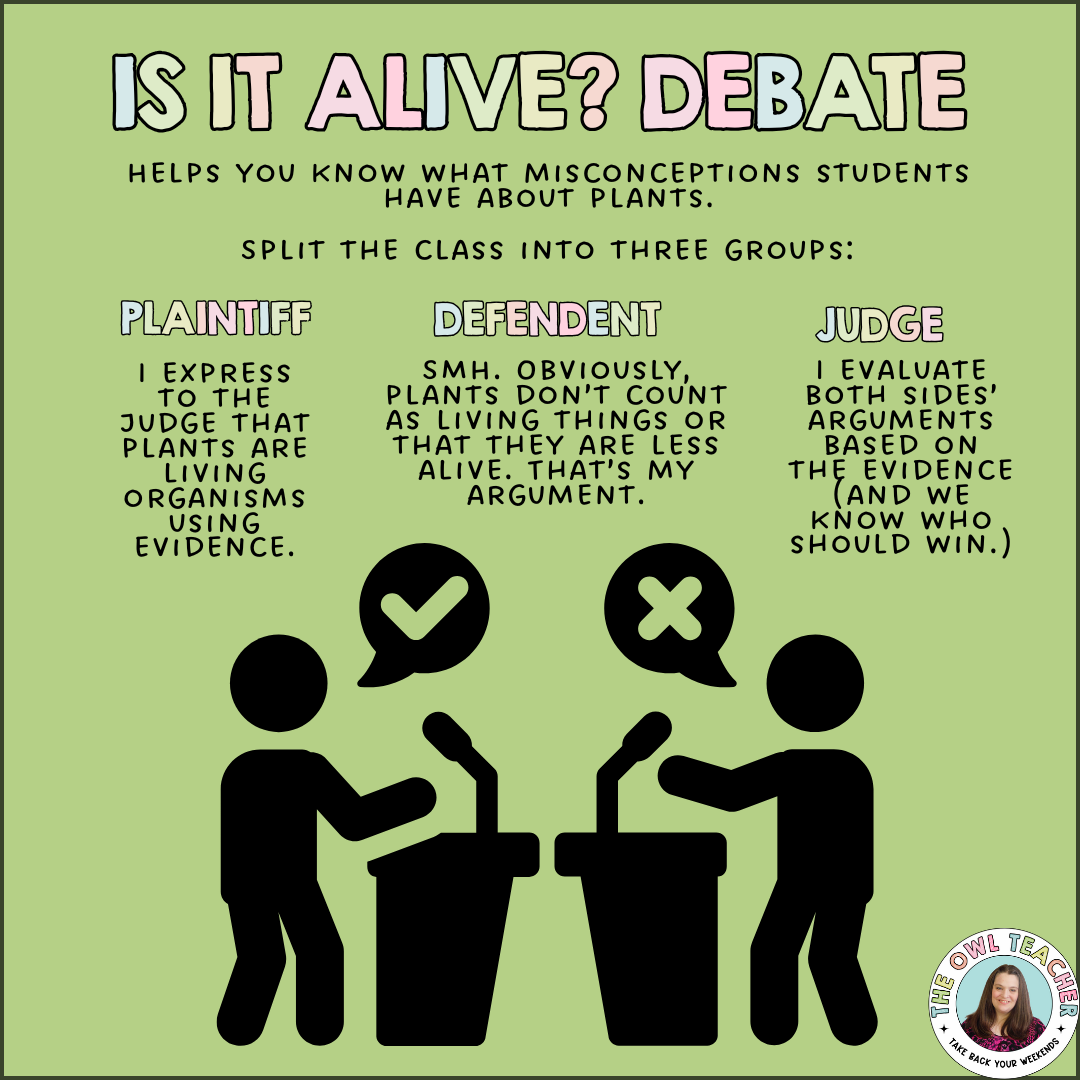
The “Is It Alive?” Debate Protocol:
This structured debate elicits students’ genuine thinking and compels them to confront their assumptions.
Split the class into three groups:
- Team Plants Are Alive: Must argue that plants are genuinely living organisms using evidence
- Team Plants Aren’t Really Alive: Must argue why plants don’t count as truly living (or are “less alive” than animals)
- Team Scientists: Judges who evaluate both sides’ arguments based on evidence
The “Plants Aren’t Alive” team will make arguments like “They don’t move!” and “They don’t make sounds!” and “They just sit there all day!” Now you know exactly what misconceptions you’re dealing with. And students are way more invested in the answer than if you’d just told them “plants are alive.”
The Evidence That Changes Minds:
After both sides present initial arguments, hit them with evidence:
Show plants MOVING in real time:
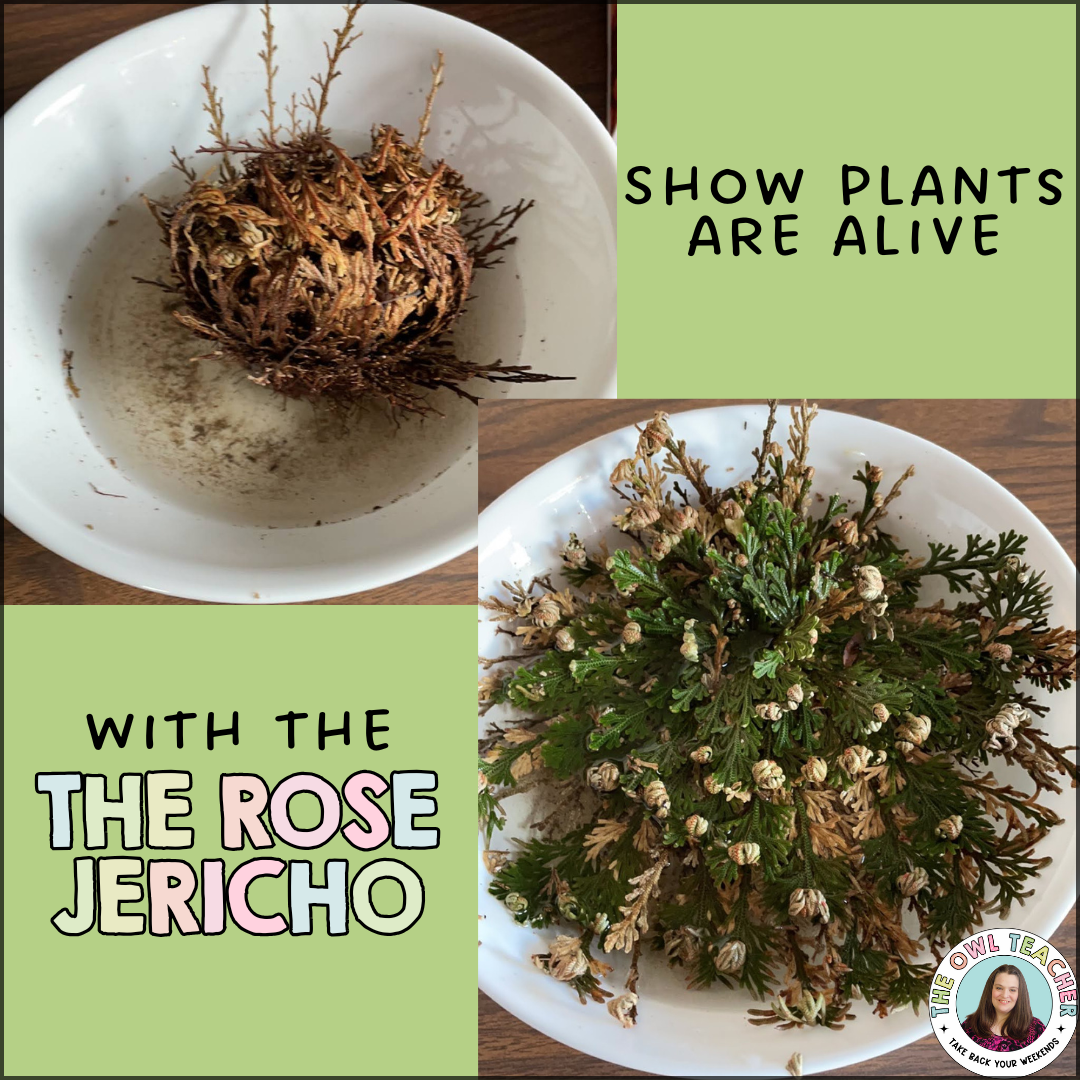
- Pour water on a dry Rose Jericho and watch leaves unfold
- Drop a fly on a Venus flytrap
- Show prayer plants opening and closing leaves throughout the day
- Display sunflowers tracking the sun
- Have students touch “Tickle Me Plants”
Actual plant movement.
The “Plant vs. Animal Olympics”:
This activity is gold. Students compare plants and animals across different categories:
- Response Time: How fast does each respond to stimuli? (Animals win, but plants DO respond)
- Growth Rate: Compare growth over a week (Plants often grow more than animals)
- Movement: Track how far each “travels” in 24 hours (Animals often win, but plants move toward light, roots move toward water)
- Reproduction: How many offspring can each produce? (Plants often win dramatically)
- Life Span: How long do they typically live? (Many plants outlive animals)
The point isn’t that plants are “as good as” animals. The point is that plants and animals are both living things that solve similar problems (growth, reproduction, response to environment) in different ways.
After this debate, students don’t just know plants are alive; they believe it. That distinction matters. And that belief changes how they approach every other concept in your plant unit.
This directly addresses the plant blindness problem we talked about earlier. When students see plants as living, breathing, responding organisms, they start noticing them.
Reason #5: Planting Seeds Isn’t Actually Teaching Science
I’m about to criticize everyone’s favorite plant activity. I know. I’m sorry.
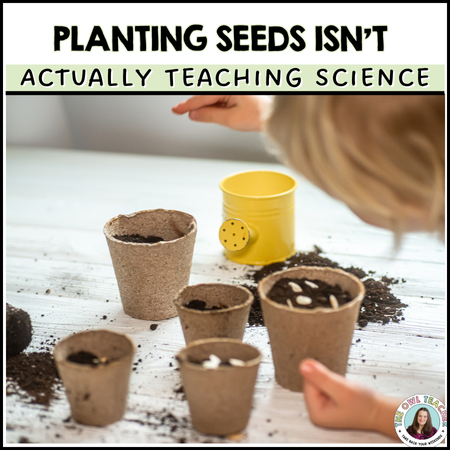
Planting seeds in cups with soil, watering them daily, watching them grow, measuring height weekly, it’s a classic for a reason. It’s hands-on. It’s tangible. Kids love it.
But here’s the uncomfortable truth: traditional seed planting is low-rigor science.
Why Traditional Seed Planting Doesn’t Work
- Low cognitive demand: Fill the cup with dirt. Place the seed in the soil. Add water. Wait. There’s zero decision-making. No problem-solving. No hypothesis testing. Students are following a recipe rather than thinking scientifically.
- Little student ownership: Everyone does the same exact thing the same exact way. No choices. No intellectual investment. No differentiation. Just following instructions.
- Observation without purpose: Sure, students observe plants growing. But to what end? “Watch what happens” isn’t a scientific question. It’s passive observation.
Research on inquiry-based science is clear: purposeful observation develops scientific reasoning. Observation without purpose is just watching things happen.
Minimal data collection: Most seed planting activities involve recording height once per week in a chart. That’s not data analysis. That’s filling in the gaps.
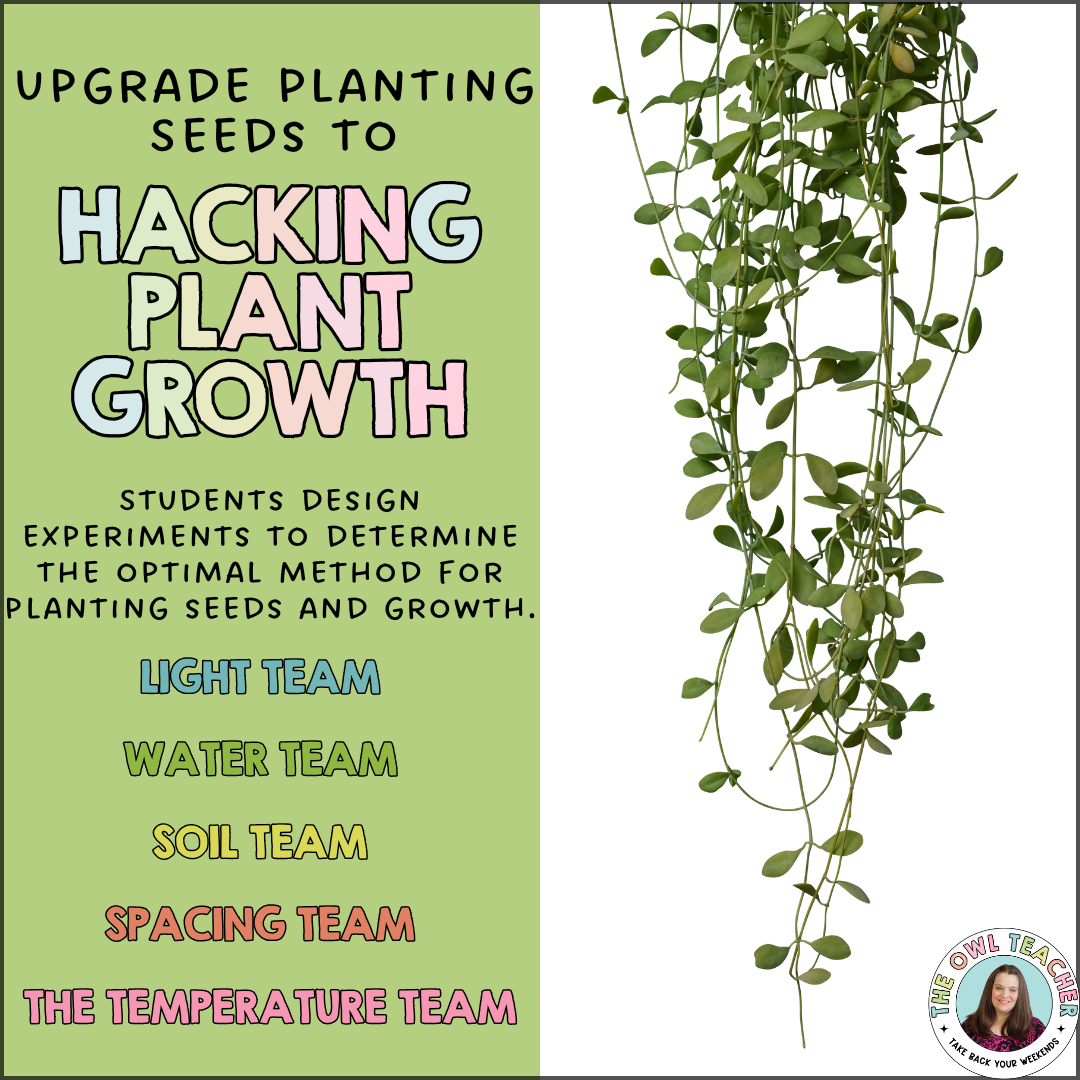
The Upgrade: “Hacking Plant Growth”
Here’s how to keep all the fun of planting seeds while making it more scientifically sound:
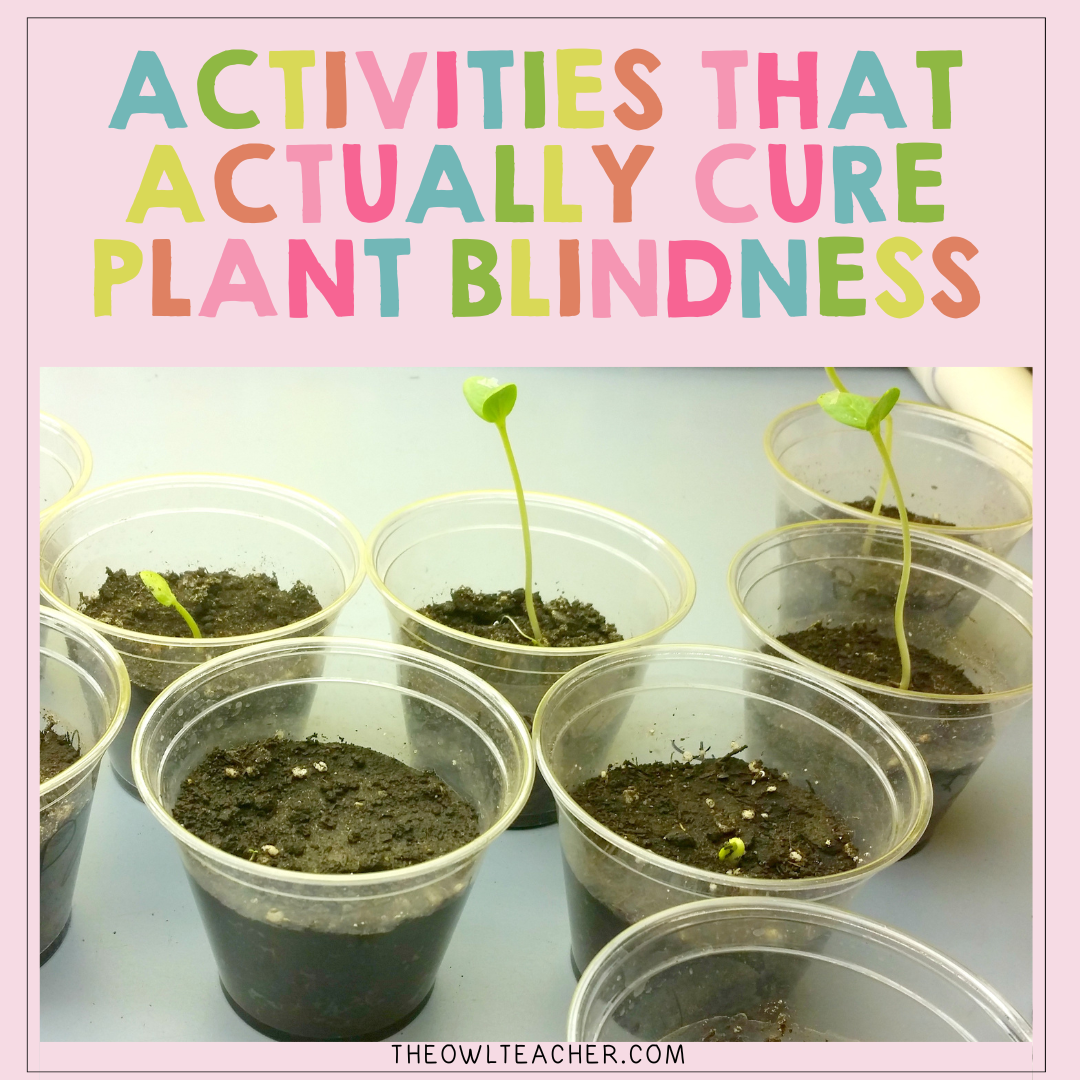
Students design experiments to determine the optimal method for planting seeds so that they grow optimally. Each group tests just one thing:
The Different Things:
- Light Team: Tries out different kinds of light, like full sun, partial shade, and complete darkness.
- Water Team: Tries out different watering schedules, like every day vs. every other day vs. twice weekly vs. weekly)
- Soil Team: Tests different growing mediums (potting soil vs. sand vs. clay vs. gravel vs. compost)
- Spacing Team: Checks how many seeds can be planted in a cup (1, 3, or 6) and how close together they can be.
- The Temperature Team tests different temperature conditions, like warm, room temperature, and cold.
This one change makes everything different:
- Built-in differentiation: Teams naturally form based on individuals’ readiness. It’s easier to test light conditions than it is to test soil chemistry. Students can choose for themselves based on their interests and confidence levels. In this case, students with varying skills are grouped.
- Important data collection: Now that students are measuring plant height and recording their observations, they are doing so to answer their experimental question. They’re not just writing on a chart; they’re getting proof.
- Students are conducting real scientific research when they vary one variable while keeping the others constant, collect data systematically, draw conclusions from the evidence, and present arguments grounded in the data.
- Students make data tables, graphs, and averages. Then they assess how well they did by comparing their results with those of other teams. Math happens naturally because you need it to understand the results.
- Argument based on proof: Teams present their findings at the end: “According to our data, plants grow best when…” Other students ask questions, challenge conclusions, identify problems with the methods used, and seek patterns in the data from all the teams. Actual scientific discussion at its finest!
You Don’t Have to Change Everything Tomorrow
Feeling overwhelmed by all this? Don’t be. You don’t need to overhaul your entire plant unit next week. Start with one change. Just one.
If plant blindness hits home: Add the five-minute “draw a nature scene” diagnostic to your next plant unit. See what you discover. Then add one “plant superpower” lesson showing plant movement or communication.
If time is your primary concern, consider the Plant Autopsy Investigation instead of your usual structure/function lessons. See if one rich activity replaces multiple worksheet-based lessons.
If student engagement is the problem: Flip your sequence. Begin with “How do desert plants survive?” rather than “Label the plant parts.”
If you love seed planting, keep it. Transform it into the Plant Growth Hacking version, in which students design experiments.
If you need a quick win: Show a two-minute time-lapse video of plant growth at the start of every plant lesson. Costs nothing, takes minimal time, and consistently addresses plant blindness.
- Video on vines climbing
- Video on gravitrophism
- Video on Mimosa Pudica Plant folding leaves
- Video on a Venus Fly Trap (though I couldn’t find any that spit it out after)
- Video of the Sundew plant growing and eating
- Video of the Rose Jericho/Resurrection plant
Small, strategic changes compound over time. You don’t need to be perfect. You just need to be intentional about what research says works.
Why This Really Matters (Reasons Why Your Plant Unit Isn’t Working)
Look, plant education isn’t just about helping kids pass a science test. It’s about helping them understand the living world they’re part of.
Plants produce the oxygen we breathe. They’re the foundation of every food chain on Earth. They prevent soil erosion, filter water, moderate the climate, provide habitats, and offer medicine. Understanding plants is essential for environmental literacy and scientific thinking.
But none of that matters if students finish elementary school still thinking plants are basically green furniture.
When we address plant blindness, when we help students genuinely believe plants are living things, when we teach about plants in ways that stick, we’re doing more than teaching science standards. We’re helping students develop scientific thinking that’ll serve them for life.
And honestly? Once you’ve experienced a classroom of fifth graders genuinely arguing about whether plants can “warn” each other about predators, or intensely debating whether their data proves plants need more or less light, or absolutely mesmerized by Venus flytraps catching prey…
You can’t go back to worksheets about labeling plant parts.
The engagement is real. The learning is deeper. Students remember what they discovered weeks and months later.
That’s what makes it worth changing how we’ve always done things.