







Ecosystems are all around us… Literally.
Okay, sorry. That was kind of cheesy. Regardless, I’m being honest: ecosystems are what make the world go ’round, and it’s vital that your upper elementary science students develop a thorough understanding of ecosystems as a whole.
As with anything, however, to create a whole you must first fit the individual pieces together. For students who are just starting out with ecosystems, it may seem like a tall order to tackle all the unique biomes and structures at once; that’s why it’s time to break it down!
… No, not like, breakdancing. I mean break ecosystems down into smaller, more easily digested pieces that won’t overwhelm your kiddos. Each student will get a unique piece of the puzzle, and once they’ve become mini masters, they’ll collaborate to build the picture together.
I’m waxing poetic, so let me put it simply: this ecosystems collaboration project invites students to create a hands-on structure for a specific animal that resides within their assigned ecosystem. Students will need to embark on a journey of collaboration (fun!) and research (not as fun) in order to flesh out their group’s assigned ecosystem before presenting their information to the rest of the class.
Ready to get started? Let’s dive into exploring ecosystems!
Ecosystems Collaboration Project
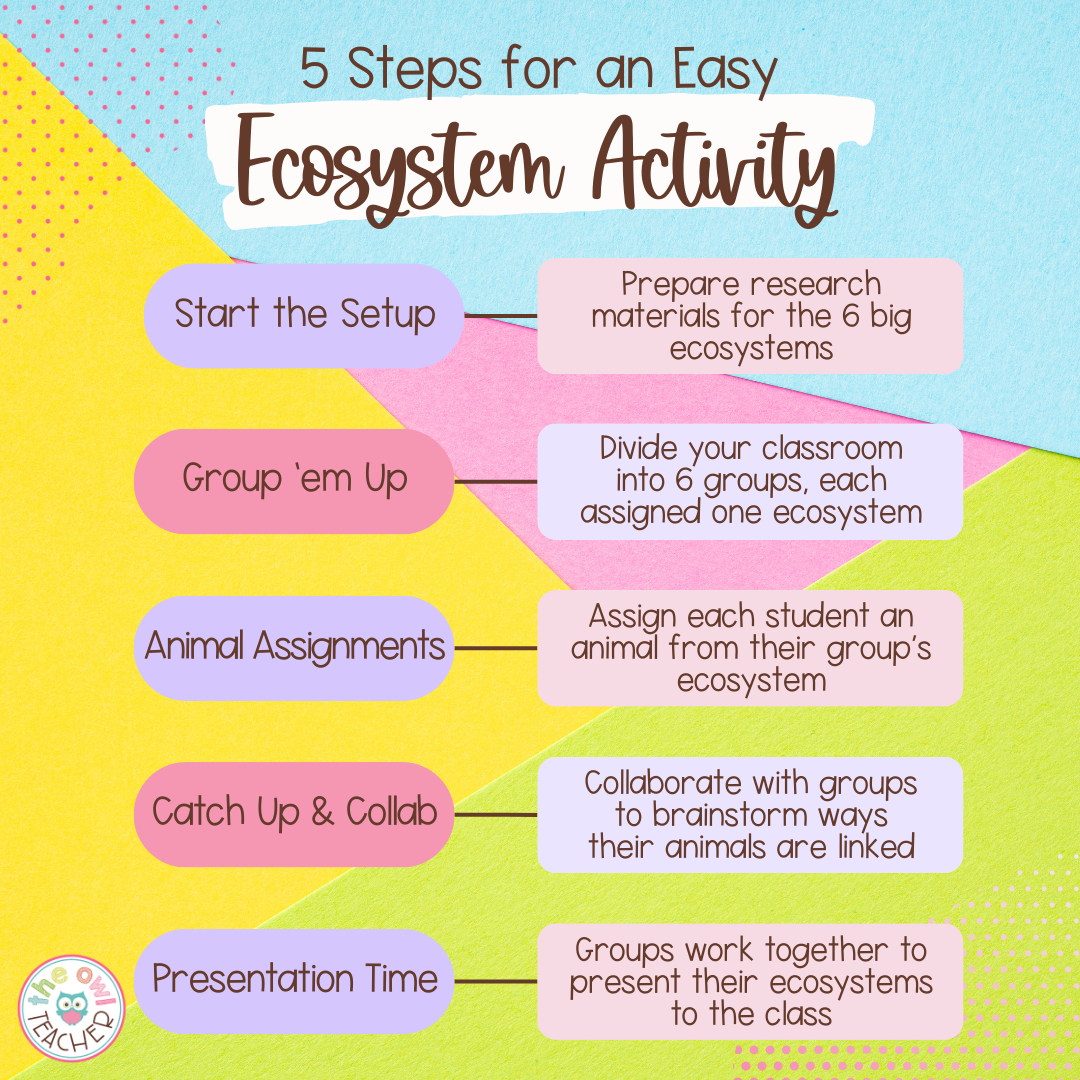
Step 1: Start the Setup!
To really make this collaborative ecosystems activity work, there are a few things (but only a few!) you’ll need to prepare ahead of time. For instance, if your students have a hard time coming up with materials, you may have to provide those resources as well as dedicating a portion of class time to working on their projects.
Some materials you may want to provide are cardboard (boxes or pieces), popsicle sticks, pipe cleaners, glue, markers, construction paper, or anything else you can think of that your kiddos could use to create unique habitats. You want to let their creativity run free, after all!
In addition, students should have access to a plethora of research materials related to their ecosystem. For reference, we’ll be focusing on forest, grassland, desert, tundra, freshwater, and marine ecosystems. The type of research materials you provide are totally up to you, but I like to mix in online resources, too. Never pass up an opportunity to work on those technology skills!
Step 2: Group ’em Up
It’s time to kick things off! Once you’ve given students an idea of the project at hand, divide your classroom up into groups of four to five students, making sure your kiddos are grouped up in a way that will optimize collaboration–after all, that’s what this project is all about, right? Well, ecosystems too, I guess. 😉
You know your classroom best, so it’s your choice on how you want the groups to play out. I recommend four to five students: it’s enough unique minds to come up with fresh, creative ideas, while it’s also not a huge group that will devolve into a social party! Using an appropriately-sized group will ensure effective collaboration as well as ample participation from each kiddo.
Once your students are grouped up, assign one ecosystem to each group from the main six: forests, grassland, deserts, tundra, freshwater, and marine. Groups should also receive their basic information about their assigned ecosystem at this time; or, if you’d prefer, you can task the group with doing research on their ecosystems together!
Either way, once your groups have a feel for their ecosystems, it’s time to move on to the main event: the animal assignments!
Step 3: Animal Assignments
Next, within each group, every student will either choose or be assigned (it’s up to you!) a unique animal that makes its home within their group’s ecosystem. For instance, a student in the grasslands group may choose a zebra, while a student in the freshwater group may opt for an alligator. Ultimately, kiddos will be given the opportunity to research the specific habitat, behavior, and needs of their assigned animal in order to… Drum roll, please… Design their very own structure for that animal!
When explaining the task to students, make sure to place an emphasis on creativity and critical thinking when they design their animal structures. There are plenty of factors to consider, like protection, common shelters, nesting, food storage, and so on. If their animal raises its young for some time after birth, then their structure should be big enough to raise a family in! However, if their animal lays eggs but otherwise doesn’t necessarily rear its offspring, then maybe their structure only needs to include a cozy nest for the eggs to hatch. The sky’s the limit!
In addition to creating these physical structures for their animals, students should also be tasked with completing a written portion–it wouldn’t be an assignment without some writing, right?! Their writing should include a brief summary of how their animal relies on their ecosystem, how the animal provides for their ecosystem, and how the animal interacts with other organisms in its ecosystem.
There are plenty of critical thinking opportunities here, too; for instance, you can ask open-ended questions, such as how they think the ecosystem would be affected if their animal disappeared. Questions like these are also a great way to build awareness about endangered species.
Ultimately, the written portion of your kiddos’ projects should serve as an explanation of their animal’s place in their ecosystem. As an added bonus, it also doubles as a way for you to check for understanding of ecosystem dynamics as well as animal adaptations! It’s like an informal assessment, but slightly more… Formal!
Step 4: Catch Up & Collab!
At the end of the allotted time, such as the end of the week, students should reconvene with their ecosystem groups. Their goal this time around is to brainstorm ways that their animals interact, how they affect one another, and how they rely on one another. Their individual animals all fit together like a puzzle that creates the ecosystem as a whole!
Here, the goal is for students to develop a thorough understanding of how their species come together to create a cohesive ecosystem. Some animals may scavenge, while others are prey animals that allow larger creatures to survive. It’s important that every student gets the chance to share about their animal within their groups, so that every creature has a chance to contribute to the ecosystem.
Step 5. Presentation Time
To wrap up the animal structure projects, it’s time for every student’s favorite part: presentations!
… Yeah, I can hear the groans. Apparently, presentations are more nerve-wracking than exciting… Who knew? 😉
Regardless, it must be done. Each group should prepare to present their ecosystems to the class, sharing an overview of their ecosystem as well as highlighting each student’s animal, the created structure, and its role within the ecosystem. Keep in mind, though, that these highlights should be brief; otherwise, you may have to clear the rest of the day’s schedule!
Some key points for each group to cover are the ecosystems’ unique characteristics, such as minimal rainfall for a desert, what makes their ecosystem thrive, and how its diverse array of animals rely on the ecosystem as well as contribute to it.
After the presentations, if you’re looking for a way to check for understanding, pop over to my Relationships in Ecosystems Science Vocabulary Games set. There are plenty of engaging, educational games in the set—your students are bound to find something they enjoy, while you gain the benefit of assessing kiddos’ understanding. In addition, it’s an easy way to free up time so you can meet with any students who may need a bit of support!
When you integrate animals and their unique structures into ecosystem lessons, you enrich students’ understanding of ecology, biodiversity, and the relationships between animals and their environments. It allows students to form a bigger picture of ecosystems as a whole, shaped by the impacts of its inhabitants.
In addition, when students are encouraged to learn about specific animals and their niche, it helps hit home just how important it is to keep these creatures and their environments safe from harm. After all, a puzzle needs every piece to be a complete, working picture!
Besides, giving your kiddos a bit of (productive) social time is always a win!
If your time is limited, however, you may want to consider creating an integrated curriculum: sprinkle some math into your science block, such as with my Ecosystem Area & Perimeter PBL activity. It’s a hands-on, engaging activity that walks students through creating their own zoo, from researching unique animals to building their enclosures.
What are your favorite ways to explore ecosystems with your students? Let me know in the comments! Oh, and don’t forget to stop by my home page and sign up for my email list while you’re here.
Thanks for reading!
For even more ecosystem project ideas — from PBL to foldables to scavenger hunts — check out my full list of 10 ecosystem activities.
Want even more hands-on ecosystem work? Check out these 8 food chain and food web activities for upper elementary.