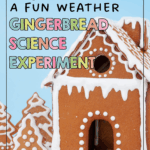










Picture a fourth grader standing in front of her gingerbread house, one hand holding a spray bottle and the other hand carrying a page of data. She is explaining to her partner why she believes the roof would remain upright more effectively at a 45-degree angle than at an alternative angle for her assigned region. She is working on a gingerbread science experiment that she will remember for months to come.

This gingerbread science experiment is fantastic because it converts something kids already adore (gingerbread houses) into a weather activity that is genuine science. The kid who typically doesn’t pay attention in class is suddenly very interested in science. The group that hurries through everything spends an extra twenty minutes constructing their gingerbread houses more strongly so they won’t break in the artificial wind. Yes, this gingerbread science experiment is a keeper!
A Weather Activity with Gingerbread Houses – But Why!?
Do not think of this as merely another cute weather activity; instead, it is a real-world activity with a hint of imagination. Not only do we read about and watch weather patterns on TV, but we can also witness how they change the structures and ecosystems around us every day.
It’s significant how fast the wind is blowing. Rain can make things less stable. Things act differently when the temperature changes. These aren’t just things to memorize for a test; we can see, measure, and understand them using their gingerbread through this gingerbread science experiment.
When you educate upper elementary students about weather and climate, you want them to learn how diverse systems operate together, how temperature affects how rain falls, how wind makes buildings weaker, and how humidity affects material behavior. These links are crucial.
Gingerbread science is an effective way for fourth- and fifth-graders to observe these connections in practice. They’re not just passively soaking up information; they’re actively testing different things and drawing inferences from what they observe in their gingerbread science experiments. And there’s frosting, which is always a wonderful thing when you’re working with kids this age.
Getting Started with Your Gingerbread Science Experiment
The good news is that you won’t have to spend much money or plan for a long time for this activity. Most effective implementations keep things simple, which is good because December is already a busy month.
Materials Needed:
- Kits for creating gingerbread houses (or graham crackers with royal icing if you don’t want to spend as much)
- Spray bottles filled with water (to seem like rain)
- Small fans or fans you hold in your palm that blow air
- Ice cubes in Ziplock bags to indicate how cold it is
- Hair dryers or heat lights on low to demonstrate warmth
- Cleaning items like paper towels (you will need these for sure)
- Sheets for keeping track of weather information
You can find most of this stuff at dollar stores. You should purchase many gingerbread kits after Thanksgiving if you want to be prepared. For extra prep, purchase after Christmas for a discounted price.
Let’s get to the point: this gingerbread science experiment activity does become dirty.
But the messy type is what helps. The kind where youngsters in upper elementary school are so busy trying out new ideas and writing down what they see that they don’t mind doing their work.
The Science Foundation
There needs to be some groundwork done before any building can start. Even though it does seem enjoyable, this isn’t a free-for-all with frosting.
First, talk about how the weather impacts buildings in real life. Use examples that fourth and fifth graders can see in their heads, like severe winds that can destroy buildings, snow that builds up on rooftops, and extreme heat that can break down building materials. Focus on the winter weather as part of your December classroom activities.
What happens to buildings when winds get strong enough to be a hurricane? What do engineers do to stop these forces? For example, we use metal straps that keep roofs in place and shingles. Some windows are made from materials that don’t break when something hits them. It is substantive information that upper elementary school students can use in their designs and understand.
- Explain how heavy snow gets when it accumulates on roofs (what engineers call “live load”). Talk about how vital it is to design a roof. When roofs aren’t built well, they fall. That’s all there is to it.
- Effects of Extreme Heat: As temperatures rise, materials stretch, fatigue, and lose strength. What does that look like in the actual world? What do engineers do to make up for this?
- Have you ever wondered why roads have potholes every spring? It’s due to the damage caused by freezing and thawing. Water enters tiny crevices, freezes, and expands, which rips things apart from the inside. This rule also applies to the bottoms of buildings.
- Next, ask this question: “What would you think about if you were building a house that had to stand up to all kinds of weather?”

The answers might surprise you. Some students remark that houses in Florida don’t usually have basements because of hurricanes. Some individuals say that rooftops on buildings in snowy areas are pretty steep. These links are helpful because they translate abstract thoughts about the weather into concrete terms.
After you have the basics down, add the weather variables that will be tested:
- Rain (made to look like rain with spray bottles)
- Wind (fans that spin at varying speeds)
- Very hot and freezing temperatures (heat and ice)
- Humidity, which comes when heat and moisture mix
Students should make guesses about what will happen in each situation before the test starts. It is very crucial. The task should be similar to what genuine meteorologists and structural engineers do: making informed estimates and systematically testing them.
The Climate Zone Challenge: Building Phase
It is when things start to get fun. Students work in pairs or small groups to construct their gingerbread houses that are strong enough to withstand the weather. But here’s the tricky part: each group has to plan for a separate “climate zone.”
Setting up climatic zones:
- Arctic climate: requires the ability to withstand severe cold and high winds
- Tropical climate: must be able to tolerate a lot of rain and very hot weather
- Desert climate: Temperatures can vary considerably between day and night
- Must be able to manage weather that is moderate yet quite changing.
This practical approach to learning about climate zones and weather patterns is superior to reading a book alone. When a kid knows that their “tropical house” needs more icing to stay up in all that rain, they are learning about both engineering and how to deal with diverse weather.
Give each group 30 to 45 minutes to assemble. For extra fun, play festive music in the background. Let them work together to solve challenges. The method is as crucial as the outcome in this activity.
And yes, part of the icing will be eaten. That will happen. As long as the house gets built, everything is good.
If you also teach ecosystems, try pairing your weather unit with these 10 ecosystem projects.
Testing Phase: When the Weather Gets Real
That is where the authentic learning happens. Each group presents its gingerbread house and explains the design choices it made based on the assigned climatic zone. Then the testing begins.
Testing for rain:
Use spray bottles to simulate pouring. Start slowly and gradually increase intensity. Students should look at and write down:
- How does water change how strong structures are?
- Does the frosting remain on, or does it begin to melt?
- Do some roof angles help water flow off better?
- What happens to the building’s different elements when it rains?
Groups intentionally constructing houses with steep roofs to allow rain to run off should be asked to explain why water collects on flat-roofed houses, whereas their roofs remain relatively dry. That’s the thinking we want them to do.
Checking the wind:
Start the fans at low speed, then increase the speed. Students should keep in mind:
- Which walls are the most fragile?
- Does the house stay in the same place or move?
- Is the wind causing any structural problems?
- How does the direction of the wind affect how stable everything is?
It’s also a good time to discuss how severe weather affects different kinds of buildings and why building codes are so important in places that are likely to get hurricanes.
Checking the temperature:
Use ice packs to cool and heat lamps or hair dryers to warm up. Check out what happens to:
- The icing: does it freeze or melt?
- The gingerbread: Does it get hard or soft?
- The overall structure (do temperature changes make things move?)
Students often observe that cold makes some houses more stable because ice hardens significantly. But when you add heat, everything breaks down. It leads to many interesting conversations on freeze-thaw cycles and why roads develop potholes every winter.
Gathering Information: Making It Matter (Using gingerbread to learn about how the weather works)
During all of this testing, students need to systematically record their observations. It works well with a basic data sheet.
This paperwork changes the activity from “that fun thing we did with gingerbread” into a serious scientific study. Additionally, it confirms the assessment that extends beyond participation scores.
Students can also record their tests with images or videos. If you have access to technology, they may even produce short video reports on what they found and what they thought.

The Debrief: Connecting to Real Science
Get everyone together for a debrief when all the testing is complete, and the cleanup is (hopefully) done.
You could ask the following questions:
- What form of weather did the most damage to your building?
- What would you do differently if you could rebuild your house?
- How can real buildings keep this kind of weather from coming in?
- Why do buildings need to be built differently in different climates?
It is where students learn to connect their work to genuine scientific requirements. They’ve observed firsthand how the weather affects structures, so they’re not merely memorizing statistics about how it works.
Students are discovering connections, such as finally understanding why their cousin’s house in Arizona looks so different from those in Michigan. That’s the kind of real-world use that lingers long after the testing is complete.
Choices for Extensions
If your upper elementary students are genuinely interested in this (and they will be), here are some strategies to help them learn more:
For a research assignment, have your students examine buildings designed for specific climatic conditions. For example, the Burj Khalifa in Dubai must contend with unusually high temperatures and sandstorms that occur from time to time. Which parts of the design help it remain viable under these conditions?
- Writing connection: Students could write essays on how the weather affects the construction of structures in different regions of the world. It aligns well with ELA standards when connecting multiple subjects.
- Math extension: Determine the optimal ratio of frosting to gingerbread to maximize stability. You can use an anemometer or an estimate to determine wind speed. Create a graph of data on structural failures across different situations. Several mathematical connections may arise from this practice.
- Engineering challenge: Tell the children to remodel their dwellings so that they can better handle the weather after witnessing what didn’t work. Give them some fake money and let them know how much different building materials cost (additional icing, graham cracker reinforcements, etc.).
Why This Works (Using gingerbread to learn about how the weather works)
This activity won’t work correctly in every classroom. It’s a big mess. It takes some time. Some youngsters will always get more icing on themselves than on their houses. That’s just the way things are.
But this is why teachers keep going back to it:
- It stays with you. When you ask previous students what they recall from science class in fourth or fifth grade, they will always say stuff like this. They may not remember every word, but they do retain the ideas they gained via testing.
- It’s pretty hands-on. We often say that learning by doing is crucial, but how do we actually do it? That’s not as simple as it seems. It is a method of learning by doing.
- In science, we want students to vary variables, observe the results, and draw conclusions.

- It facilitates collaboration. When your structure is actually falling apart, working together to solve problems teaches you how to be strong, how to talk to people, and how to function as a team. Also, it’s gratifying and enjoyable to see upper elementary school students handle problems while they’re under considerable stress.
- It has something to do with the real world. When children witness how the weather changes everything, even stupid gingerbread houses, they start to see how it changes everything around them. That’s the kind of scientific reasoning that kids this age should learn.
- It works with the energy of December. This activity doesn’t go against the fun of the holidays; it uses it in a good way. Kids may learn real science and have fun at the same time. That’s as good as it gets for both sides.
Things to think about when you do this (Using gingerbread to learn about how the weather works)
When teachers think about this practice, they often worry about:
- Need more room? Testing can occur in groups on different days, or it can shift to larger areas such as gyms or cafeterias during the testing phase. Some teachers even set up stations outside when the weather is nice (and everyone knows how hilarious it is to undertake weather experiments outside).
- Not enough time? Have the kids create the houses at home with their parents’ aid and then bring them in to be tested. You may also use existing houses and focus solely on testing.
- Are you short on cash? Graham crackers work just as well as gingerbread kits for the real science. The test results are the same, and it’s a lot less expensive. Parents can also donate funds, and most teachers have no difficulty obtaining supplies when they request them for science classes.
- Cleaning up messes? Plastic tablecloths, paper towels, and students responsible for cleaning up make a significant difference. Placing this immediately before a break also allows pupils time to clean up well before they return.
- Are you concerned about ensuring everything is up to code? This gingerbread science experiment encompasses multiple areas, including weather patterns, climate zones, engineering design, scientific inquiry, and more. The science is solid, but the manner in which it’s presented is more engaging than ordinary worksheets.
Ultimately, the cleanup was worthwhile.
When you teach in December, you must address some unusual issues. Kids in upper elementary school are hyper, full of energy, and want to make it to the next break. At this time of year, regular review activities don’t always work.
But things like this, a gingerbread science experiment, weather activity? They work. They make kids who might not be paying attention pay attention. They help you understand and make sense of ideas that aren’t very clear. They help children retain information over time by encoding it.
It’s also highly significant to see a student’s face light up when they figure out why their house fell in the “wind” but stayed up in the “rain.” That moment of actual understanding, that “aha!” when the science suddenly makes sense, makes all the preparation and cleanup worthwhile.
The classroom might smell like gingerbread for a few days after that. There will undoubtedly be frosting in places you don’t expect it to be. Some houses will fall dramatically, which is the most effective way to learn.
But when a student sees hurricane shutters on their grandma’s house in Florida during winter break, or asks insightful questions about why Michigan buildings have steep roofs to protect snow from piling up. That’s when you know it worked.
At that point, all the cleaning work was worthwhile.