









The last December I taught, I did something I’m not proud of. I pulled up a worksheet of word problems right before lunch, and my usually enthusiastic fifth graders just… died inside. You know that look, the one where their eyes glaze over and suddenly three kids need to use the bathroom?
Yeah. That happened.
Holiday word problems that actually make sense in December feel like an uphill battle. The room smells like peppermint, construction paper snowflakes are everywhere, and my kids were mentally on winter break. But I kept trying to push through with problems about buses and pencil boxes from our textbook, knowing why everyone was miserable.
Then something clicked, changing my entire approach.
The Thing Nobody Tells You About Holiday Word Problems That Actually Make Sense in December Math
Most of us have been in this exact situation. It’s mid-December, curriculum goals are breathing down our necks, and we clearly know it’s time to teach “multi-step multiplication word problems.” So we do what we’ve always done, pull out the textbook with its generic scenarios.
Meanwhile, our students are physically in our classroom but mentally building snowmen.
I’ve tried everything. “Math doesn’t take a vacation!” I’d announce, cringing even as the words left my mouth. I thought that if I could make them focus harder, it would work.
One year, out of pure desperation, I rewrote a problem. Instead of the usual “The store has 24 boxes with 8 apples in each box,” I changed it to “Mrs. Anderson needs to wrap 24 gift boxes, and each box needs 8 feet of ribbon.”
My struggling math student, the one who usually shuts down during word problems, raised his hand. “Oh! My mom does this every year. She always runs out of ribbon and has to go back to the store.”
That’s the moment I got it. December wasn’t the problem. My word problems weren’t speaking their language.
What Gets Students Actually Engaged
Real engagement happens when kids see themselves in the problem. Think about what’s actually consuming their brain space right now: the cookies they helped bake last weekend, counting down gifts, that whole Elf on the Shelf situation at home, and whether it’ll snow before break.
When you frame multiplication word problems around things like gift wrapping or figuring out how many candy canes fit in stockings, something shifts. Students don’t have to work as hard to picture it because they’ve lived it.
I tested this theory with a cookie problem: “The fifth grade is making cookies for the school bake sale. Each batch makes 18 cookies, and they need to make six batches. If they want to package them in boxes of 12, how many boxes will they need?”
My kids jumped on it. Why? Because half of them had literally just done this at home. They understood batches. They’d seen their parents dividing cookies into containers. The math stopped being some abstract thing and became a situation they could actually picture.
This is what researchers call “contextual math problems,” word problems that connect to students’ real experiences. When students relate the scenario to their own lives, they’re not just solving numbers; they’re engaging with their own lives. They’re solving situations they understand.
But Here’s the Catch
Not all holiday problems work the same way. Trust me, I’ve created some absolute duds.
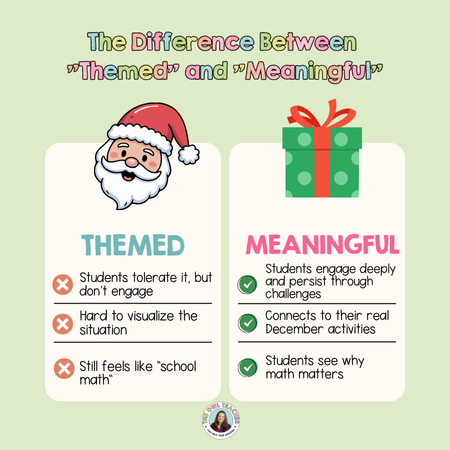
I’ve seen plenty of “holiday” word problems that slap the word “Santa” onto a regular problem. “Santa has 42 presents…” Sure, it’s festive. Does it actually engage students more? Not really.
The holiday word problems that actually work do three specific things:
They use scenarios kids have experienced or can easily imagine. Wrapping presents? Yes. Santa’s workshop inventory management system? Not so much.
They don’t sacrifice the actual math for cuteness. You’re still teaching multi-step problem solving, still requiring students to identify operations and show their work. You’re just doing it with context that makes sense to them right now, in this moment.
They build on each other. Start with simpler holiday scenarios to hook them in, then add layers. “If one roll of wrapping paper covers eight presents, how many rolls do you need for 35 presents?” Then extend it: “Each roll costs $4.50. What’s your total cost? You have a $25 budget. How much will be left over?”
Students push through challenging multi-step problems when the context matters. Research shows that students who can visualize problems through relevant contexts develop significantly stronger problem-solving skills than those working with abstract scenarios. (based on Edweek)
What Makes a Word Problem Actually Work
I’ve tested hundreds of word problems over the years. The ones that work, the ones students engage with even in December, have some things in common.
First, they tell a story students care about. Not just any story. A story that feels real and relevant right now, in their lives.
Second, they require more than one operation. Real life is messy. Figuring out holiday shopping budgets isn’t just multiplication; it’s multiplication, then addition, then maybe subtraction when you realize you’re over budget. (Ask me how I know.) Multi-step problems teach students to break down complex situations, and holiday contexts make that process feel more natural.
Third, they include the right amount of information. Not so little that students feel lost, but not so much that they can solve it by randomly picking numbers. Students should be able to identify what information actually matters.
My favorite problems leave room for different problem-solving strategies. Maybe one student draws out the cookie batches, another uses repeated addition, and a third goes straight to multiplication. All valid approaches, all building mathematical reasoning.
Teaching students multiple strategies, like part-part-whole diagrams and visual representations, helps them tackle different types of word problems with confidence. (Check Teaching with Kylee B highlight)
Pictures Make Everything Better
Holiday word problems work even better when you give students concrete ways to visualize them. I’m not talking about fancy manipulatives or expensive materials. Sometimes it’s as simple as having students draw out the problem.
For a problem about decorating cookies, I had students actually sketch the cookies and show how they’d divide frosting colors among them. Suddenly, a division problem became something they could see and almost touch. (They definitely wanted real cookies.)
Teaching students to represent word problems visually before diving into calculations isn’t a crutch; it’s a powerful tool. Draw the presents. Sketch the cookie batches. Map out the classroom party tables. These visual representations help students understand the mathematical relationships at play.
I also love “interactive word problems” where students physically manipulate pieces. I’ll have students cut out images of ornaments or candy canes and physically move them around to solve problems. The tactile experience makes abstract concepts concrete. (Similar to Miss Giraffe’s cut-and-paste approach)
Real Examples That Worked in My Classroom
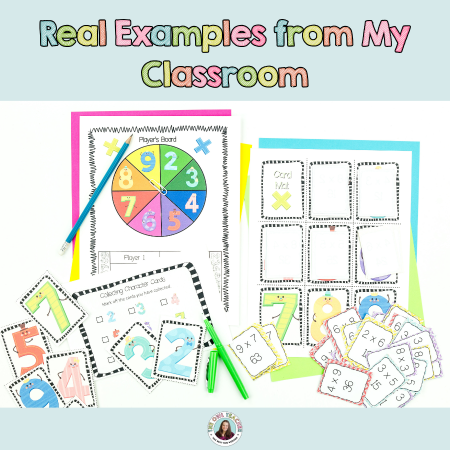
In my 5th Grade Multiplication & Division Math Workshop Bundle, I’ve included problems that actually work during the December craziness. Here’s one my students loved:
“The school is planning a holiday party. Each table seats eight students. One hundred fifty-six students are attending. How many tables are needed? Each table will get three candy canes per student. How many candy canes total?”
Students had to divide to find tables, round up (because you can’t have half a table, they always catch this!), multiply to find students per table, then multiply again for candy canes. It’s genuinely challenging. But they stuck with it because they could visualize setting up a party.
Another favorite: “You’re buying gifts for your family. Each gift bag costs $3. You need seven bags. Wrapping paper costs $5 per roll, and you’ll need two rolls. You have a $30 budget. Can you afford tissue paper that costs $4?”
This one hits different because students have watched their parents budget shop. They get why this matters. Suddenly, they’re performing multi-step operations without even realizing how complex they are.
Here’s one that sparked excellent discussions: “Each of 4 classes is making ornaments for the school tree. Each class makes 18 ornaments. The ornaments come in boxes of 6. How many boxes will all the classes fill?”
The conversations from this were gold. Students debated whether you’d have partial boxes, discussed remainders in authentic contexts, and argued about what would happen to leftover ornaments. That’s the kind of mathematical thinking I dream about.
Why This Works Better Than Generic Problems
There’s actual science behind why themed word problems work better in December. When students encounter familiar contexts, their brains don’t have to work as hard to decode the scenario. That mental energy gets redirected toward actual problem-solving.
Think about it. When you present a problem about train schedules or warehouse inventory, students first have to imagine a scenario they may have never experienced. That’s cognitive load before they even get to the math.
But holiday shopping? Baking cookies? Decorating a tree? They’ve done it. They’ve watched parents do it. They understand the basic framework without any mental gymnastics.
When students read about situations they recognize, counting candles, wrapping gifts, dividing treats, they’re not just solving. They’re connecting math to cultural moments they understand. (Mr. R’s World of Math demonstrates this perfectly with problems that tap into shared December experiences)
Not Everyone’s at the Same Level (And That’s Okay)
Not every student in your class is at the same level, and December is definitely not the time to pretend they are. The beauty of holiday word problems is how easily you can differentiate them.
For students who struggle, start with single-step problems using smaller numbers: “Each stocking needs four candy canes. How many candy canes for five stockings?”
For your middle group, add complexity: “You have six stockings. Each needs four candy canes and three small toys. How many items total?”
For advanced students, throw in multiple steps and decision-making: “You have 40 small toys and 24 candy canes to divide equally among six stockings. How many items are in each stocking? If you need at least eight items per stocking, do you have enough?”
Same theme, same holiday spirit, but differentiated to meet students exactly where they are. And because everyone’s working on “stocking problems,” nobody feels singled out.
You Don’t Have to Overhaul Everything
You don’t need to reinvent your entire curriculum to make this work. I started small by replacing just one word problem per day with a holiday version. That’s it.
During morning work, instead of the textbook warm-up, I’d project a quick holiday word problem. “The cafeteria is serving hot cocoa today. Each cup needs three marshmallows. They served 47 cups. How many marshmallows?”
Boom. Students are awake, engaged, and solving, all before 8:30 AM.
I also loved using holiday word problems as problem-of-the-day challenges. Post one problem on Monday morning. Students work on it during transitions, free time, or as a fast finisher activity. Friday, we share strategies. It becomes a week-long investigation instead of a one-and-done worksheet.
Some teachers in my building even created holiday word problem scavenger hunts. They posted problems around the room, each with a piece of a bigger puzzle. Students solved problems at different stations and collected clues to reveal a final answer (usually something like “Hot chocolate party on Friday!”).
The Vocabulary Thing Nobody Mentions
Here’s something that surprised me: holiday word problems actually helped my English learners and struggling readers more than generic problems did.
Why? Because holiday vocabulary is everywhere in December. They’re hearing these words, ornaments, wrapping, baking, decorating, in conversations, on TV, in stores, and at home. The context clues are built in.
When I used a problem about “distributing pencils equally among six boxes,” my ELs got stuck on “distributing.” But when I used “putting ornaments equally on 6 trees,” they got it immediately because they’d seen ornaments distributed among the trees.
This doesn’t mean dumbing down the math or avoiding essential vocabulary. It means meeting students where they are in their current language experience and building from there.
When Things Don’t Work (It Happens)
Real talk: not every holiday word problem lands. I’ve had some spectacular flops.
Like the year I created this elaborate problem about calculating the exact gift wrap needed for irregularly shaped presents using surface area. My fifth graders looked at me like I’d completely lost it. Too complicated. Too disconnected from their experience. (Kids don’t calculate surface area when wrapping; they use way too much paper and tape.)
Or the time I tried to incorporate every possible December holiday into one word problem. It became this confusing mess about Hanukkah gelt, Christmas cookies, Kwanzaa candles, and… nobody could follow it.
What I learned: keep it simple and authentic. If you wouldn’t actually do this calculation in real life, your students probably won’t connect with it either.
Also, read your room. If your students don’t celebrate December holidays or if it’s a sensitive topic in your community, pivot to winter themes instead. Snowflakes, hot chocolate, winter sports, or even “end of year celebrations” work just as well.
Why This Actually Matters
When students zone out with word problems in December, it’s not because they suddenly forgot how to multiply. It’s because we’re asking them to care about situations that feel disconnected from their actual lives.
Holiday word problems work because they meet students where they are, literally in the season they’re living. They work because students don’t have to do the exhausting mental work of “translating” an irrelevant scenario into something they can visualize. The visualization is already there.
And here’s the bonus: when students engage with word problems in December, they’re actually building stronger problem-solving skills than they would with generic problems. Because they’re not just memorizing steps, they’re genuinely reasoning through real situations.
Research backs this up. When students solve problems rooted in familiar contexts, they develop deeper conceptual understanding and can transfer those skills to new situations more effectively.
Start Small
You don’t need to reinvent your entire curriculum. Take one word problem from your lesson this week and rewrite it with a holiday context. Instead of “The farmer has…” try “Your family is preparing…” Instead of “The factory produces…” try “The bakery makes…”
Watch what happens. Watch how many more hands go up. Watch how students who usually struggle suddenly have an entry point. Watch how your “I don’t get it” kids start explaining their thinking because they actually see the problem.
Because at the end of the day, math isn’t just about numbers. It’s about making sense of the world. And right now, your students’ world is full of wrapped presents, cookie batches, and candy canes.
Why wouldn’t we use that?
Want to grab ready-made holiday word problems that actually work? Check out my 5th Grade Multiplication & Division Math Workshop Bundle. It’s got everything you need to make December math meaningful without the extra planning stress, including problem-solving activities that keep students engaged even during the sugar-filled weeks.
And if you try rewriting even one problem with a holiday twist? Tell me how it goes. I’d bet money your students will surprise you.
The magic isn’t in the holiday theme itself. It’s in the recognition that our students are whole people living in a specific moment in time. When we honor that in our teaching, when we build bridges between what they’re learning and what they’re living, that’s when real learning happens.
Even in December. Especially in December.