












COPYRIGHT © 2016-2026. The Owl Teacher | Privacy page | Disclosure Page | Shipping | Returns/Refunds
I have a word problem for you: There was this girl who was given well over 100 math word problems in her lifetime. She learned zero strategies throughout elementary school, middle school, and high school. How many word problems did she solve? (I’m guessing none or close to none, too!)
When I was in elementary school, I wasn’t too bad at math. However, I do remember struggling really, really badly with word problems. I hated seeing them on worksheets or in textbooks. Whenever I would see them, I would not even bother to try. Instead, I’d just guess. That’s right. I’d write down a random number, hope my teacher didn’t call on me for anything related to it, and move on.
While teachers tried to teach me problem-solving strategies (and even some who know the secret to painless problem-solving in math), none were successful until I got into college. And I was given more than strategies to help me finally master them. Hopefully, these ideas and tips will help prevent someone else from sliding by unnoticed.
Why Word Problems Are Challenging
Word problems can be difficult for children for several reasons. First, the way word problems are written is completely different from the day-to-day things children are in contact with; The books they read, the videos they watch on YouTube, the way their friends talk to them, the music they listen to, and even you talking to them. So essentially, the word problem is talking to them in a bit of a foreign language and they aren’t sure what it’s asking. Even more so, most word problems looooooooovvvveeee to throw in extra information that has nothing to do with the problem. This confuses children because in their minds it would not have been said if it wasn’t important, right? The word problem doesn’t come straight out and say what operation they need to complete, and this becomes even more difficult when there are multiple steps! Lastly, let’s throw in that other stuff like fluency (both reading and math), critical thinking skills, and being able to relate to the problem. Whew! No wonder kids can resort to just randomly writing down any ole’ number.
Conquering the Word Problems
Alright, so obviously we can understand and relate to why children are not big fans of word problems, but we aren’t going to just give up are we? We can definitely learn the skills it takes to conquer them! Let’s consider some of these strategies to help them – and not in any particular order.
- Teach Word Problem Structure. I would begin with word problems that use basic math skills much lower than their level so that you can work on the “language of word problems.” Use these word problems to help familiarize students with its language and teach them what to look for. This is also the opportunity to teach children that word problems love to throw in extra information that is not important. I wouldn’t teach that they are “trying to trick” you, but help them understand that word problems require a different set of reading skills.
- Teach the Different Word Problem Types. While it may not seem like much of a big deal to us, helping students familiarize themselves with the different types of word problems can help them know how to approach and solve the problem. It will also help build their confidence in the future when they see them. This also helps students know which operation it is asking to do. Some types they may encounter are addition, subtraction, multiplication, division, comparisons, equal groups, fractions, time, and money problems.
- Encourage Sharing. When working on word problems, consider having students work collaboratively and share the strategies they used to solve the problem. It can be helpful to see how other students think and to learn from one another.
- Start Small and Work Your Way Up. When we learn any new math concept, we start small with manipulatives and small numbers and work to semi-concrete and then eventually to abstract. We can do this with word problems too. We can use basic operations, work into small numbers with basic operations but multiple steps, and then get a bit more complex. We can also pull out manipulatives and visual aids to help students move from concrete to eventually abstract. It’s similar to the “act it out” strategy.
- Teach the Problem-Solving Strategies. At some point, I was going to have to say it. If students have a “toolbox” of strategies to choose from it could be helpful later. However, it’s really important that students are understanding when they use these strategies.
- Provide Plenty of Practice. Unfortunately, students do not get enough practice when it comes to word problems. They rarely come across these types of problems except at the end of a worksheet or chapter. Students need to see them much more than this. It needs to feel as natural as breathing to them and the only way that will happen is if they do it almost as much as breathing! Ha!
- Scaffold. I have always been huge on scaffolding strategies and it’s a great way to help build a student’s confidence. You can break it down into smaller steps and even consider relating it to prior knowledge or experiences.
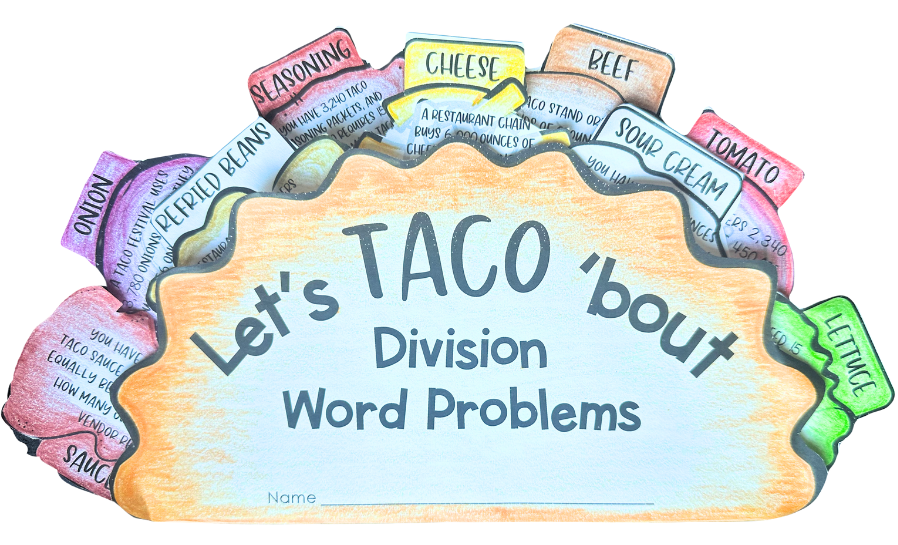
Looking for a fun and FREE way to explore word problems? Check out this engaging Division Word Problems Activity called Taco Math! Click below to grab it free!
These are just a few strategies that can help your students master word problems and not feel like they have to resort to randomly writing down any number just to be done. Word problems can be difficult but they don’t have to be! Help your students master them and give them confidence!