



When it comes to teaching fractions, we often feel a sense of defeat before we even begin. This is usually because our students struggle with fractions more than any other math concept in elementary school. However, out of all the fraction concepts, we all would rather teach multiplying fractions. This seems to be the easiest to teach. We teach students to multiply straight across, and boom, you have your answer. Easy, peasy. The students get it, and you feel a sigh of relief for that fraction of your unit. You can only hope the division of fractions goes just as great, am I right? But, if you were to ask students why they multiply fractions, how many could tell you? Times have changed, and now we need to teach strategies for multiplying fractions. Well, technically, they are supposed to discover them on their own, but who has that kind of time or patience?
It’s easy to skip the strategies and head straight to the algorithm, but that doesn’t prepare students for future concepts or potential testing. The algorithm is technically a shortcut after students learn the why. Once students truly understand that multiplying fractions involves finding part of a part or resizing a number, rather than simply getting the correct answer, they will be less likely to rely on memorized steps.
The strategies listed below do not all need to be taught; however, some may be more suitable for specific individuals. You may have heard of or done some of these in your classroom. The purpose is to help you identify various strategies that will enable you to meet the needs of your students best. As I’ve mentioned in previous posts, such as “Teaching Math So Students Get It,” there’s a natural progression of moving students from hands-on to visual (or representational) to abstract. As long as those three are represented at some point during your unit, the rest can be layered in through guided math, small groups, centers, discourse, or teacher prompts.
The Natural Progression for Multiplying Fractions
The order of the strategies provided is not set in stone. They are aligned to the best practices recommended by the National Council of Teachers of Mathematics (NCTM, 2000) and research on fraction learning (Siegler et al., 2011; National Mathematics Advisory Panel, 2008).
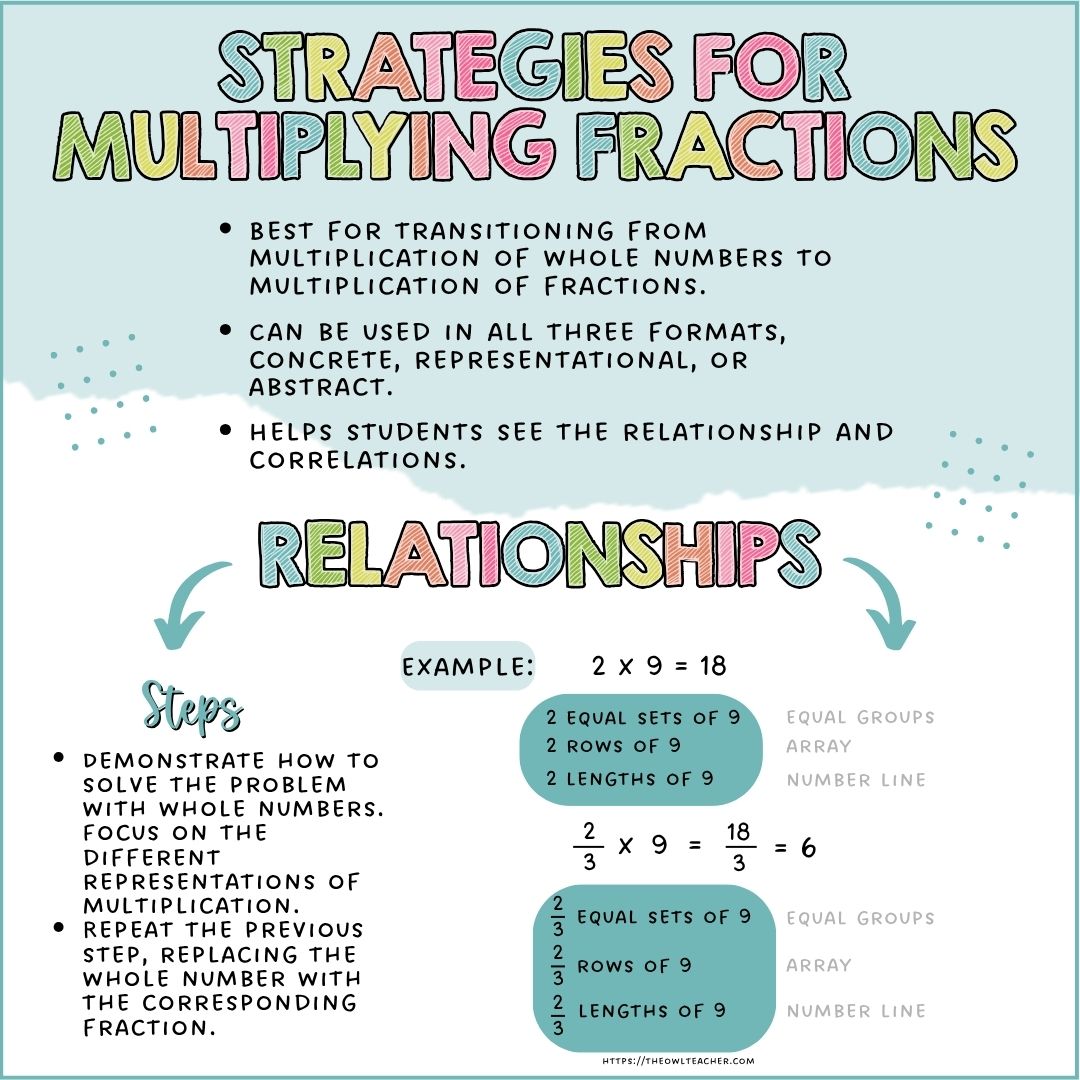
Comparing relationships is a standard practice in nearly every subject, not just mathematics. When we incorporate a student’s prior knowledge, we can then build upon it. When reviewing multiplication, its reasoning, and the ways to represent it, we can immediately replace a whole number with a fraction to help students see that, first, a fraction is a number, and second, that it represents the same concept, but now in a fractional form.
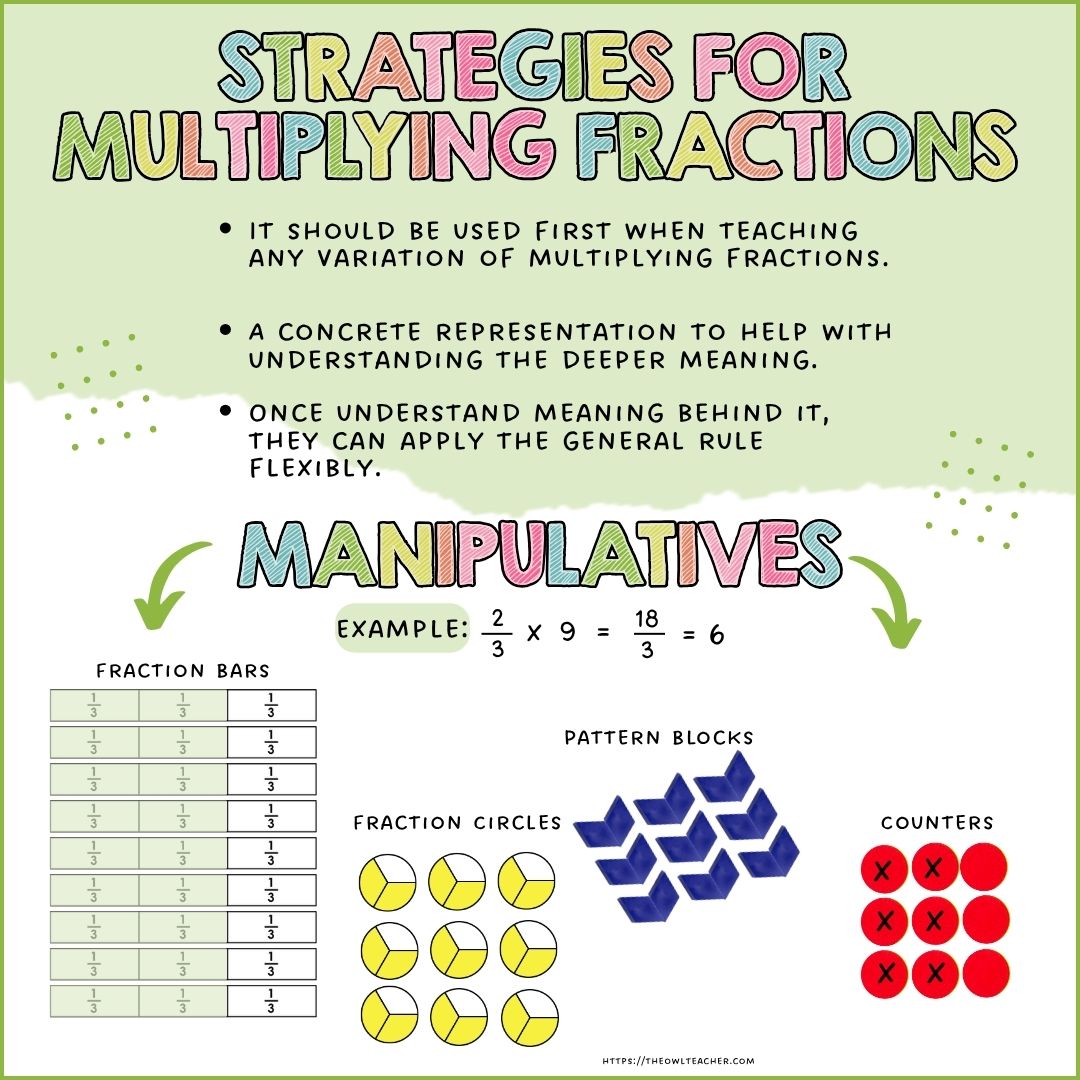
The order of this one and the one following is at your discretion based on your students. When you feel comfortable with your students’ understanding using multiple forms of manipulatives, then students are ready to move forward to representational. The use of different forms of manipulatives helps solidify knowledge because it’s being transferred to a different “format.” However, keep in mind that concrete manipulatives should be used not only for multiplying fractions smaller than one but also for multiplying mixed fractions.
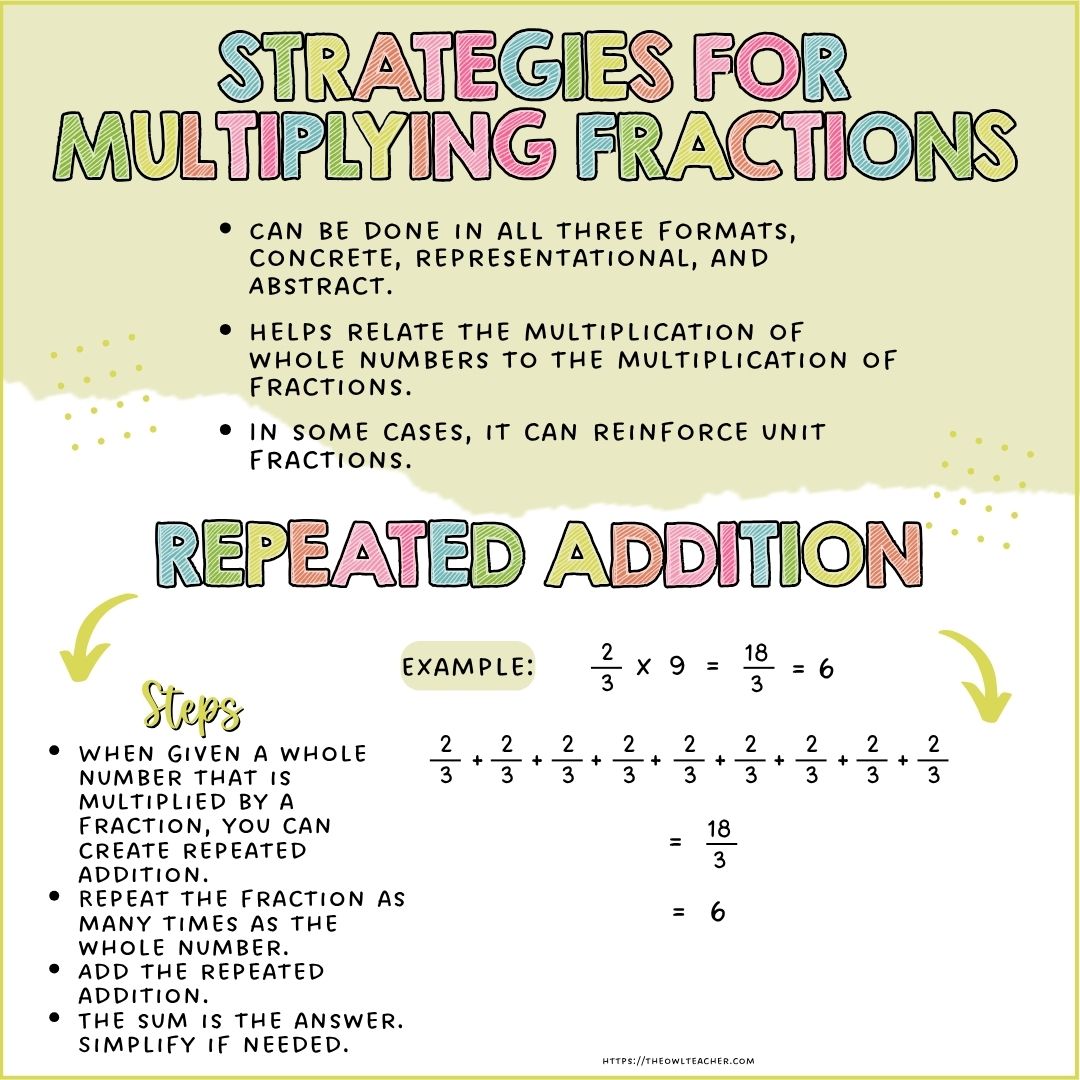
Repeated addition is a great starting point when working with whole numbers and unit fractions. It can be used with any fraction, though. The difference is that, at some point, it can be more work than necessary. Once again, we are comparing the fractional form to the multiplication of whole numbers. Students are decomposing fractions, which is essential with mixed numbers. This helps students see that fractions are nothing to be afraid of because they’re a number too.
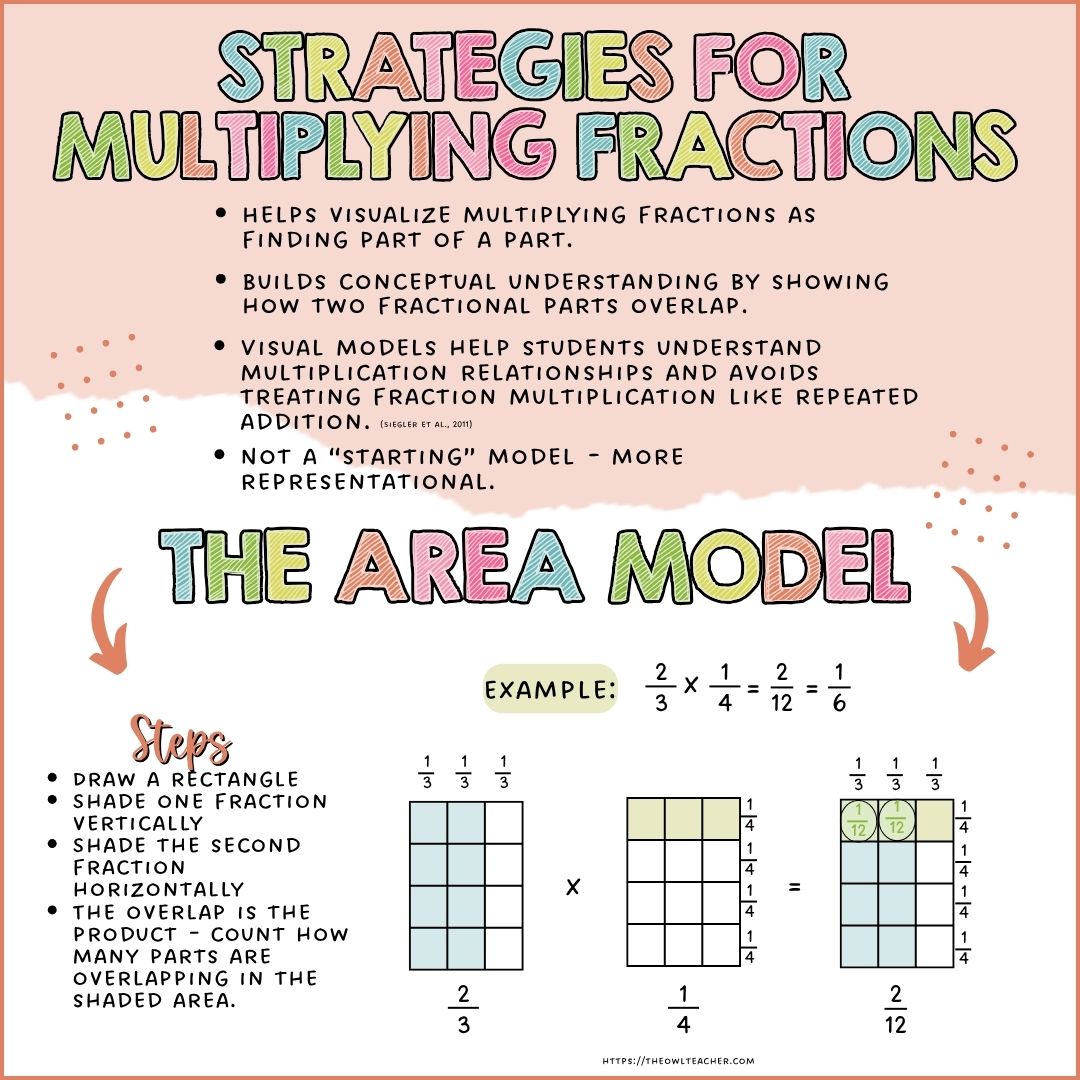
The area model is the one that most teachers use and feel most comfortable with. In some classrooms, this is the only strategy taught, which robs students of a deeper understanding. This strategy can be created using overhead transparencies for a full effect, but cutting out grid paper also achieves the same result when overlaying the two area models.
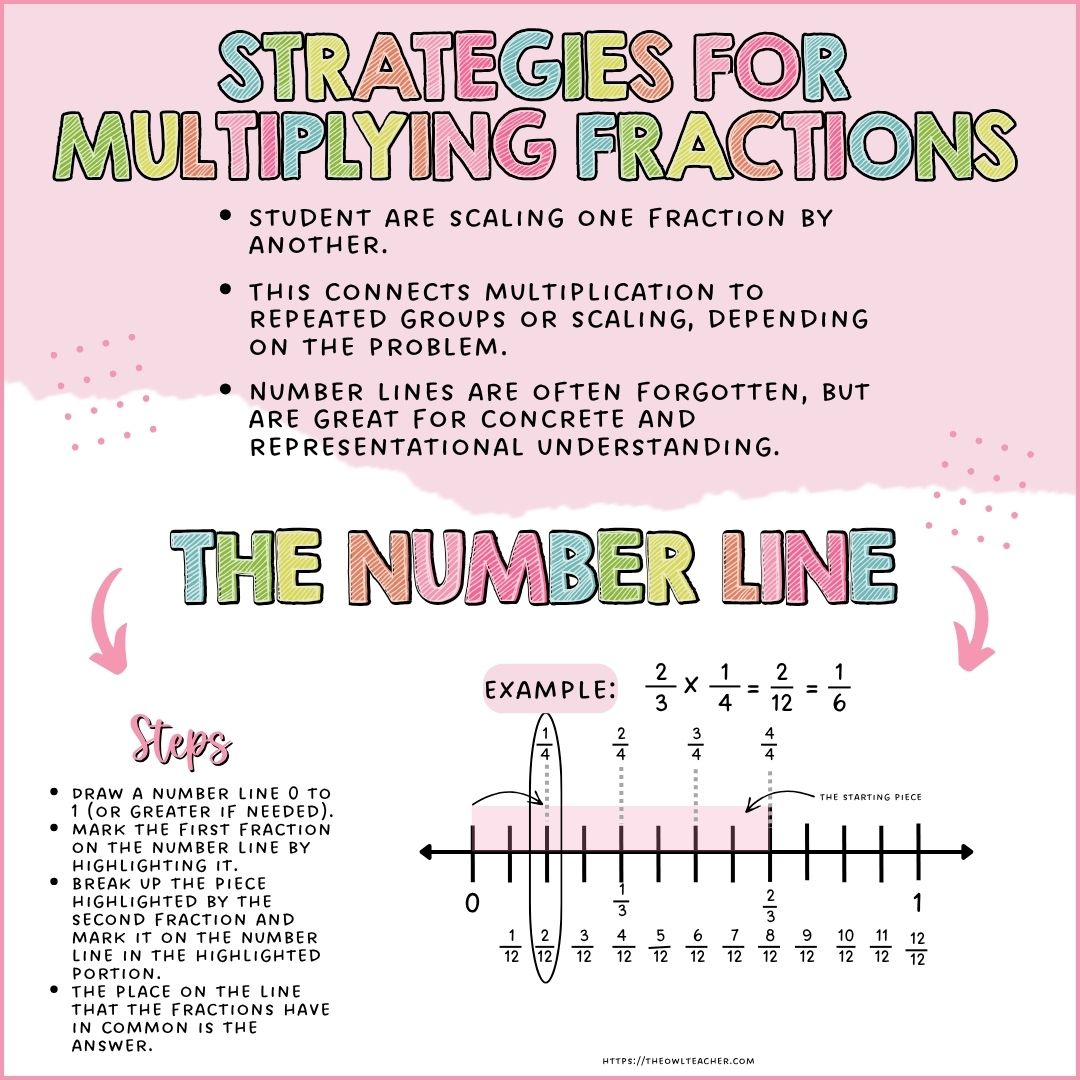
The number line is typically used in place value and addition/subtraction, and is rarely seen again. However, the number line is a very valuable tool to help students understand how they are multiplying fractions is a part of a part. It also requires understanding how to partition a number line, something children have very little practice in. Students can partition a square, a rectangle, or a circle, but can they partition a number line? Not so much. They need this practice to further develop the skills in their mathematical toolbox.
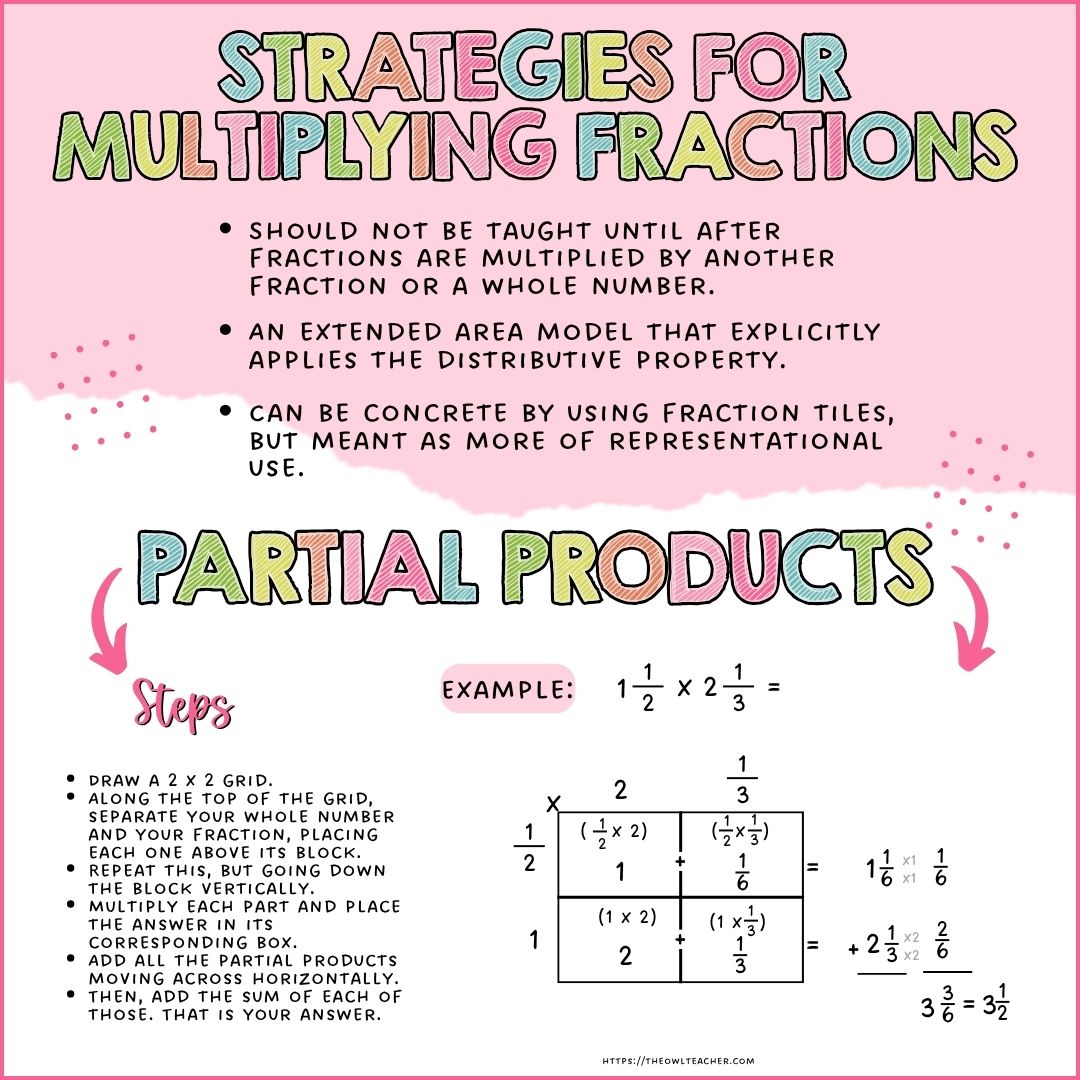
I’m curious if there are any teachers out there who do not use the partial products or box method. This method is frequently used with multiplication, but also lends itself well to multiplying fractions. This can also help check for understanding to see if students know that a mixed number is the whole number plus the fraction. Many students do not understand this. This provides the opportunity for a teachable moment. Additionally, it provides students with the extra practice they need to master adding fractions. And, if you’re feeling spunky on the day you teach this, you can even mention its relationship to the distributive property (but briefly, as that’s covered below).
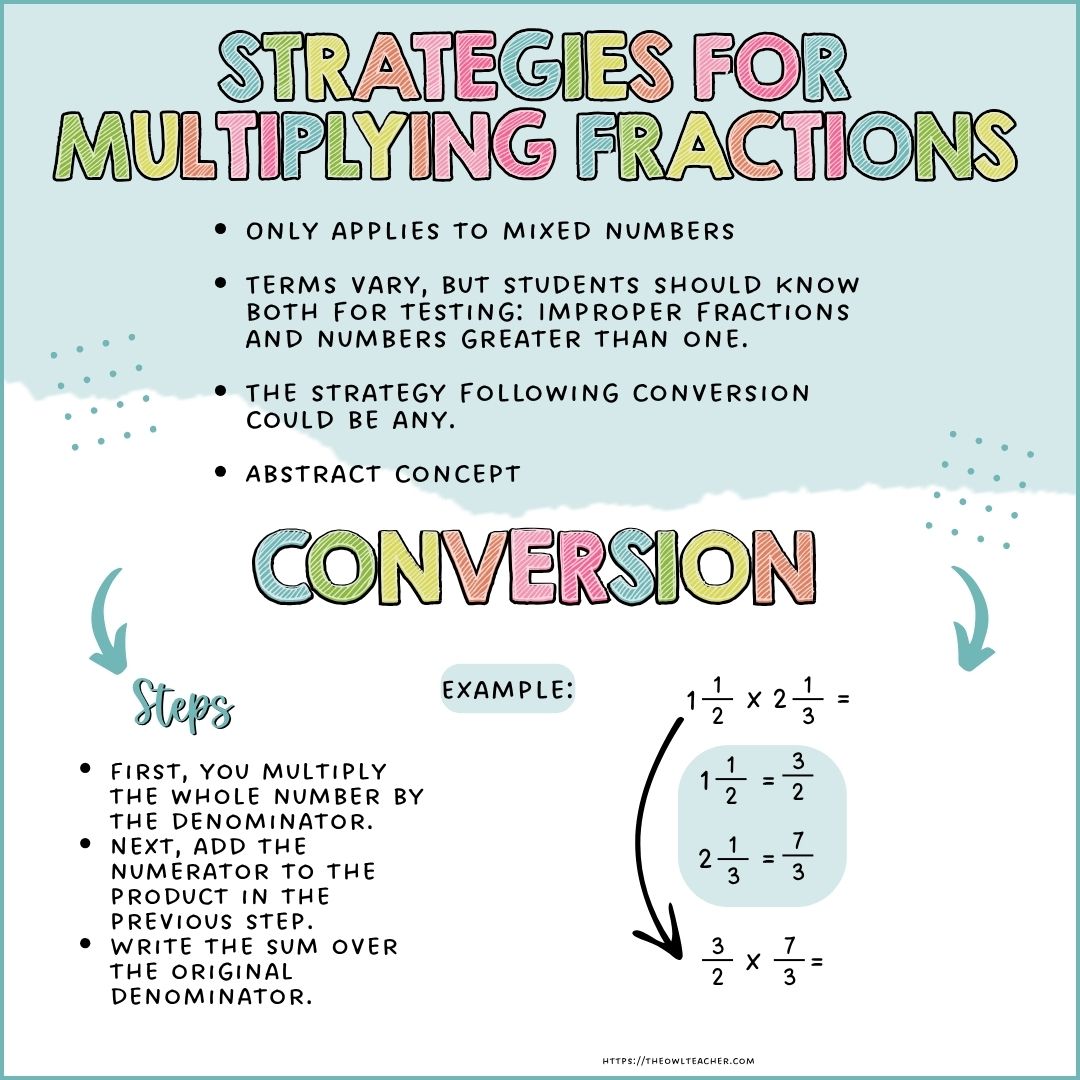
At some point, students will run across mixed numbers that are being multiplied. When this happens, you can teach students alternative methods (as described in this post) or have students convert the mixed number into an improper fraction, or a fraction greater than one. (Some districts do not use the term improper fraction; however, due to the multitude of testing a child will have in their lifetime, you do not know when it will be used so that I would teach both.) Once the number has been changed, the student can proceed with one of the other methods. This concept should not be new.
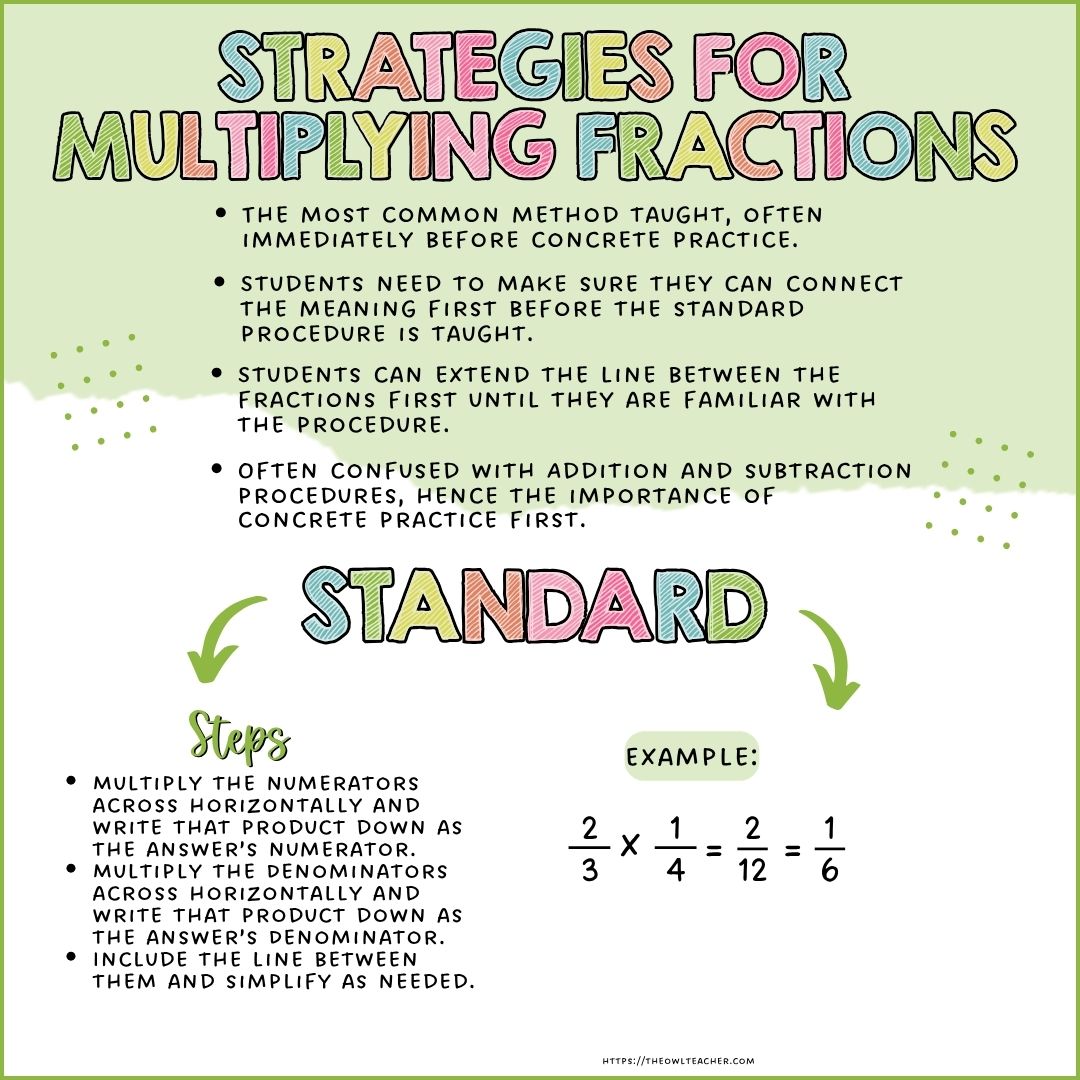
Fractions can be multiplied just like whole numbers, but their behavior is different and must be visualized, contextualized, and understood through reasoning, rather than just following rules. It’s very important not to press students to memorize rules quickly. This will create a barrier to solving proportional and algebraic expressions later on.
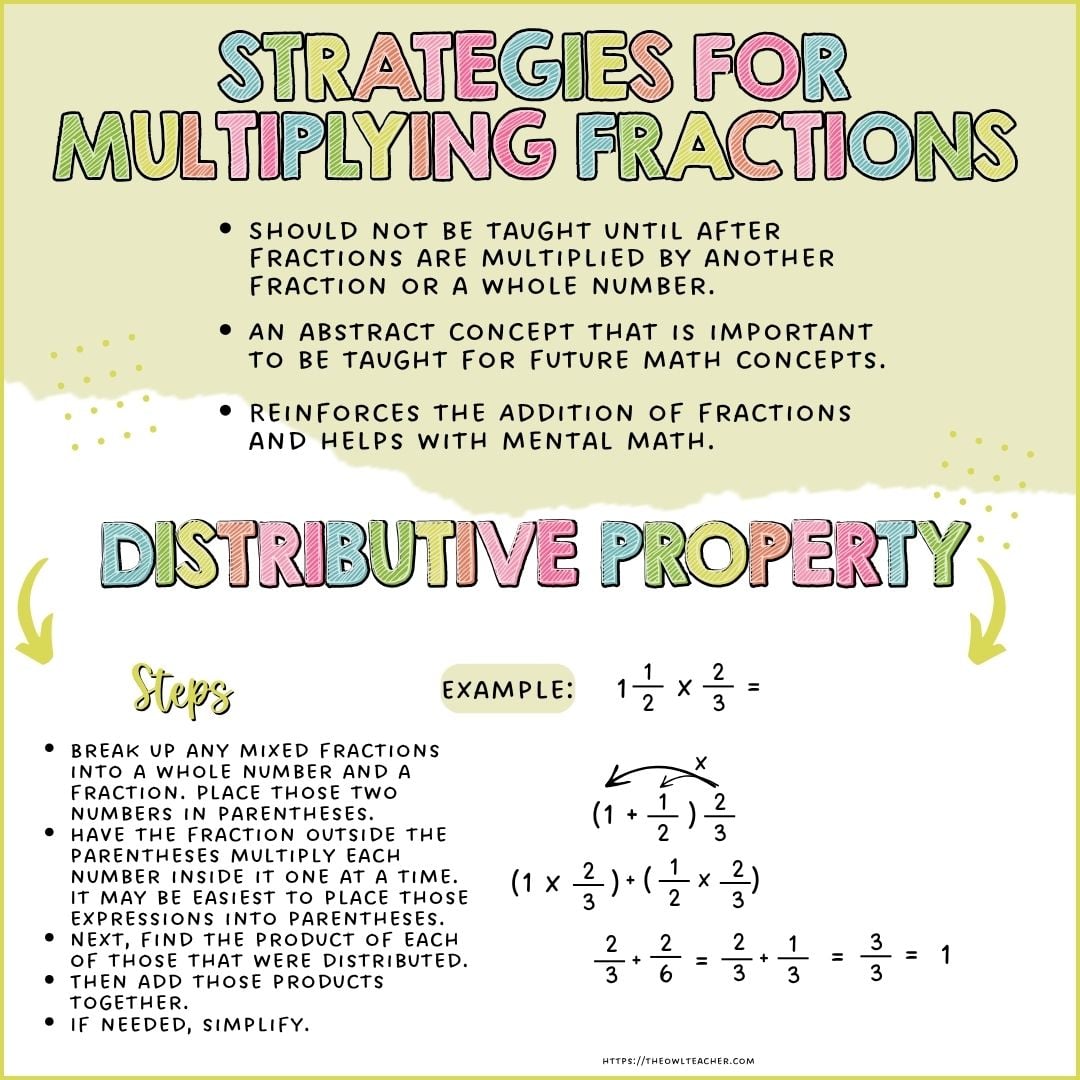
The distributive property is also an important strategy that students will need later on for algebraic expressions. Depending on your students’ ability, this could be an option, especially as enrichment. However, this is a very abstract concept that would likely require students to understand the underlying rationale behind it.
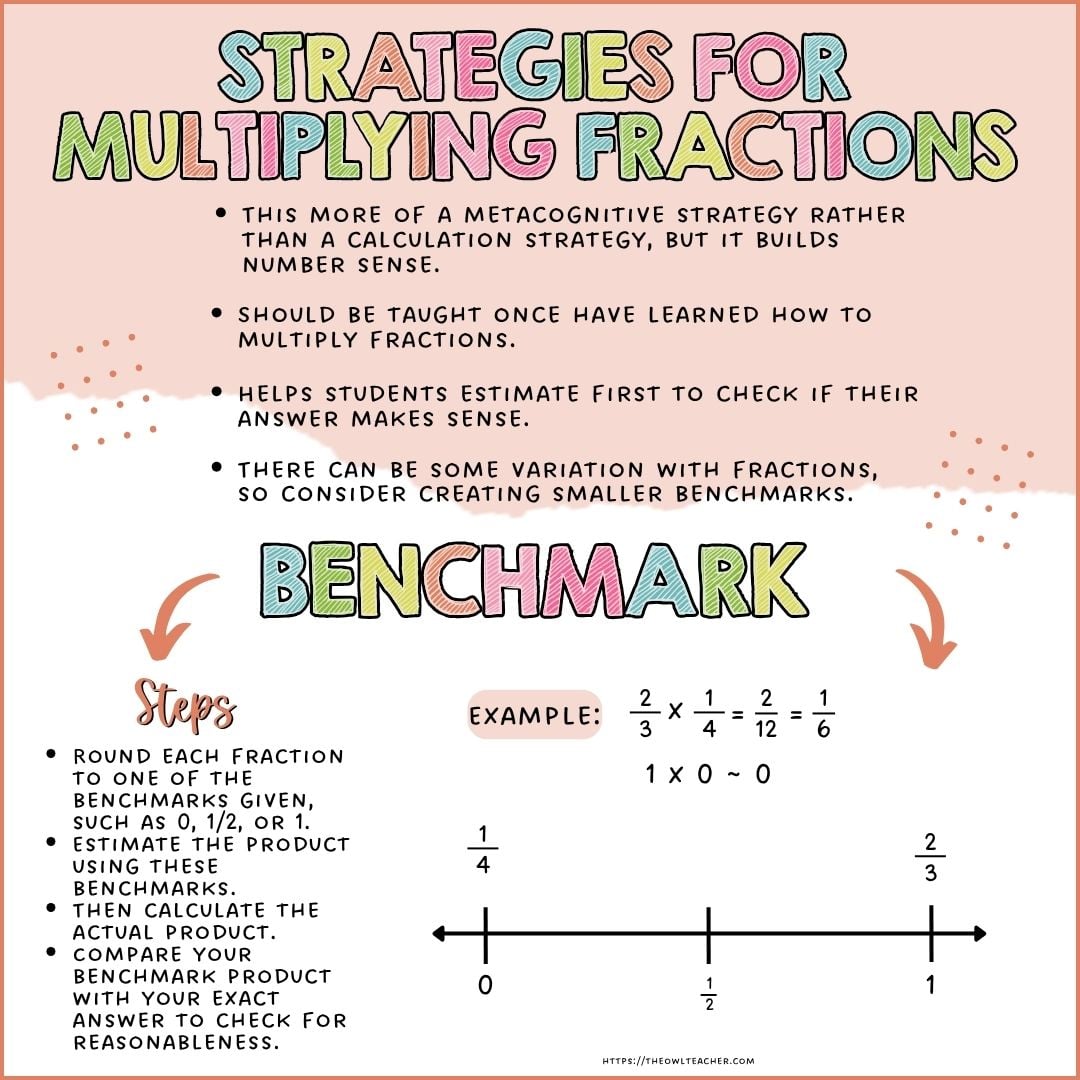
Estimation should be part of every unit. Multiplying fractions is no exception. When it is taught is up to the individual teacher and his/her class. Benchmarks are often represented in fractions as 0, 1/2, and 1. However, this can be changed to help students narrow it down a bit. This would also help answers be a bit more alike. Students require extensive practice with reasoning and justification.
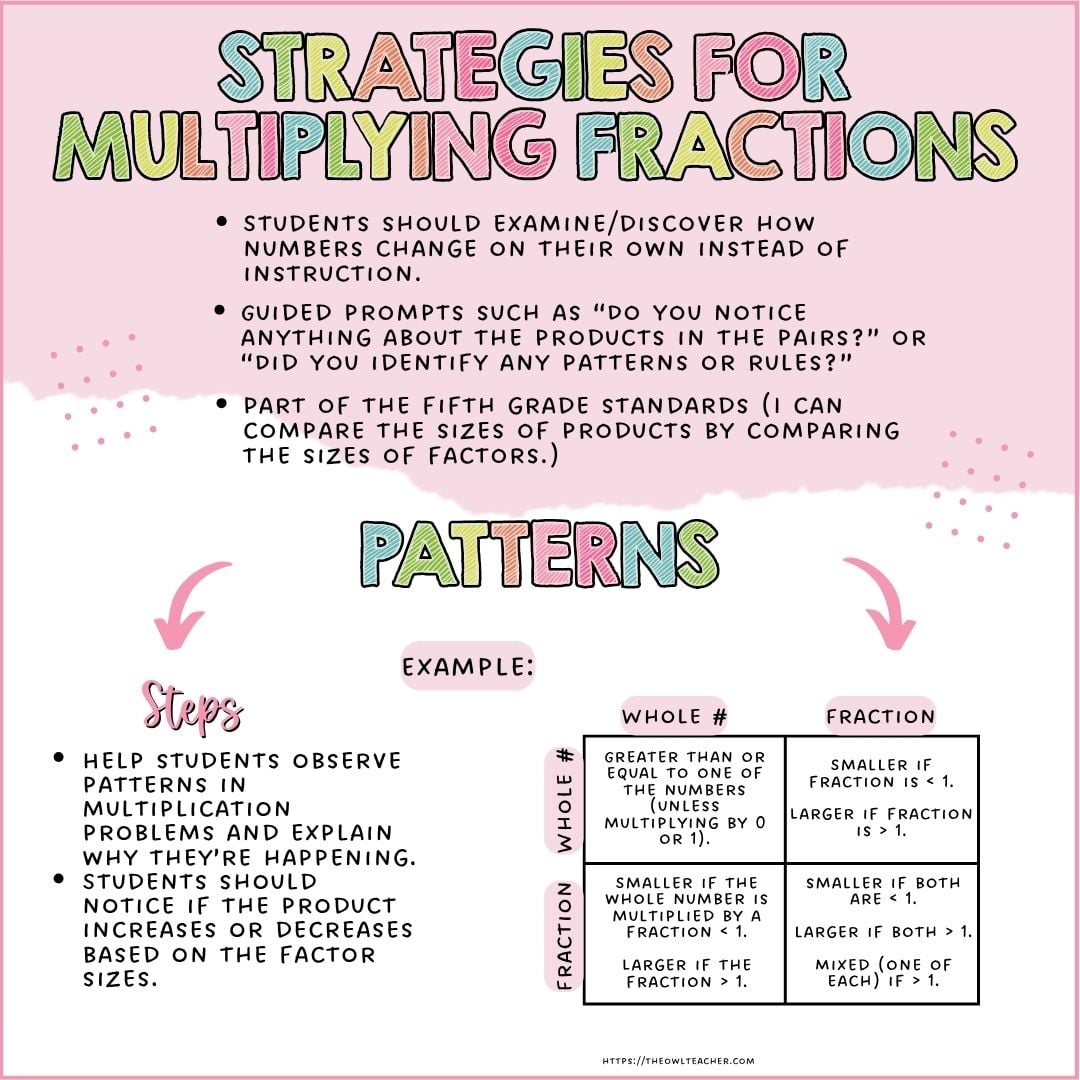
The fifth-grade math standards indicate that it’s essential to identify the patterns when multiplying fractions. Students should start to notice that when they multiply by different sizes, the product either increases or decreases. This is also a form of scaling, but that should be woven throughout the concepts in the unit. Once students start noticing and identifying these patterns, it will help with reasoning and justification, as estimation would.
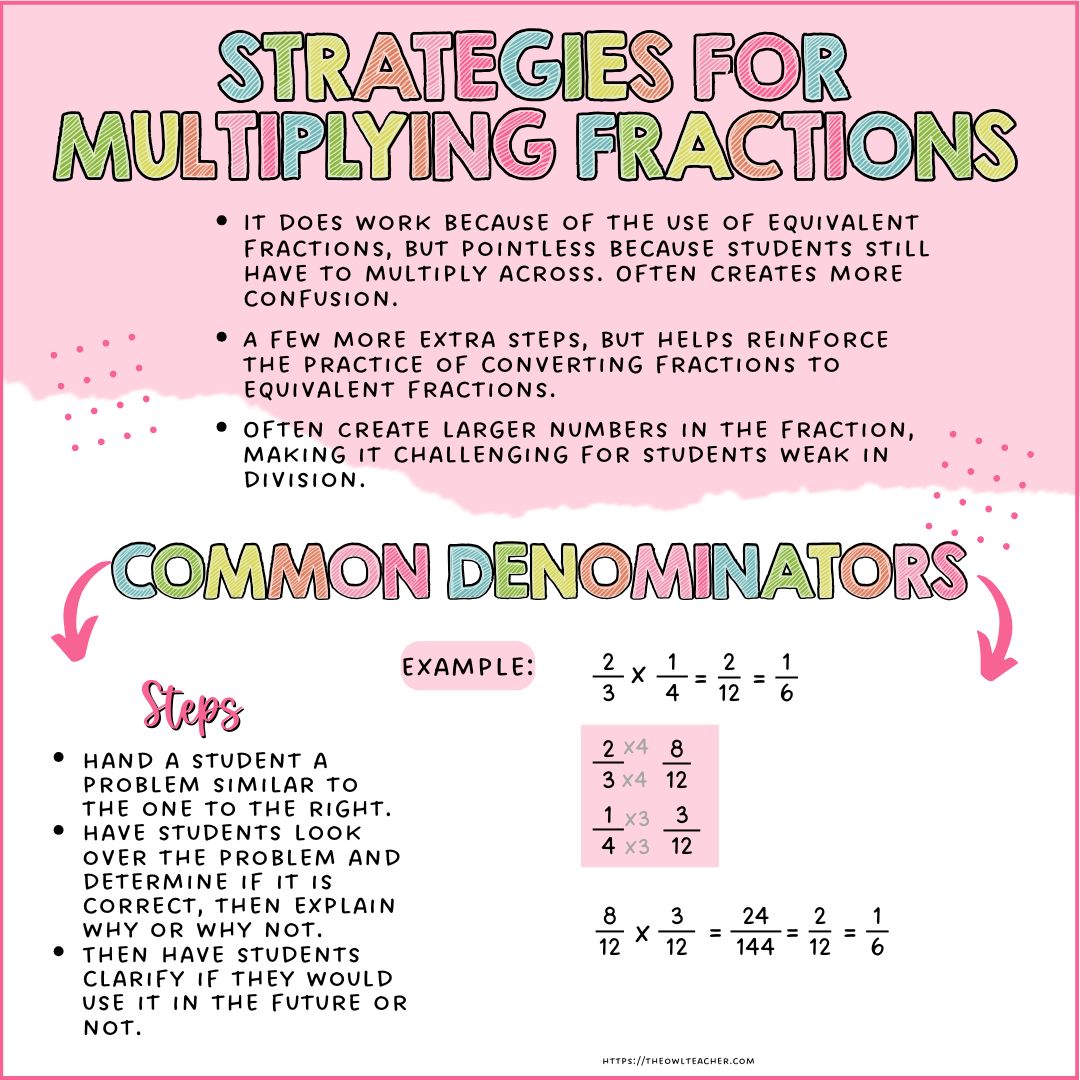
I strongly do not recommend teaching this to your students because it involves more steps than are worth it, creates confusion, and is pointless, as they still end up multiplying the fractions. I wanted to mention it because it’s interesting to think that it’s possible to use common denominators in any fraction operation. This type of problem would be great for getting students to think differently about fractions. Students can determine if it is correct, what is happening, and if it is a good strategy to use. Of course, students have to share their reasoning. It’s perfect for math talk!
Speaking of math talk, the correct language must be used when multiplying fractions, including the terms’ numerator’ and ‘denominator’, rather than simply referring to the ‘top number’ and the ‘bottom number.’ Additionally, keywords should not be taught when they are practicing the concept with word problems. 56% of students believe ‘of’ is always multiplication, but that is not entirely true. It’s best to make meaning of the situation and not base it on one or two words in the entire problem. I teach students multiple strategies, including looking at the problem without numbers first.
These strategies mentioned above are often under-taught; however, the NCTM emphasizes the use of multiple representations. When we incorporate models like number lines, partial products, and scaling, we support diverse learners, including those who require visual, verbal, or kinesthetic approaches, while also providing them with multiple entry points. It’s important to note that at this grade level, cross-canceling (simplifying before multiplying) is typically not taught.
Ultimately, if you aren’t sure which model to use, you can model the ones you feel most comfortable with, work together through a new model with your students (you both learn!), or use this order:
- Use manipulatives for multiplying a whole number by a fraction
- Use area models for teaching fractions by fractions
- Use partial products for mixed numbers
Whatever method you choose, start small and ensure that you always return to the meaning. Take a moment to slow down before introducing the algorithm. Let students explore, compare, draw, and reflect on their findings. This will save you more time later by going deeper now.

Sources:
- Booth, J. L., & Newton, K. J. (2012). Fractions: Could they really be the gatekeeper’s doorman? Contemporary Educational Psychology, 37(4), 247–253. https://doi.org/10.1016/j.cedpsych.2012.07.001
- Fuson, K. C., & Beckmann, S. (2012). Standard algorithms in the Common Core State Standards. NCSM Journal of Mathematics Education Leadership, 14(2), 14–30.
- Hackenberg, A. J., & Lee, M. Y. (2015). Relationships between students’ fractional knowledge and algebraic reasoning. Journal of Mathematical Behavior, 40, 91–115. https://doi.org/10.1016/j.jmathb.2015.10.003
- Lamon, S. J. (2007). Rational numbers and proportional reasoning: Toward a theoretical framework for research. In F. K. Lester (Ed.), Second handbook of research on mathematics teaching and learning (pp. 629–667). Information Age.
- National Council of Teachers of Mathematics. (2000). Principles and standards for school mathematics. NCTM.
- National Mathematics Advisory Panel. (2008). Foundations for success: The final report of the National Mathematics Advisory Panel. U.S. Department of Education.
- Prince, M. (2004). Does active learning work? A review of the research. Journal of Engineering Education, 93(3), 223–231. https://doi.org/10.1002/j.2168-9830.2004.tb00809.x
- Siegler, R. S., Fazio, L. K., Bailey, D. H., & Zhou, X. (2011). Fractions: The new frontier for theories of numerical development. Developmental Science, 14(1), 127–133. https://doi.org/10.1111/j.1467-7687.2010.00999.x
- Siegler, R. S., Thompson, C. A., & Schneider, M. (2011). An integrated theory of whole number and fractions development. Cognitive Psychology, 62(4), 273–296. https://doi.org/10.1016/j.cogpsych.2011.03.001
- Van de Walle, J. A., Karp, K. S., & Bay-Williams, J. M. (2019). Elementary and middle school mathematics: Teaching developmentally (10th ed.). Pearson.
- Witzel, B. S., Mercer, C. D., & Miller, M. D. (2003). Teaching algebra to students with learning difficulties: An individualized approach. Learning Disabilities Quarterly, 26(1), 24–36. https://doi.org/10.2307/1593681


One Response
Thank you so much for this support! It is so organized and has really got me thinking how to portray different strategies! So awesome! You are the best!