






I have always started the back-to-school season with get-to-know-you activities. I mentioned in previous posts about building a classroom community as part of the 10 Things Teachers MUST Do on the First Day of School. The first few days are more than just trying to create a fun, low-pressure way of welcoming everyone back. It’s about laying the groundwork for academic routines, expectations, and trust. And the most important part? Creating a safe environment where everyone feels that ‘family-like’ connection. So, instead of using the usual icebreakers, why not build that classroom community in a way that is different, fun, and academically engaging? We are going to go through nine back to school math games that help students learn about each other, practice math skills, collaborate, and start building a safe learning culture from day one.
Math About Me Match-Up
In the past (and it appears they still have them), we have used the large, Scholastic posters that students would fill in and color. Then these were hung in the hallway for display. They weren’t typically looked at, nor did it help build community. In fact, the closest these were to assisting students to get to know each other was if the teacher had students present a few things on their poster or take a minute to share with someone in the class (which often led to students sharing with someone they knew). Don’t get me wrong, these posters aren’t bad. A quick Google search will yield a multitude of similar posters.
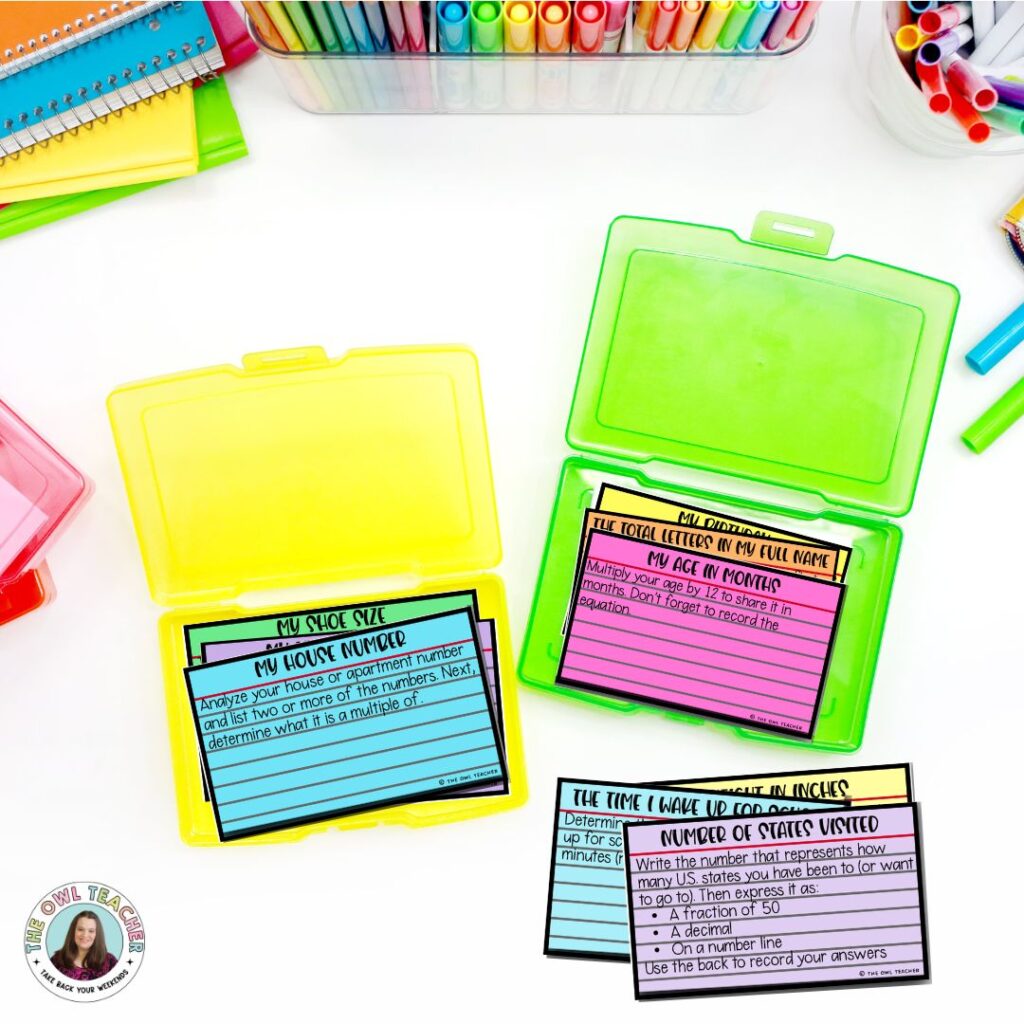
Why not do something different this year and complete a Math About Me Match-up? This back to school math game is an activity where students have to walk around the room and match math facts about themselves with other students based on shared or related numbers. Before students share this information, they must fill out short index cards that not only share things about themselves, but also include math concepts. For instance, students have to use elapsed time by determining what time they get up to get ready for school, then figure out how many minutes that is from midnight. These back to school cards don’t just stick to the traditional ‘About Me’ sheet questions. Some are very interesting.
This activity requires very little setup. Students are given index cards printed out or the teacher can place the questions on the board and have students create their own index cards – even their own questions, though the math would need to be included in their questions. Then, of course, model for students. When students are finished, give them one more index card where students reflect on one thing they learned about someone else. You can grab the cards for free here or by clicking on the image below.
Number Line Human Sort
In this back to school math game, students are given a card or sticky note with a number on it, such as decimals, fractions or whatever is best for your grade level. Then once everyone has their number, they are to silently arrange themselves in the correct order on an imaginary number line across the room. If desired, you can create the number line using painter’s tape on the floor to mark it. If you are feeling really spunky, you can make it challenging by mixing in different forms of numbers, such as fractions mixed with decimals, and percents, so students must convert them first. You’ll be amazed at how many students will group themselves in line by type rather than by numerical order. Once everyone is sorted you can have students explain why their number belongs where it does, but using math vocabulary. Throughout the year this can be done with elapsed time, equations, or even coordinate points.
Find Someone Who (Can Solve It!)
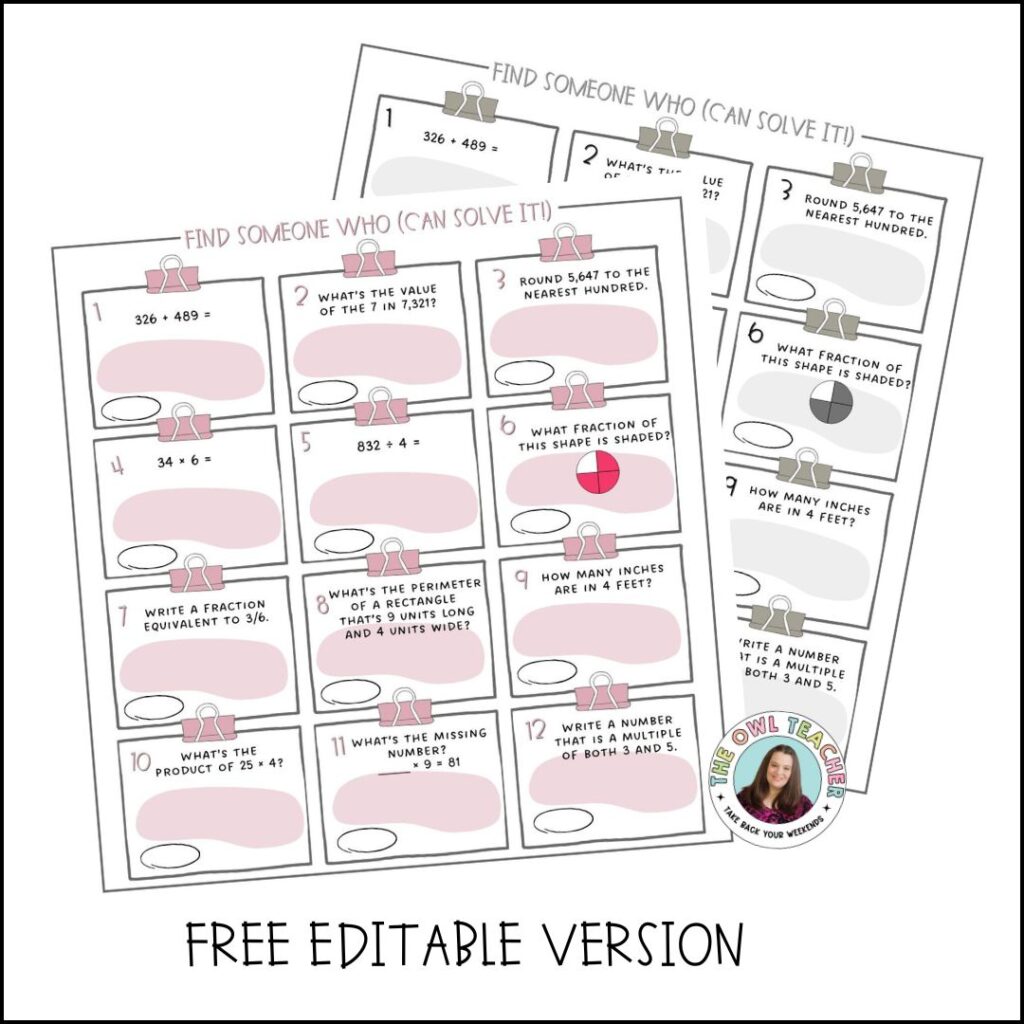
I’m guessing that at some point, you have played the game “Find Someone Who.” To make it mathematical and add a twist, have students find classmates who can solve a math question from a spot on the grid. In the image above, you can see that students are given a grid with 12 math problems. Then, students walk around, asking other students to solve one box, write the answer in the pink area, and sign their initials in the black circle at the bottom left corner. Once a student has filled in all 12 boxes, have them check the problems and note the strategy they used. If you want to add a little bit of a challenge, try adding a personality-themed question, such as “who also loves tacos.”
If you want this free, editable back to school math game, click on the picture or here.
Math Jenga: Get-to-Know-You Edition
Jenga is a classic game in school and even likely in math, but it may not have been thought of as a back to school math game. While it takes a bit of time to get started, you can then store it with your other back to school math games and reuse it again next year.
With this game, you will label blocks one to forty-eight and then tie them to a question. Some of those questions will be math problems, while the others can be get-to-know-you prompts. After labeling each block, create an answer key.
Like the game, students pull a block out and complete the problem. Others in the group will check it to determine its accuracy. You can have students turn in the math papers if you’re concerned about students staying on task. You can use the colored Jenga blocks and assign a different category to each color.
Name That Number (Team Edition)
These two back to school games that I’m about to talk about have students on teams. In this activity, teams create as many equations as possible that are equal to a target number using a set of given digits. For instance, each team gets a target number, which is 24 in this case, and a set of 5 digits. You can choose a total number (such as using four digits) or specify individual digits, such as 2, 4, 6, 8, or 1. Then, the teams would write as many valid math equations as they could in five minutes using the numbers (or the number of digits) given to reach 24. If desired, you can add a little student discourse by having them justify their favorite equation.
Math Charades
Since back to school can be stressful for some and boring to others, this back to school math game is the perfect way to ease any anxiety and create a low-stress environment. Math charades is the same as the regular version. The difference is that students are acting out math vocabulary or problem types while the class tries to determine what it is. To get started, all you would need is a stack of math terms. Students gather in teams, draw a card, and act it out while teammates guess. After each round, require the team to write a sentence or draw a model of the math term they guessed. This could be a back to school math game your students will enjoy!
Would You Rather…? Math Style
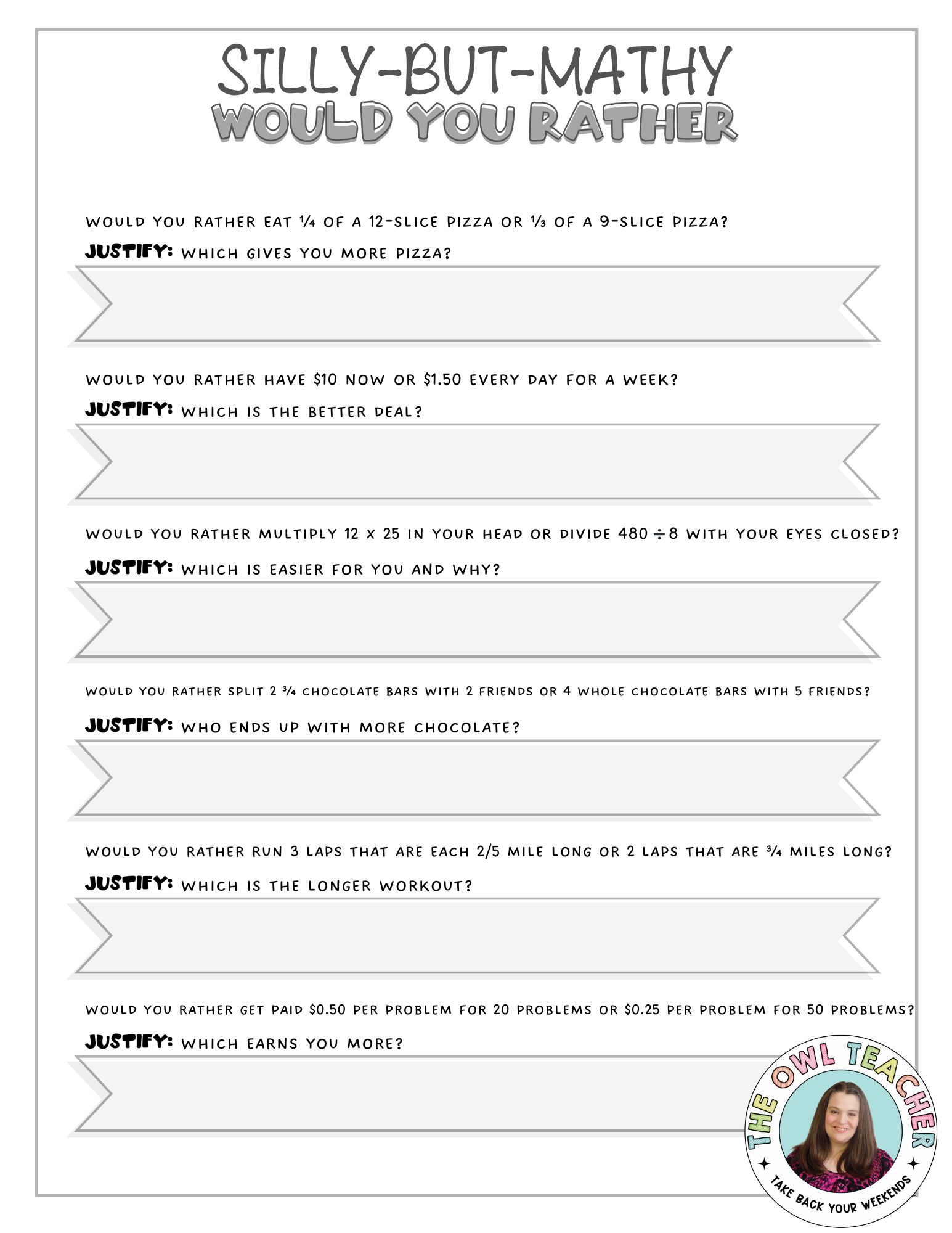
The famous game “Would You Rather” is a fun activity that has now become one of the back-to-school math games added here. In this math game, you would first come up with a list of “Would You Rather” questions that require students to reason, compare, and justify. For example, you would ask, “Would you rather have 1/2 of $100 or 3/5 of $80? Which provides the most money?” These can be presented on a slide deck, as printable cards, in a worksheet, or displayed on chart paper around the room. To get students moving around, have them stand in different parts of the room to show their answer. Have them explain their reasoning in journals or to a partner after each round. While this may be overlooked, it is beneficial because it fosters mathematical reasoning, opinion sharing, and trust simultaneously.
Mystery Number Circle
Who doesn’t love a good mystery, but how does this relate to back to school math games? You’ve likely done something similar in your classroom with morning work or math warm-ups. In this back to school math game, students guess a mystery number based on clues related to place value, factors, or multiples. You (or a student) begin by choosing a number, and have others try to narrow down to the answer using clues. They can only ask yes-or-no questions to help them revise their guess after each question.
The Sky is the Limit Posters
I know a collaborative math poster sounds like one of the back to school math games I’ve mentioned at the top, but only now it’s in poster form. But that is not at all what I’m about to talk about. A collaborative math poster can be a powerful community builder and a math review tool. How many of us spend a few days reviewing at the beginning of the year? Win-win!
Provide each student with piece of 11″ x 17″ white construction paper. Teachers will have a stack of paper strips with one or more questions on them. (vertical for multiple questions or horizontal for one or two questions.) These strips could vary from math topics and skills, along with difficulty. When you say begin, students are to start with the first strip and solve the problem(s) on it. Then they move to the next desk (like scoot). That student either finishes an unfinished strip or solves a new strip. Each time a strip is unfinished, and time is up, the next person in the rotation must complete it. If the student finishes before the time is up, they must grab a new strip and start again. Each student is completing a problem on a different strip each time they rotate. The length of time you provide for students at every rotation is at your discretion.
Once you have had a full rotation, have students look at the collection they have of strips. Provide students with answers (this can be done as a self-check activity also) and if any problem is wrong that building has to be placed for demolition. (What student doesn’t love to tear and destroy paper?!). The correct buildings can be glued to their construction paper as their city (Strips with writing horizontally can be rotated). Have students reflect on their goals and thoughts about the activity. For instance, “Are the buildings in your city a true reflection of what you know right now at this time? Why?” “What about the goal? Was it realistic to set one? Why or why not?”
Conclusion
You don’t have to pick between math practice and community building. You can do both from the first week of school, and you get a bonus: You get to evaluate some of the students’ prior knowledge.
Don’t be afraid to pick out one of these back to school math games instead of the traditional fluff. Add a little twist instead.
Don’t forget to grab your freebies up above to help you get a great start to the new school year!


One Response
Thank you!