






This is a sponsored post. I was paid to publish it, but I only share content I think is useful for teachers.
You can walk into any third-, fourth-, or fifth-grade classroom and find students with different learning needs. One student may be confident with fractions, while the next kid still needs a visual model to understand how they work.
Unfortunately, the learning gap is very real. The National Center for Education Statistics reported that school leaders estimated 31% of public school students were behind grade level at the end of the 2024-25 school year.
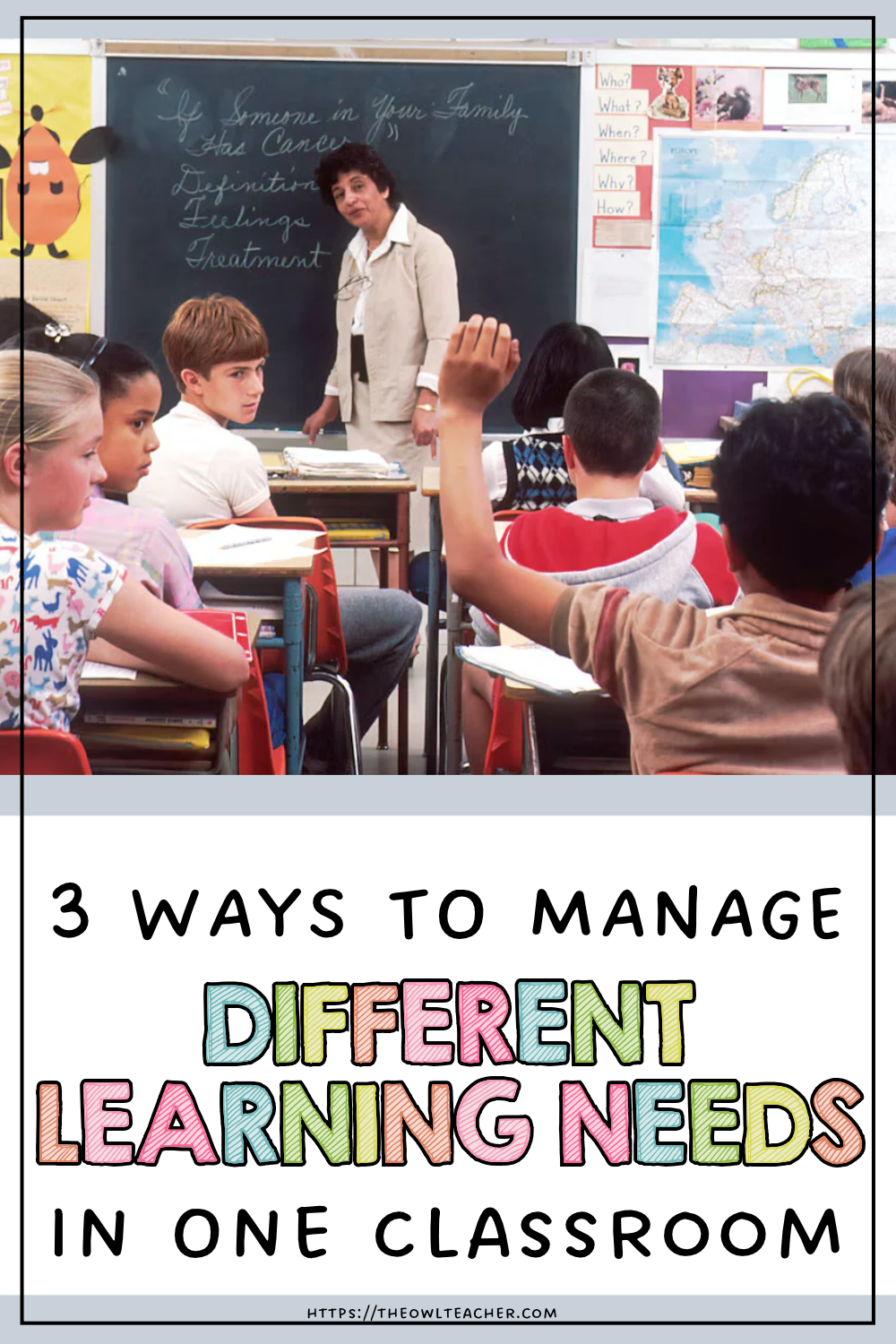
It’s unrealistic to try to develop a separate lesson for every student as a form of differentiation. Most of them don’t even need one. Here are three practical ways to meet the diverse learning needs in grades 3-5, with examples and ideas you can adapt to your lessons.
1. Create Flexible Groups Based on Specific Learning Goals
Students are at different stages in their learning journey. Some may need to relearn a concept, while others may be ready to apply it in new situations. Flexible grouping is one way teachers can handle this mismatch.
Groups are built around one learning goal, and they change as kids grow. Edutopia contributor Dani Fry Jackson suggests using the student work you already have to find the exact skill each child needs next.
This keeps planning simple. You group by what kids need to learn next and everyone works on the same learning objective.
How to Put It Into Practice
First, identify a specific skill one student needs to develop. Use a short assessment or review recent work to then identify who needs similar support.
Then, create temporary groups and plan an activity for each based on that group’s learning goal. A simple routine is best, such as modeling the specific skill, providing an opportunity to practice, and then closing with a quick reflection.
The rest of the class should be engaged with independent activities that students already know how to do. You do not need to meet with every group during every lesson. Rotate your attention based on student needs, and track their progress.
A Classroom Example
If your class is learning about main idea and supporting details, you would give them a short passage, such as how honeybees help plants grow by carrying pollen from flower to flower. Then ask students to write the main idea and details that support it. Then you would group students as follows for differentiation:
- Group 1: Students who confuse the main idea can work with you to summarize the meaning of the entire passage.
- Group 2: Students who understood the main idea but struggled with the supporting details can highlight two sentences that explain how bees help plants reproduce.
- Group 3: Students who answer both questions correctly can read a new passage about butterflies and pollination, then write a two-sentence summary.
Use the same reading objective and existing passages for all three groups. At the end, ask each student to write one main idea and a supporting detail independently. This lets you know who is ready to move forward without the need for preparing three separate lessons.
You can find some great reading passages in my store, including the highly engaging Eating Bugs and Toy Inventions.
Common Mistakes to Avoid
The purpose of flexible grouping is never to assign permanent labels. Don’t keep the same students in a low-performing group simply because they struggle regularly. That can limit their opportunities to tackle more challenging work.
Also, don’t give students independent work merely for its own sake. Other students should have clear, purposeful tasks they can complete successfully. And check each student’s understanding after group activities. The whole point is to regroup on purpose.
2. Change the Support, But Not the Expectations
It’s hard not to help or give a struggling student easier work. If the class is learning to solve a multi-step problem, some students may need more help than others to understand the information. The goal hasn’t (and shouldn’t) change, but the approach can.
A 2025 study published in the Journal of Intelligence analyzed 45 third-grade students in Türkiye during a science unit on electrical devices and tools. Students taught with differentiated lessons scored significantly higher than students with the regular curriculum. Students who received differentiated instruction averaged 15.54 on the post-test, compared with 12.52 among students taught using the standard curriculum.
Despite the small group tested in this study, academics should cater to each student’s learning needs.
How to Put It Into Practice
Start by getting a clear idea of the skills each student needs to work on. You can break down complex tasks into smaller steps. Guide students through the first step, then ask them to continue by themselves. Eventually, pull back your support, but do it gradually and only once students become more confident and accurate.
This process often requires you to reflect on your teaching and keep developing your instructional skills. Such practices especially matter in higher education, where faculty and academic leaders must support students while maintaining certain academic standards.
This also requires reflection on your part. Teachers keep sharpening their ability to read students’ needs. Those who want to strengthen their expertise in postsecondary teaching and leadership often pursue online EdD programs in higher education. Saint Leo University’s online EdD programs in Higher Education let them pursue advanced study and apply their knowledge in real time while continuing their professional responsibilities. It lets working educators dig into academic leadership, student affairs, and education policy while staying on the job.
A Classroom Example
Another example of this kind of differentiation, you have fifth graders whom you’re teaching to write a paragraph explaining how a character changes in a story. There can be the following three possibilities:
- Students who need a lot of support. These students can use a graphic organizer or worksheet that includes three questions. The first asks what the character was like at the beginning. The second would focus on how the story developed. The third would discuss how the character changed.
- Students who need some support. Ask them to complete the same organizer independently and find one detail from the story that supports their explanation.
- Students who are ready for a challenge. Have them skip the organizer and write a paragraph explaining how and why the character changed, using evidence from the text.
Overall, every student must describe how the character changes, using evidence from the story. The difference is only in how much help each student got, not in the learning objective.
Common Mistakes to Avoid
Easier work does not automatically mean better support. A struggling student given a simpler task may finish quickly, but it can also prevent them from developing the skills they need. So, keep the goal the same and make the path easier to reach.
Also, avoid providing too much scaffolding so that students no longer have to think through the problems themselves. You can offer a prompt, give students time to figure it out, and step in only if they really need it.
Don’t assume that the same type of support will work for everyone. Some children respond well to verbal explanations, while others need a model or a drawing. Look closely at each student’s work to figure out what’s working.
3. Give Students Different Ways to Practice and Show What They Know
Students do not learn the same way, and they do not show what they know the same way either. Some students can explain a mathematical concept clearly in a conversation. Others find it difficult to do so. Your goal is to offer your students different ways to practice and demonstrate their knowledge.
When you give students a few solid ways to practice and show understanding, you get a clearer picture of who still needs help. If your class is learning how water changes state, one student could draw and label the process, another could write a short explanation, and yet another could complete a states-of-matter craftivity.

How to Put It Into Practice
Decide what students should know or be able to do by the end of the lesson. Then, pick practice activities and ways to show the learning that measured that goal. Let the students choose between a couple of options, like writing an explanation or drawing a diagram.
Use quick checks before a formal assessment. Additionally, provide different ways to practice the same skill. For example, students learning multiplication can build arrays with counters or solve word problems.
Group or partnership-based projects are great for teamwork but its important to pair them with individual tests. It’s important to know each student’s understanding of the concepts.
Classroom Example
Suppose your fourth-grade class is learning to classify two-dimensional shapes by their properties, like parallel lines, perpendicular lines, and types of angles. Examples of the possible three categories would be:
- Those who need more practice. Have students sort paper shapes into groups and describe what they notice about the sides and angles.
- Those students who understand the basics. Have students draw two shapes, label their properties, and explain how the shapes are different.
- Those students who are ready for a challenge. Have students find 2D shapes in the classroom, record examples, and explain which properties helped them classify each object.
Common Mistakes to Avoid
Don’t offer so many choices that students become overwhelmed. This will also make lesson planning complicated. Two or three well-planned options are usually enough. Reuse the same formats across different subjects, changing the content instead of creating an entirely new activity.
And don’t rely on projects or group presentations alone to judge learning. This is why having individual assessments is equally important, because a solid group project can hide individual gaps in student learning.
Meeting the Different Learning Needs, One Lesson at a Time
Every classroom has students with different needs. This is completely normal and expected. It doesn’t mean you have to write a new lesson for each one. Using differentiation with flexible groups, steady expectations with the right support, and a few choices in how students show their learning can go a long way.
Start small and adjust your steps as you go. Consistent, responsive teaching has a power that can make any classroom a haven where students can learn at their own pace. So, what changes are you planning to make going forward?