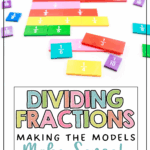









Most of us grew up dividing fractions by memorizing the chant “Keep, Change, Flip.” It was quick, worked, and helped us survive the test. We didn’t know why it was that way, and honestly, we didn’t care. We quickly implemented the algorithm, found it easy, and moved on. Now, those days are gone.
The Common Core Standards for fifth-grade math insist that we use fraction visual models rather than the algorithm. Students don’t learn to flip and multiply, or the “Keep, Change, Flip,” until 6th grade. If you have been around a while, this likely doesn’t surprise you since virtually everything in upper elementary Common Core wants students to understand what is happening, how it’s happening, and why the answer is what it is. There is no exception, including dividing fractions.
Since students are expected to understand what it means to divide fractions, we have to put away the algorithm and create models. But, if you’ve ever tried to model dividing fractions with bars, rectangles, or number lines and found yourself staring at your drawing thinking “Wait…how exactly do I do this?” — you are not alone.
Today, I want to slow down and help you make sense of dividing fractions with visual models so you can confidently explain it to your students (without sneaking in “keep, change, flip”). I’ll walk you through:
- The difference between dividend and divisor in word problems.
- Step-by-step bar models for common types of fraction division problems.
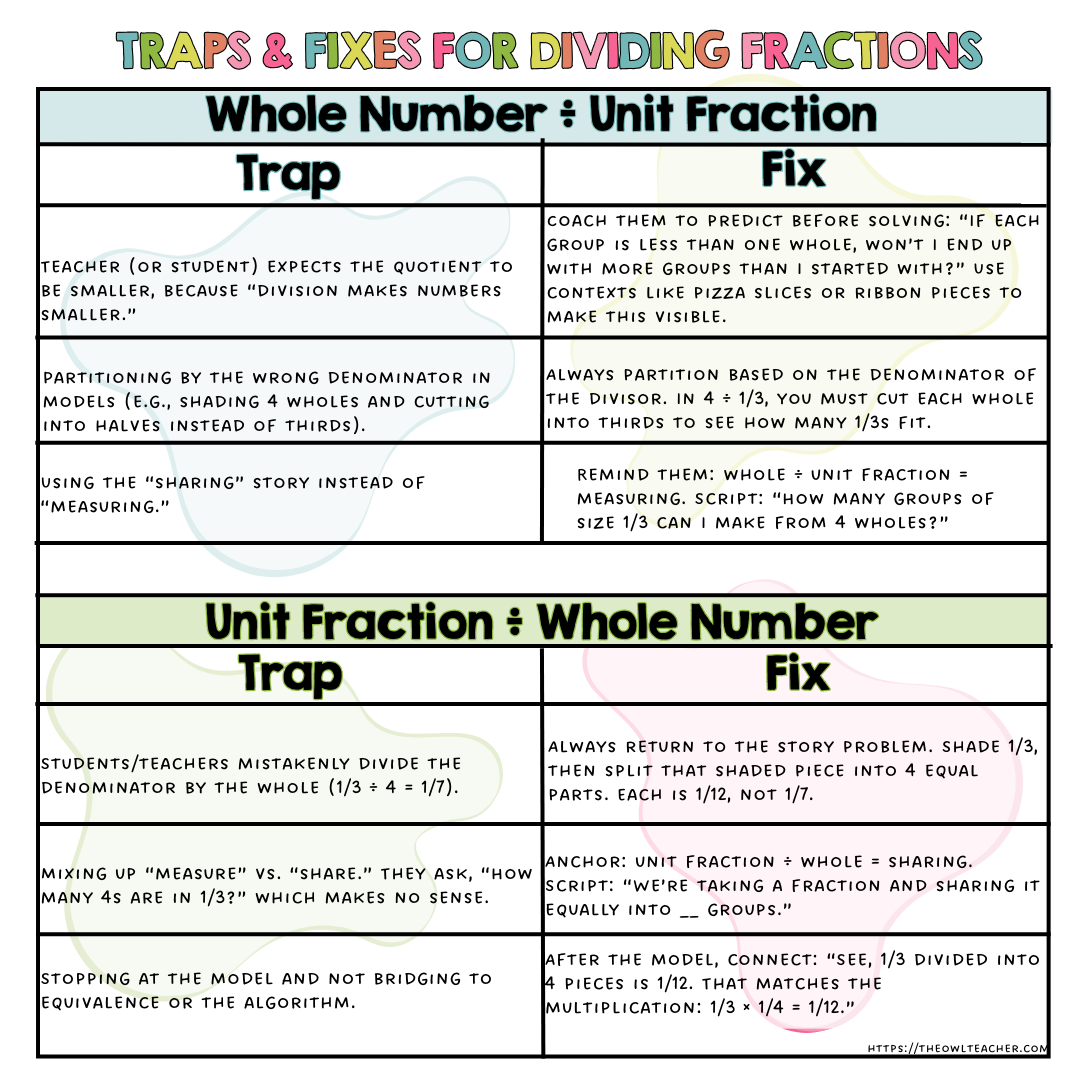
- The traps teachers (and kids) fall into.
- A fun, active way to help students truly “see” what’s happening.

Reasons for Confusion when Dividing Fractions
As mentioned before, dividing fractions can be challenging for many adults because we weren’t taught the visual models. We can follow a textbook’s directions, but they still don’t help when we encounter a challenging or “trick” problem. At that point, we don’t want to be left trying to figure out the meaning on our own.
With that said, when teachers tell me they are nervous about dividing fractions, here are the three biggest reasons:
- Division Already Has Two Meanings
- Sharing (partitive): “I have 3 pizzas, I share them with 6 people. How much does each person get?”
- Measuring (quotative): “I have 3 pizzas. Each serving is 1/2 pizza. How many servings can I make?”
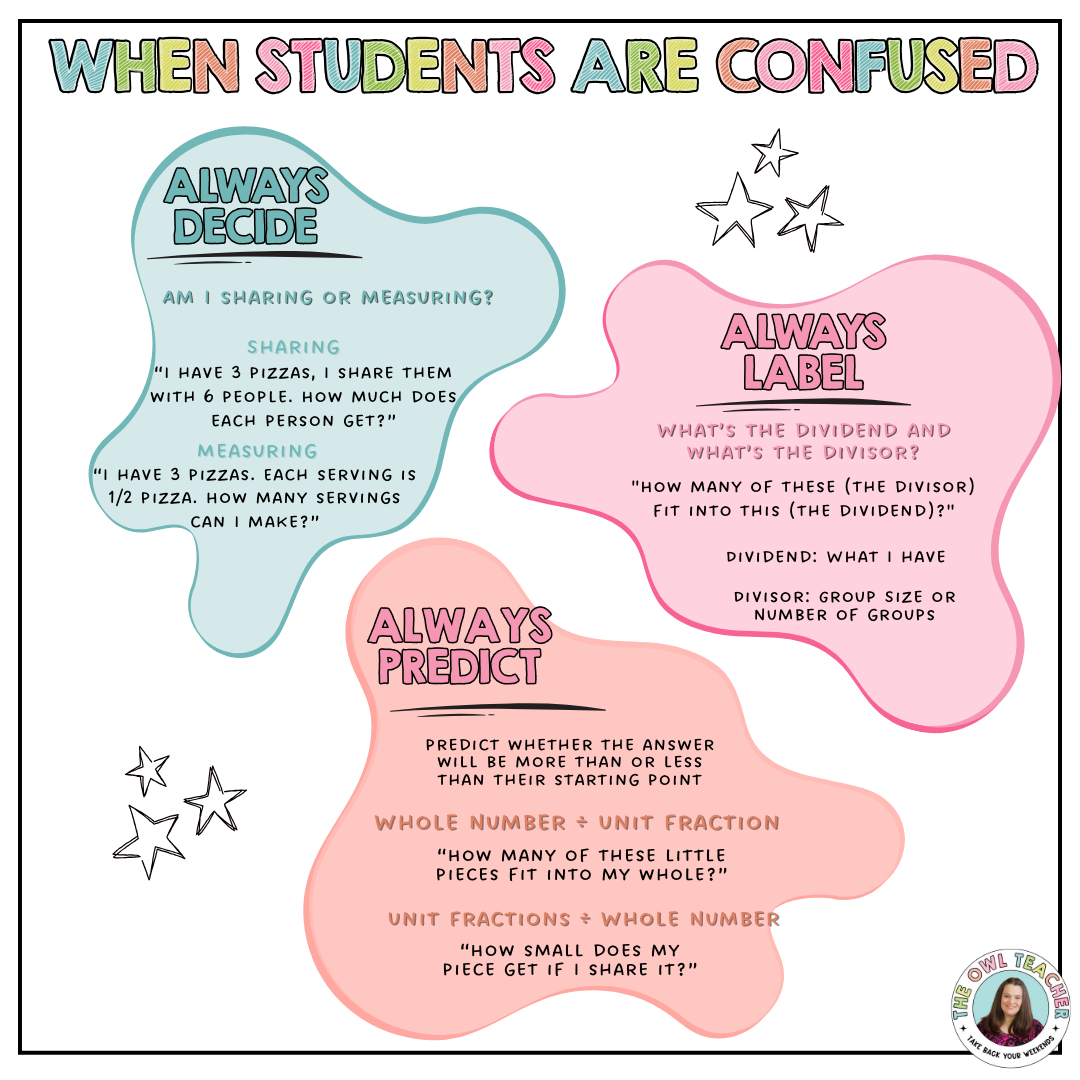
Most teachers (and kids) default to sharing. But when dividing fractions, measuring is often more natural. To combat this, always start by asking, “Am I sharing this out, or am I measuring how many fit?” Using both stories with children (such as cake shared vs cake sliced) and a signal anchor chart can be helpful.
- Fractions Are Dual-Purpose
- Fractions can be a quantity you have: “I shaded 2/3 of the bar.”
- Fractions can also be a group size: “Each group is 1/3.”
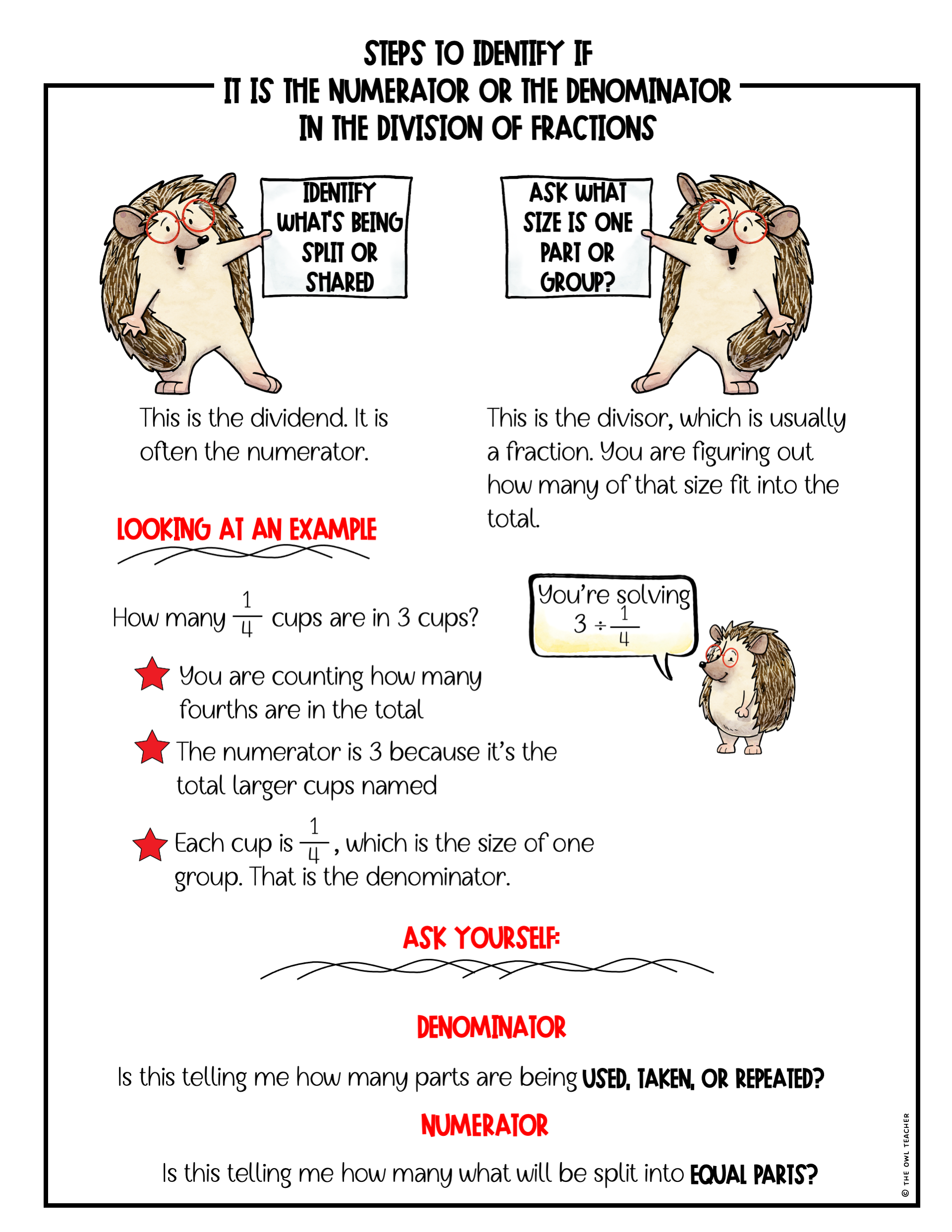
It can be confusing when a fraction plays different roles in a single problem. For example, in 4 ÷ 1/3, the four is a whole number you have, and 1/3 is the group size. But, in contrast to 1/3 ÷ 4, the 1/3 is what you have, and the four is how many people to share it with. To help students, it’s essential to explicitly label the dividend as “what I have” and the divisor as the “group size or number of groups” every single time.
Not only do we need to review the parts of division along with its relationship to fractions, but we also need to ensure that students understand how to write the problems when reading word problems. When reviewing division vocabulary, students need to know that the dividend is the quantity being divided, the shaded part; the divisor is the size of the group we are looking for, and the quotient is how many groups fit or can be made.
When we divide a fraction, we could easily ask students to ask themselves to think of these sentence stems:
- “How many of these (the divisor) fit into this (the dividend)?”
- “I have ____. Each group is ____. How many groups can I make?”
- “I have ____. I’m sharing it into ____ groups. How much is in each?”
This constant language not only helps them untangle the roles but also helps them learn the vocabulary.
- The Results Feel “Backward”
- 4 ÷ 1/3 = 12 → division made the number bigger.
- 1/3 ÷ 4 = 1/12 → division made the number smaller.
Per the multiplication of fractions standard in fifth grade, students need to notice patterns related to scaling. While it applies to multiplication, learning the patterns of dividing fractions can also help students understand why the results are the way they are. Students are taught early that division always makes numbers smaller. But dividing fractions breaks that rule, and without models, it feels like math is tricking them, which definitely leads to confusion.
While we hear it all the time, having students focus on the problem as if they are there in the situation will help students understand and connect more. Comparison charts could be placed in the room for students to reference. When reading the problems, ask students first to predict whether the answer will be more than or less than their starting point.
When dividing fractions, three things trip students up: divisions have two meanings, fractions have two roles, and the ‘backward’ results. The best way to help is to remember always decide, always label, and always predict, as indicated in the image below.
Let’s Look at Some Examples
In fifth grade, students aren’t expected to master fractions divided by fractions yet either. That also comes later in sixth grade. Instead, the Common Core State Standards (5.NF.7) keep things focused on two types of division problems, using visual models:
- Whole number ÷ Unit fraction (like 4 ÷ 1/3)
- Unit fraction ÷ Whole number (like 1/3 ÷ 4)
Example 1: How many sets of 1/3 are in four wholes? (Measuring)
When we are looking at a whole number ÷ unit fraction, we are asking, “How many unit fractions fit into the whole number?” Kids often stumble here because they expect division to make numbers smaller. But dividing fractions less than one increases the number of groups. The best way to counteract this misconception is to revisit the story problem continually. For instance, you may say, “If each serving is just 1/3 of a cake, doesn’t that mean you’ll get more servings than cakes?”
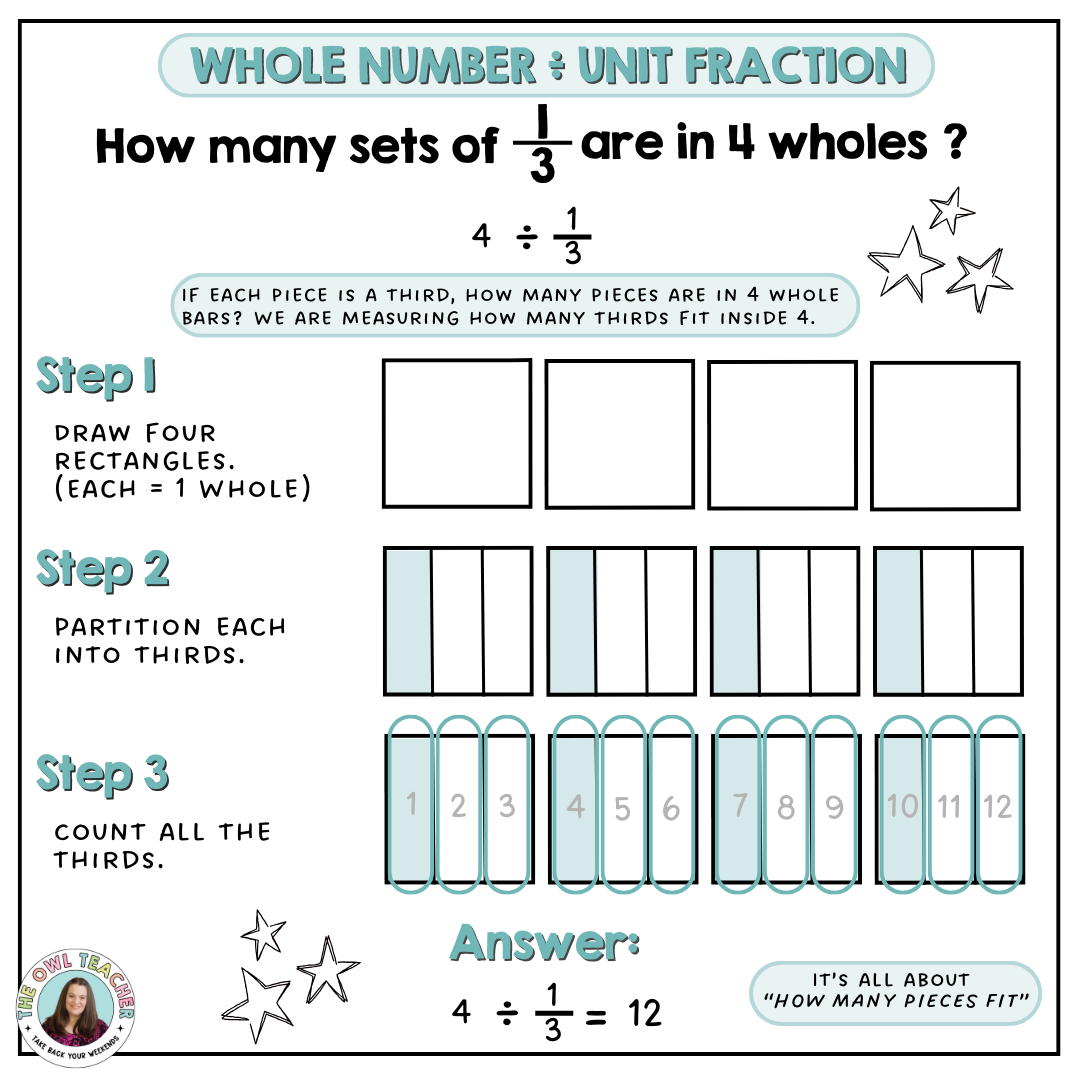
Equation:
4 ÷ 1/3 = ?
Step 1: Draw the whole number in the form of rectangles or squares.
Step 2: Now ask: How many thirds fit into this amount? Partition the same bar into thirds. (Shading is not necessary, but good practice!)
Step 3: Count the number of thirds inside each box. You’ll have 12 total. Students may notice that there are four boxes with 3 in each, leading them to multiply and arrive at 12. This is an excellent opportunity to connect multiplication as the reciprocal of division (for later on, when we flip).
Answer: 4 ÷ 1/3 = 12.
Example 2: If 1/3 is shared among four people, how much does each person get? (Sharing)

Equation:
1/3 ÷ 4 = ?
Step 1: Draw one rectangle.
Step 2: Partition that rectangle into thirds and shade one-third.
Step 3: Turning the opposite direction (or using a separate box if you prefer), create the four equal parts.
Step 4: Count what one piece would be. The denominator is the total number of boxes.
Answer: 1/3 ÷ 4 = 1/12.
As students complete these activities repeatedly, they will start to notice a pattern that makes “keep, change, flip” understandable when it’s time. They won’t need to create models anymore; they’ll automatically start multiplying.
Activity: Fraction Serving Station
Instead of sitting with pencils and silently shading, get kids up and moving with the Fraction Serving Station Activity below.
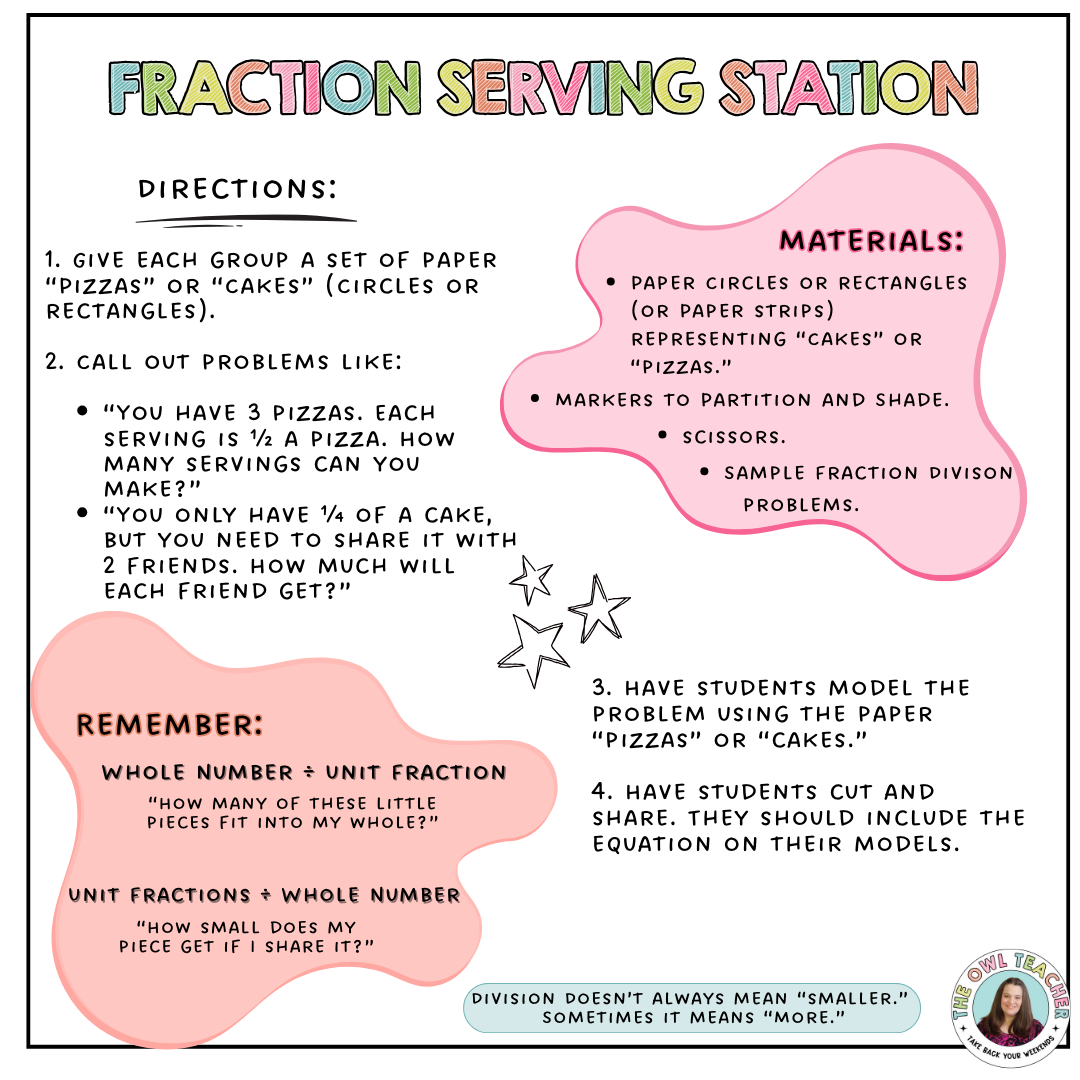
Materials:
- Paper Circles or Rectangles (or paper strips) representing “cakes” or “pizzas”
- Markers to partition and shade.
- Scissors
- Sample fraction division word problems
How it works:
- Give each group paper pizzas, cakes, or rectangles to cut apart.
- Call out a problem (e.g., “You have 4 pizzas. Each serving is 1/2 pizza. How many servings?”).
- Students model the problem, count the pieces, and write the equation.
- Flip it: (“You only have 1/2 a pizza. Share it among 4 friends. How much does each get?”).
This activity does two things:
- Reinforces the difference between whole ÷ unit fraction (more groups) and unit fraction ÷ whole (smaller pieces).
- Gets students physically cutting, sharing, and counting, rather than just staring at equations.
This approach keeps kids engaged, moves fraction division away from abstraction, and reinforces the interpretation of measures.
Conclusion
Teaching fraction division without the reciprocal shortcut is messy — but it’s also powerful. When your students see that dividing by a fraction means asking “how many of these fit?”, you’re giving them number sense that sticks. And here’s the best part: the day they are introduced to “keep, change, flip,” they’ll understand why it works. It won’t be magic. It will be math. Remember, “Students who only memorize rules without meaning are the first to forget them when the rules no longer apply.” (NCTM, 2014, p.6) So slow down. Draw the bars. Always label the dividend and the divisor. And watch those traps!
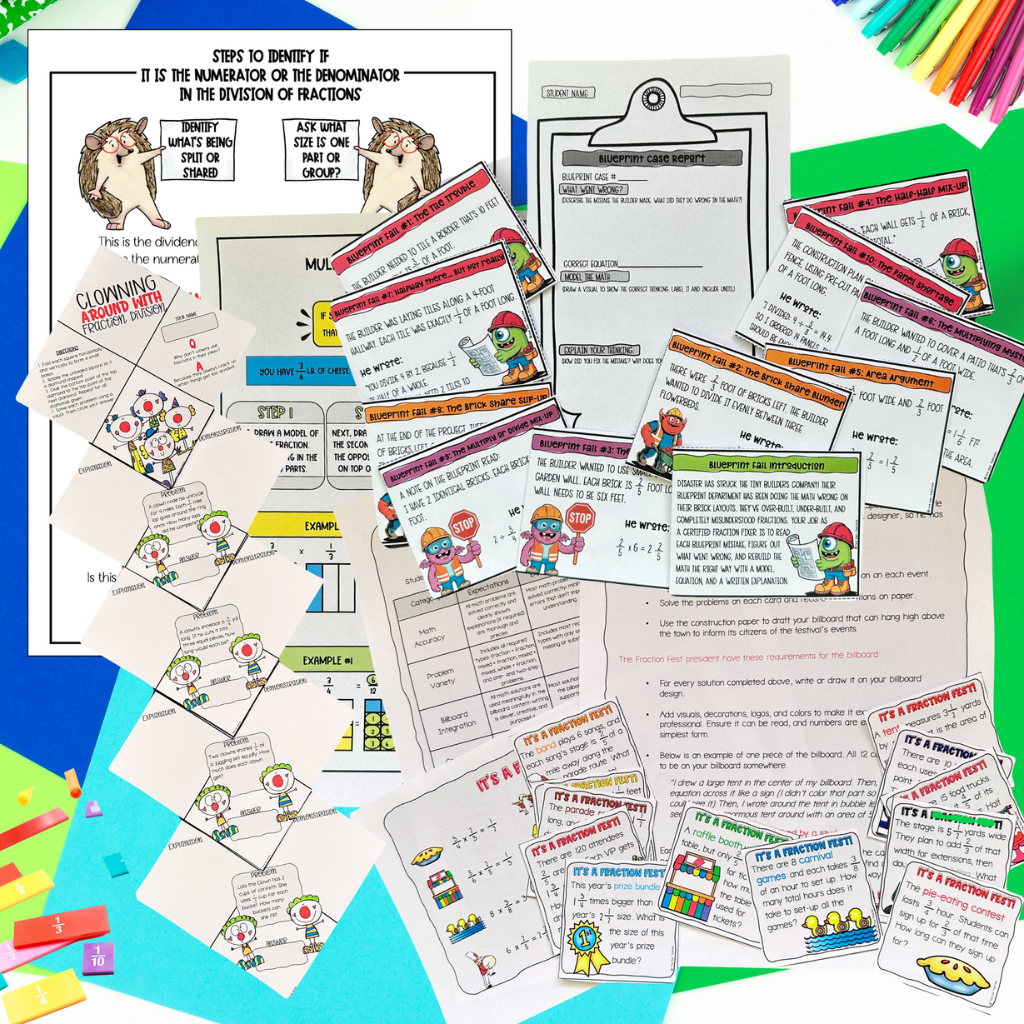
Of course, you can avoid the traps and trouble by picking up my complete fifth-grade math unit on multiplying and dividing fractions by clicking on the image below.

Sources:
National Council of Teachers of Mathematics. (2014). Principles to actions: Ensuring mathematical success for all. Reston, VA: Author.