







This is a sponsored guest post. I was paid to publish it, but I only share content I think is useful for teachers.
Every math teacher has seen it, especially at the elementary level: students struggling to justify their math. For instance, a student solves a problem correctly but fumbles for words when asked to explain the reasoning. That’s when you start to question whether the student truly understands the concept or is just following a memorized procedure.
And the national numbers back up that concern. According to the 2024 National Assessment of Educational Progress (NAEP), only 39% of US fourth-graders performed at or above Proficient in Math. Although this is an overall assessment, it also reflects reasoning ability.
A strong foundation empowers students to tackle complex math problems with confidence. Teachers in grades 3 to 5 are uniquely positioned to strengthen a student’s foundation.
Here are four practical ways to encourage deeper understanding before misconceptions become harder to address. They teach mathematical justification so kids understand the why, and so you can catch misconceptions before they stick.
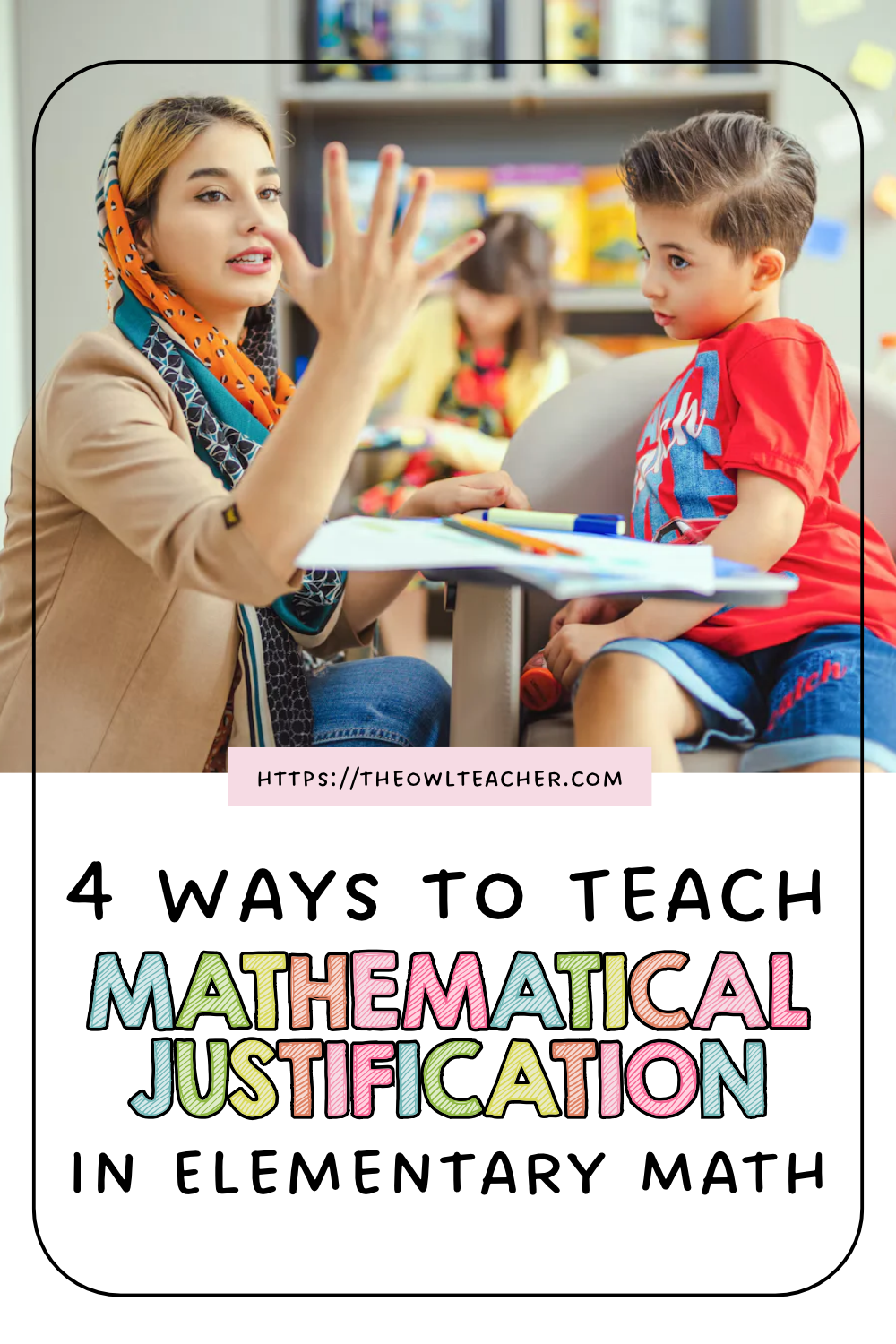
Why Mathematical Justification Matters
When students memorize formulas and concepts, they overload their working memory. However, their reasoning faculties lie dormant. Because mathematical concepts build on one another, this approach won’t work every time.
If teachers make mathematical justification a regular part of teaching, they can address misconceptions early and help students become independent thinkers. Students then start to see themselves as math thinkers, not just answer finders. So, this kind of learning requires thoughtful teaching and collaboration among educators.
Those who wish to shape mathematical instruction on a larger scale can explore leadership opportunities through advanced professional study. They can even pursue a degree beyond a master’s. Online EdD programs in Higher Education would prepare experienced teachers for instructional leadership and mentorship roles. In this context, teachers can assess whether current mathematics pedagogy matches student needs.
As the American International College notes, anybody with advanced knowledge can coach new teachers, design district-wide initiatives, and shape student learning for years. In a nutshell, it’s ideal for those who aspire to turn classroom experience into meaningful change across schools and districts.
At the school or district level, leaders can help make mathematical justification part of everyday math by:
- Encouraging the use of visual models and open-ended problems
- Having teachers evaluate students’ reasoning, not just if the answer is correct.
- Using shared lesson planning for mathematical justification
- Using team-based professional development
1. Use the Always-Sometimes-Never Method to Help Test Mathematical Claims
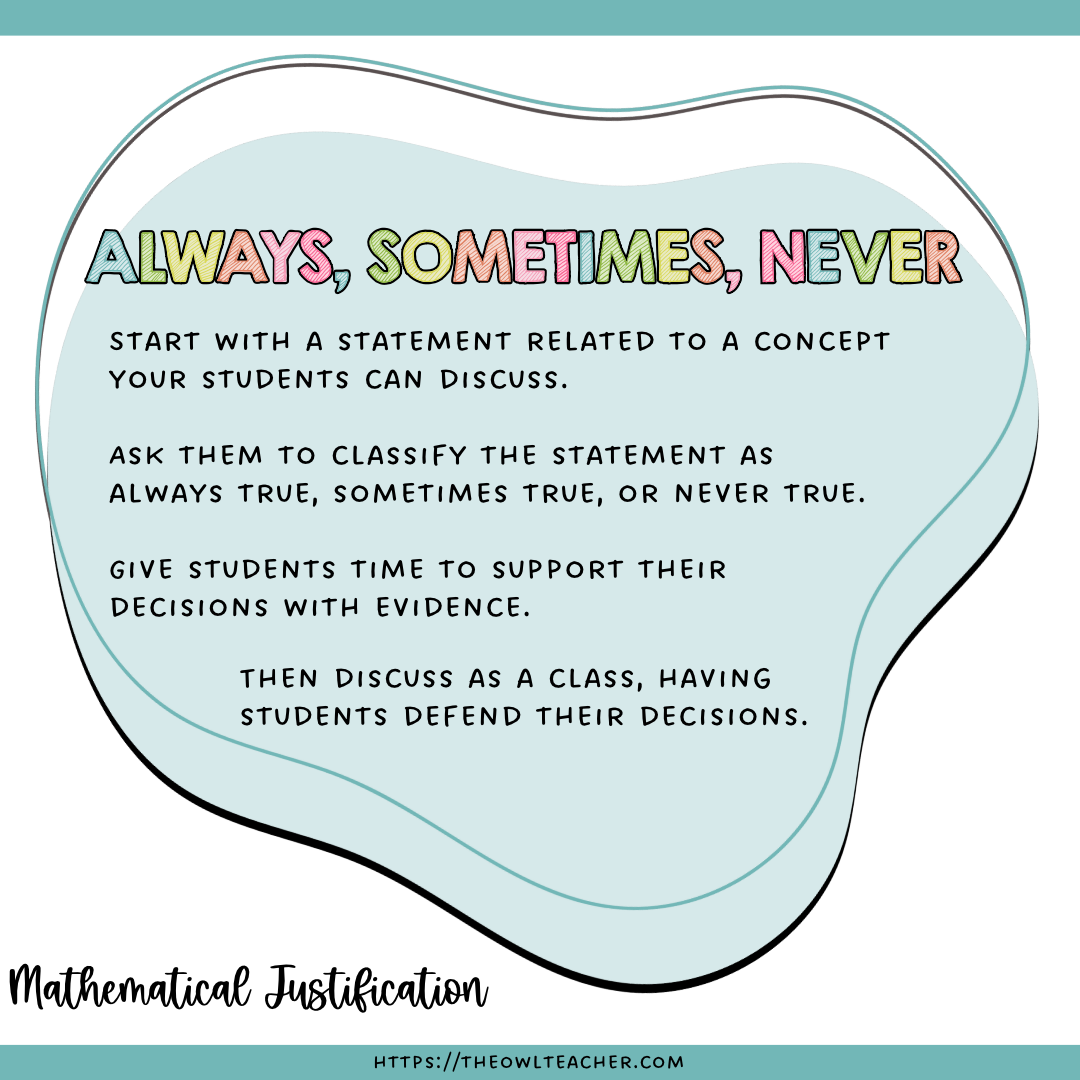
With this mathematical justification method, students take a statement and determine whether it is always, sometimes, or never true.
This method helps students test the rule instead of trusting it. In other words, it is designed to make students think, especially since many apply a math rule to a familiar problem even though they may not understand when it applies.
Asking students to decide when a statement is always, sometimes, or never true encourages them to test the rule. Research shows students need this kind of practice. A 2025 review of 55 studies on K-12 mathematical argument writing found that students’ written reasoning often misses the mark. Unfortunately, getting the answer is not enough. Students need to practice explaining how they got there.
How to Do It:
Start with a statement related to a concept your students already understand. Then ask them to classify that statement as always true, sometimes true, or never true.
Give students time to support their decisions with examples, calculations, or even drawings. Then, discuss the conclusions as a class. If any student disagrees with another student’s explanation or thinking, have them use evidence to support it and explain why.
Sample Prompts:
- Can you find an example that supports your decision?
- Can we find a counterexample?
- If it’s sometimes true, when is it true?
- How would you convince someone who disagrees with you?
- Did you find a reason it’s always true, or did you just test a few examples?
Once students get the hang of this activity, also have them come up with statements to test. When teaching geometry, everyone can sit together and investigate the claim that “every four-sided figure is a square” is true. Students can draw different quadrilaterals and compare their properties to prove their answers.
2. Have Students Prove Their Answers With Models & Evidence
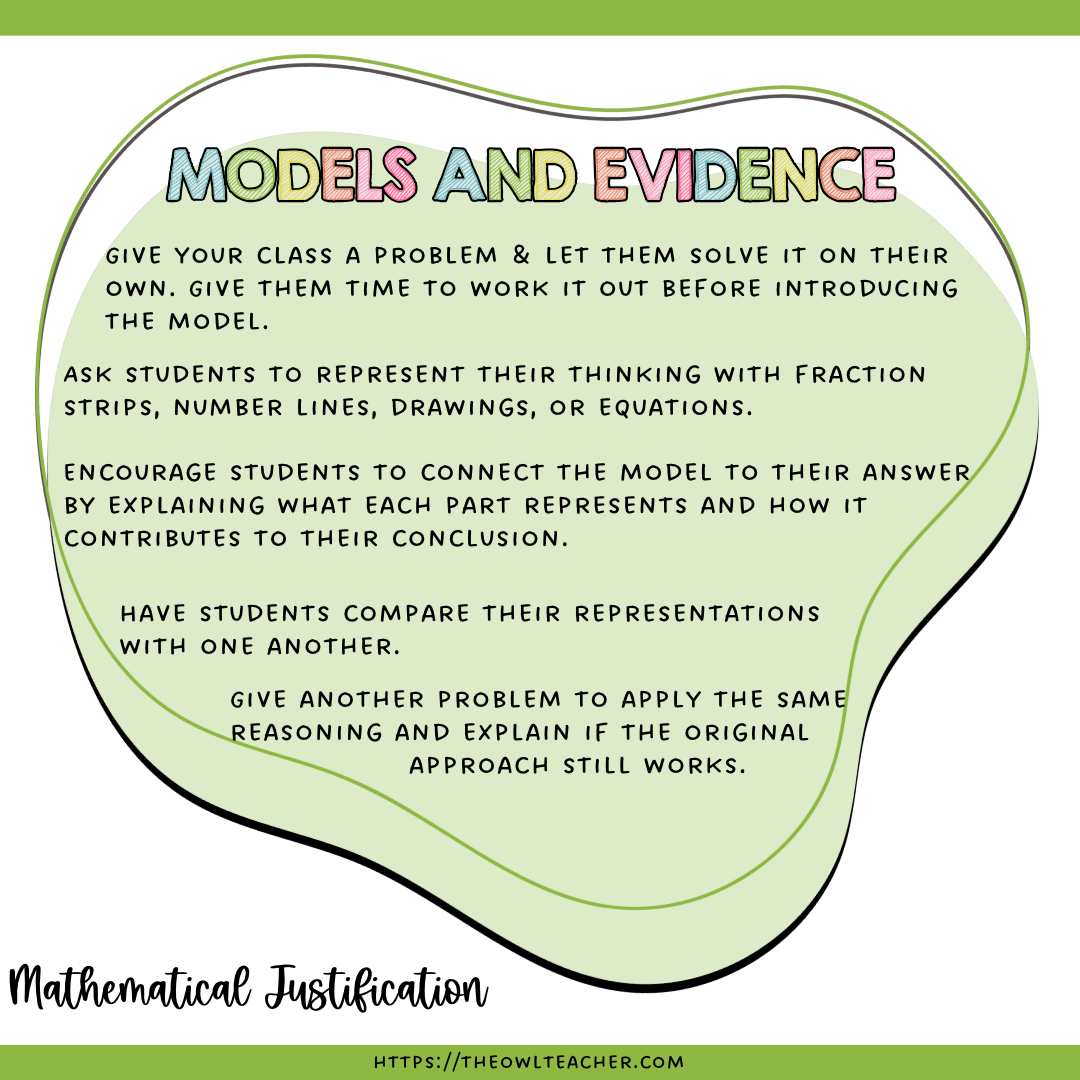
This mathematical justification helps teachers distinguish students who just know the steps from those who truly understand the concept.
Many students know math well enough to get the correct answer, but not enough to understand the concept behind it. Mathematical models make the concept visual, giving students something concrete to use as evidence.
Here, each child can evaluate their reasoning by clearly communicating their mathematical ideas. In a 2026 report, Education Week revealed that 9 in 10 educators or administrators viewed fractions as a foundational skill their middle and high school students lacked.
Teachers must ask students to show not just the answer they found, but also how their representations support it. This helps close that gap early.
How to Do It:
- Give your class a problem and let each student solve it on their own before you introduce a model. Allow time to work out the answer.
- Have students show their thinking using fraction strips, number lines, drawings, or equations.
- Have students connect the model to their answer by explaining what each part shows
- Have students compare models. Ask if a different model could show the same thing.
- Give a similar problem with new numbers and ask if their reasoning still works.
Sample Prompts:
- What does each part of your model show?
- How does your model show that your answer is correct?
- Can you connect your model to an equation?
- Could a different model show the same thing?
- Would your reasoning still work with different numbers? Why?
For example, students can compare fractions using both fraction strips and equivalent fractions. They can explain how both prove the same answer.
Models can help you test misconceptions. Ask students, “Does multiplying always make a number larger?” Then show them examples, like multiplying by a fraction, that challenge their thinking.
3. Let Students Analyze Incorrect Solutions and Explain Errors
This method teaches students to spot errors, explain why they are wrong, and correct them using mathematical justification.
Students get wrong answers for many reasons. Some misunderstand place value. Others only know half the procedure. Error analysis makes them dig into the thinking behind an answer and it shows you what they really understand. This gives teachers valuable insight into students’ understanding.
A 2025 study analyzed the mathematical errors of 206 4th- and 5th-grade students struggling with the subject. The researchers found around 1,646 errors across 22 computation problems and 10 word problems. On computation problems, the most common mistakes were miscalculations, regrouping errors, and subtracting the smaller digit no matter which number was on top. On word problems, the most common mistake was picking the wrong operation or setup. The need for mathematical justification is significant.
When students study a wrong answer, they get better at finding those same mistakes in their own work.
How to Do It:
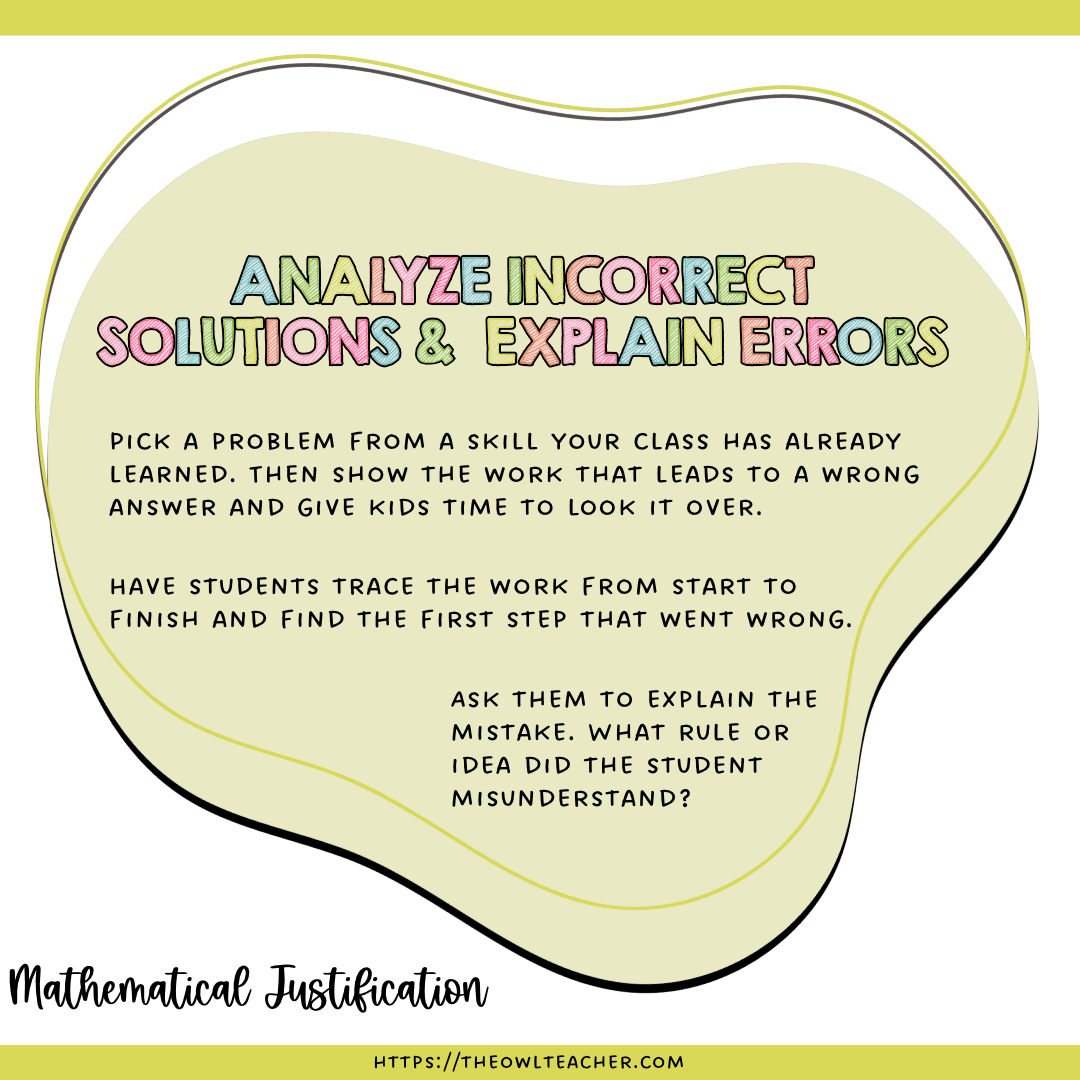
- Pick a problem from a skill your class has already learned and show the work that leads to a wrong answer. Give students time to review it.
- Have students trace the work from start to finish. Then find the first step where it went wrong.
- Have students explain the error. Ask them, “What rule or idea did the student misunderstand?”
Sample Prompts:
- What is the problem asking us to find?
- Which step takes the answer in the wrong direction?
- Did the student misunderstand the question, or did they calculate wrong?
- What information in the problem tells us which rule to use?
- How can we fix it without changing the parts that were right?
- How can we check if the new answer makes sense?
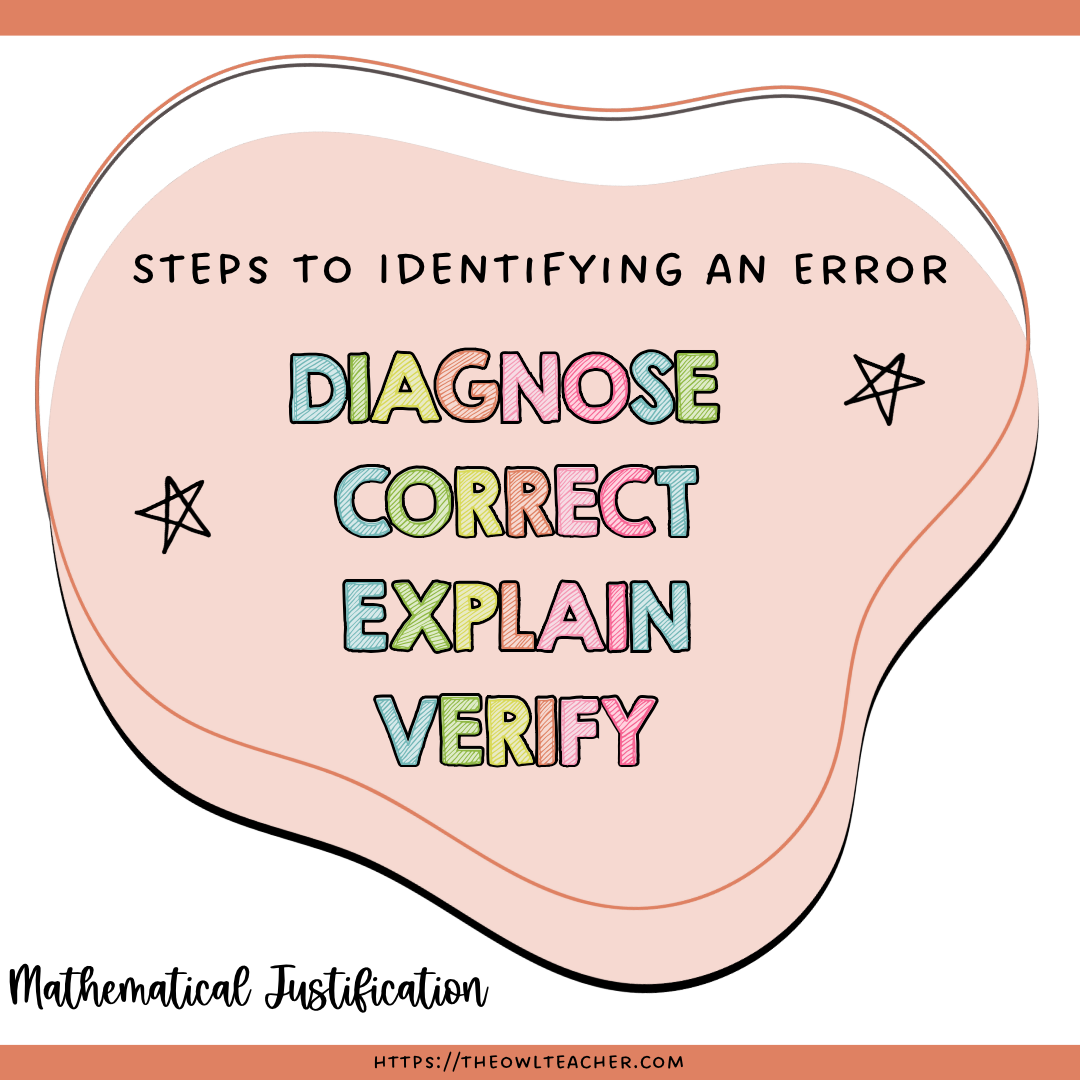
Students will get the support they need to distinguish between different types of mistakes. You can even follow the classic ‘Diagnose, Correct, Explain, and Verify’ strategy. In this order, students can first identify the step that caused the mistake, then provide the correct solution.
Then, they can explain why the first way failed and why the corrected way works. They can then check their answer using another way or the information provided in the problem.
4. Compare Different Ways to Solve the Same Problem
With this form of mathematical justification, students see that a problem can have more than one method and learn why each one works.
Two children can get the same correct answer and think about it in completely different ways. For example, one may break numbers apart, another may use the standard algorithm, and another may use repeated addition. Each student may think their way is the only way that exists until they see how others do it.
A 2025 NPR report on teaching math in Alabama is a good example. In one third-grade classroom, students were challenged to solve 12 x 9 mentally. The class used different approaches. One student counted by nines 12 times, while another broke 12 into 10 and 2, multiplied each part by 9, and added the results. Both methods produced the same answer: 108.
Alabama’s State Superintendent, Eric Mackey, spoke about the value of mathematical thinking. He said, “Math is a way of thinking about the world. It really is the language of philosophy.” In other words, math done right isn’t just about solving problems.
How to Do It:
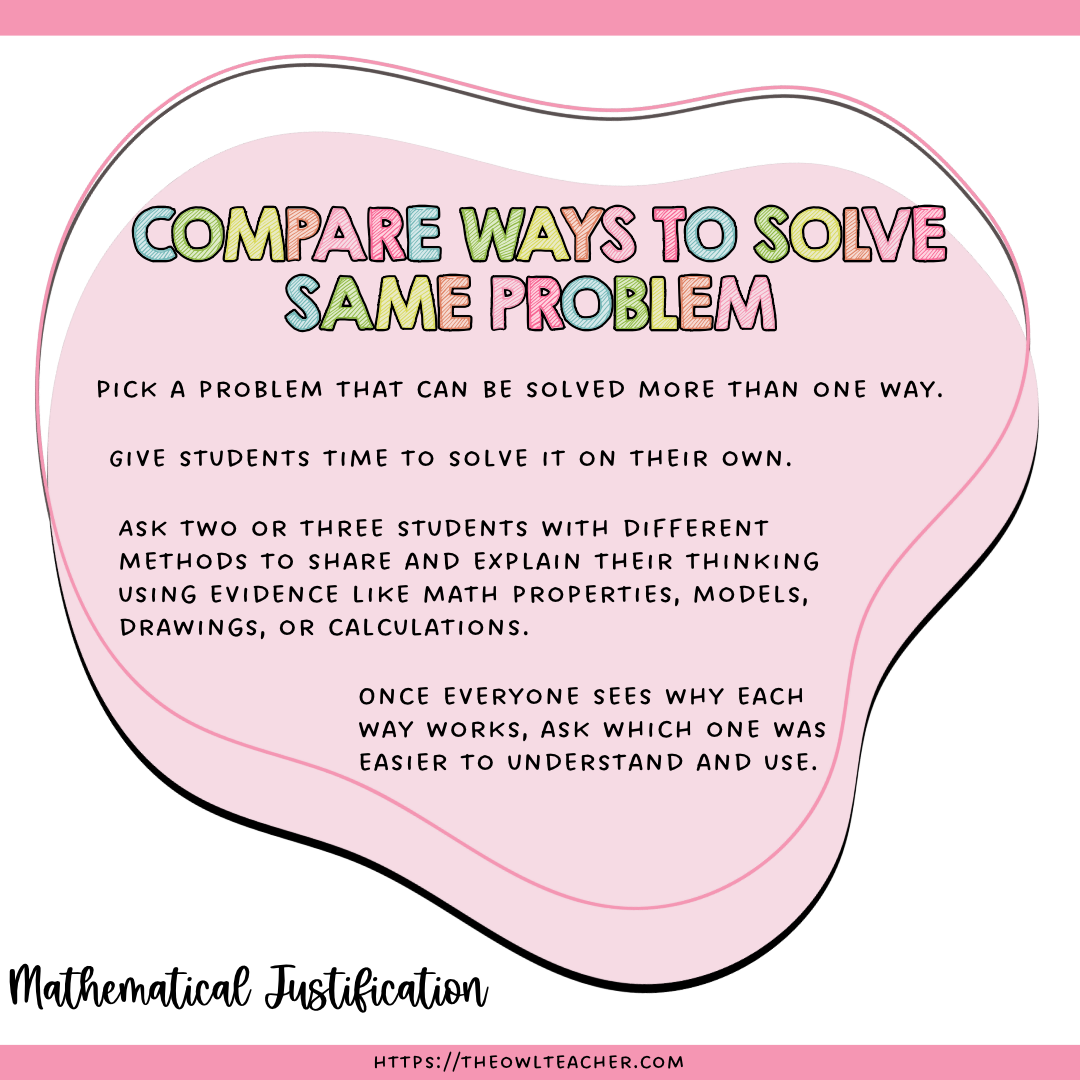
- Pick a problem that can be solved more than one way.
- Give students time to solve it on their own.
- Ask two or three students with different methods to share.
- Have each one explain their thinking.
- Ask them to support their method with evidence, such as math properties, drawings, models, or calculations.
- Once everyone sees why each way works, ask which one was easier to understand and use.
Prompts to Use
- How are these two methods alike, even though the steps look different?
- What math idea makes each method work?
- How does a step in the first method connect to a step in the second?
- Which method do you think is fastest or easiest?
- Would both methods work with different numbers? Why or why not?
- How would you explain your favorite method to someone who disagrees?
It’s important to have students point to specific steps when they explain. For instance, instead of saying breaking apart 12 is easier, they should explain how 12 = 10 + 2 lets them calculate two smaller products and combine them without changing the original expression’s value.
Make it Part of Every Math Lesson
You don’t need to add a giant reasoning block to an already packed schedule. Students would likely tune it out. It works best as a small, regular part of your math lessons, like a warm-up.
Remember that progress takes time. In Maryland, 35.8% of students in grades 3-5 were proficient in math in 2025-26, up six points over five years.
Keep using these strategies, and explaining their thinking will eventually start to feel normal. Over time, they won’t stop at finding an answer; they’ll start to understand why it makes sense.