








COPYRIGHT © 2016-2026. The Owl Teacher | Privacy page | Disclosure Page | Shipping | Returns/Refunds
When I mention picture books in the classroom, I’m sure your first thought is of a lower-elementary read-aloud. My kiddos always loved those days–relaxing in a circle listening to the latest iteration of “If You Gave a Mouse a Cookie.”
So let’s bring those days back!
One of my all-time favorite activities when teaching problem solving in the classroom is to bring in picture books and have my students create their own math problems themselves. Then students will exchange “books”–the newly-minted math problems–and solve the problems from their peers to get in the much-needed practice. This method not only helps them practice problem solving strategies, but it also engages and excites them.
If you have extra time, or if you want to make the lesson into more of a project, you can have students create illustrations and bind the pages to make it more of an official problem-solving picture book. Ultimately, so long as students are engaged and getting in some practice, it’s a win!
Problem Solving Picture Book Choices
To start, I go through the various choices to decide which picture book I want to read to my class. There are a wide variety of picture books out there that are wonderful for teaching problem solving skills and offering problem solving exercises. Sometimes, I’ll break my students up into groups of 3 or 4 and give each group a different book to read on their own rather than do a read-aloud.
Still, though, which books should you choose?!
Call me old school, but you can never go wrong with Greg Tang and any of his stories. For instance, in The Grapes of Math, the story follows a girl as she uses math skills to pick grapes from a mysterious tree. Throughout the story, your students can solve problems that are posed by the tree, such as creating patterns with shapes and numbers. He also writes Math-terpieces: The Art of Problem-Solving. It features beautiful paintings and engaging stories that encourage students to explore creative ways to solve math problems.
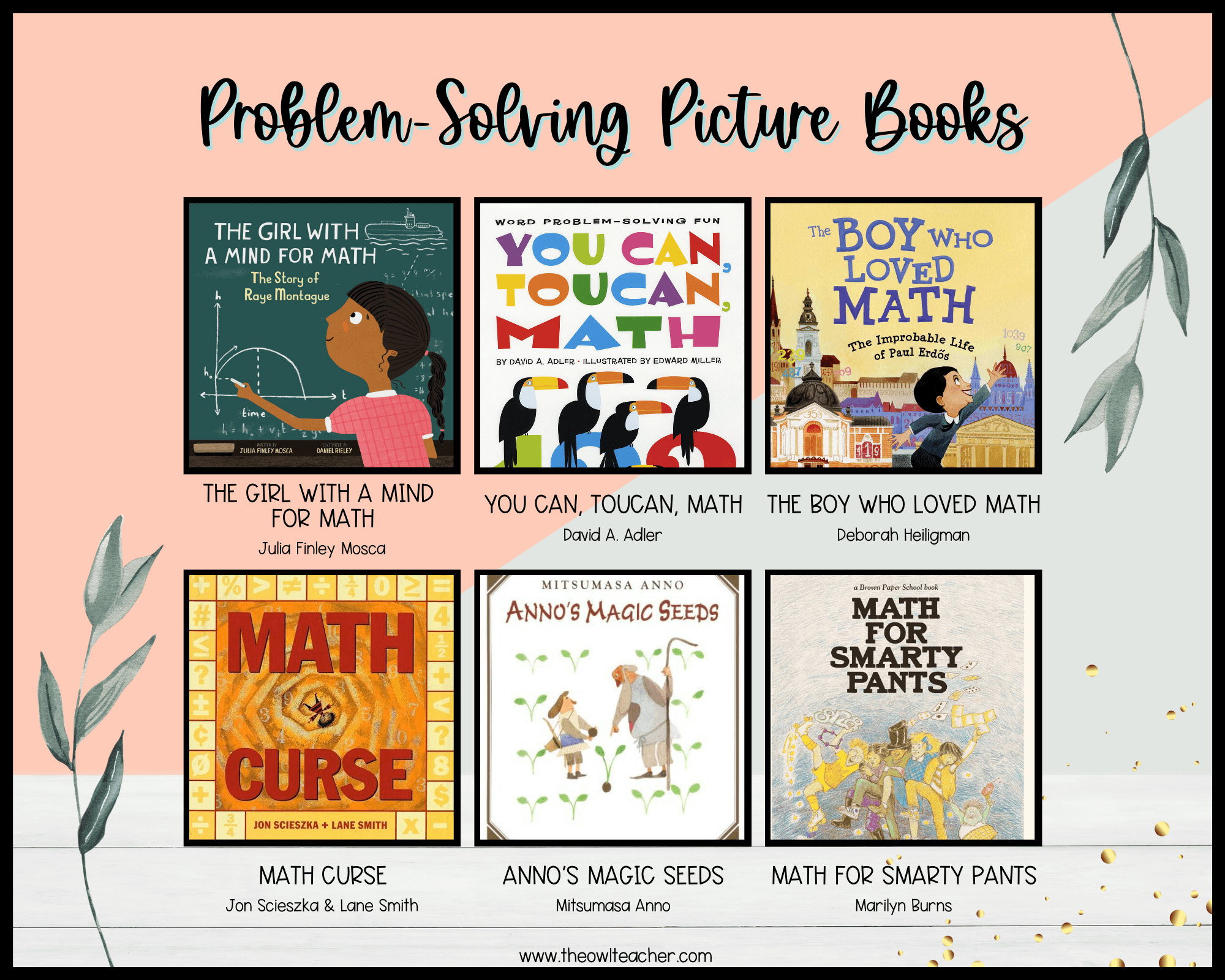
Alternatively, you can check out any of these prime problem-solving pieces:
- The Girl with a Mind for Math
- You Can, Toucan, Math: Word Problem-Solving Fun
- The Boy Who Loved Math
- Math Curse
- Anno’s Magic Seeds
- Math for Smarty Pants
While the books above are certainly excellent tried-and-true resources, they’re just the tip of the iceberg as far as problem-solving picture books go. There are a plethora of other enchanting books related to specific math concepts as well as many excellent series such as the Sir Cumference books, the Arithmechicks books, the Warlord’s Series, and so on. New math books are released constantly, so there’s bound to be a perfect fit for your classroom somewhere!
The Problem Solving Assignment
After students have thoroughly vetted the problem solving books, we reconvene to discuss how problems were solved in the stories–easy text-to-self connections, anyone? During our discussion (and afterward!), I try to make problem solving as painless as possible. It’s important that students are able to solve problems and think critically, as this is a life-long skill that applies to so many areas beyond mathematics! There’s really no understating the importance of problem solving; that being said, if you’re in need of help teaching the concept, I do offer a problem solving unit for purchase here.
Together, we discuss the different problem solving strategies such as working backwards, guess and check, drawing a picture, and so on. I like to make sure that I have modeled not only how to solve problems, but also the spirit of perseverance and how to handle mistakes.
Next, I model how to write a word problem. I start off with a one-step problem, but my goal is to eventually have my students write a two-step word problem. Depending on how the initial lesson goes, we may or may not reach two-step problems in one day. If not, no worries! We can revisit it at a later time.
After I write out a word problem, I have students use scrap paper to try it themselves. I’m huge on the gradual release of responsibility model (alternatively referred to as “I do, we do, you do“). I give students a few minutes to write up their own word problem and then call on a few volunteers who are willing to share. Once I feel students are ready and rocking it, I have them move on to creating their own books!
If your students are still in groups, have them decide on a common theme and then have each student in the group create one of the pages. Then they put them together to create the book. Otherwise, provide students with one or two pieces of copy paper, fold them in half, and voila! They are ready to get started!
Depending on time and desire, you could have students exchange their hot-off-the-press books and complete the problems. If you decide to exchange books, I would make sure that students provide an answer key for their books. Then, when completing the problems, students can check it against the answer key and “grade” it to some degree. Of course, I would definitely create a rubric for a true summative assessment.
You know your students best, so only you can say what the perfect fit is for them. Regardless of how you choose to teach problem solving in your classroom, I’m sure it’ll be a hit!

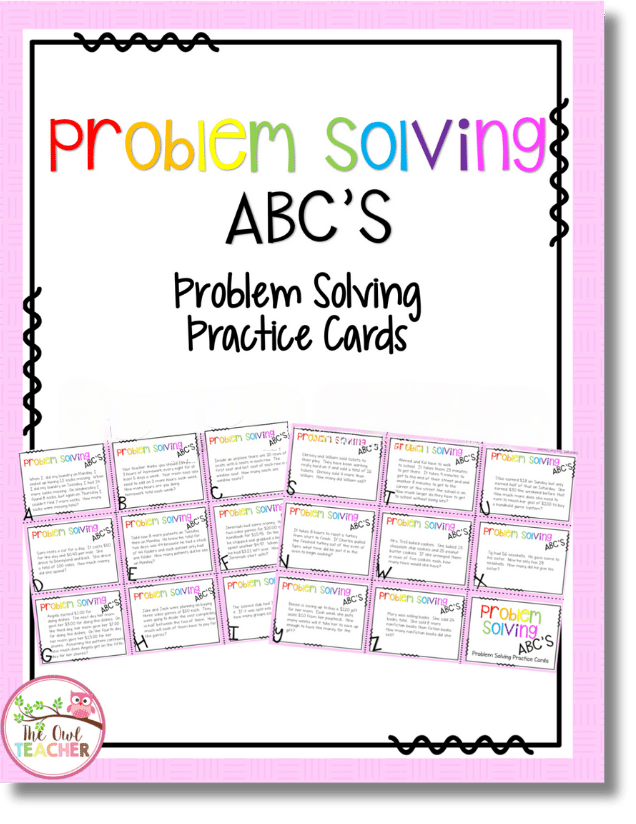
ABC’s Problem-Solving Practice Cards FREEBIE
Want a FREE problem-solving activity to help your students practice word problems? Check out this FREEBIE below!