





How are you feeling today? Did you wake up bright and early, or did you oversleep? Are you well-rested? Maybe you had lots of protein for breakfast, or maybe you skipped breakfast entirely (though I hope you didn’t!).
Regardless of the kind of day you had, one thing is for sure: you’re full of energy. Of course, you may not always feel like it, but it’s true nonetheless! It’s not just you, either; all of the various types of energy are all around us, from overhead lights to toasty furnaces.
Of course, you’re an educator, and likely a science teacher, so surely you already know all about the types of energy! Certainly I don’t need to point them out to you, right?
Well, the goal of this blog post is to get you thinking about the variety of ways we interact with the energy around us that we may overlook or take for granted on a day-to-day basis. We can start with the basics: energy is the ability to do work. However, to students, this definition makes it sound like energy is always a visible process, like knocking over a glass or throwing a ball. It’s important to remind kiddos that all energy affects matter in some way, so while they can’t always see the work being done, it’s definitely there!
While I’ve written about ways to explore types of energy in the past, I wanted to revisit the subject in order to provide specific examples for each type rather than the broad strategies outlined in the prior post. Of course, those methods still hold up—these tactics here are simply more specific to each energy type!
With that in mind, what can you do to ensure your classroom is exploring the types of energy to the best of their ability? For students to have an in-depth understanding of this physical science concept, it’s important to give attention to all types of energy. It may seem overwhelming to focus on them all at once, but when we break it down into ten different tactics, it becomes much easier–and your students will get it, too!
Ready to take a look? Let’s pump up the energy!
1. Brisk Brainstorming
Once you’ve briefly introduced the types of energy, consider conducting a class-wide brainstorming session! On the whiteboard or a hanging chart, work together as a class to come up with as many examples of energy as you can, such as the overhead lights or the sound from the PA system. Then, have students think-pair-share to determine what types of energy are at play with all of the examples written down on the list.
If you’d prefer, you can have students think-pair-share to come up with examples for each type of energy after you introduce them, and then share those out to the class. It’s your classroom—you know what works best! Either way, it’s important to get your students to start thinking about the way they interact with the various types of energy on a daily basis. Understanding the impact of energy on our everyday lives is a sure way to help students apply their learning to real life, which is something we should always strive for!
2. Hands-On Energy Hunt
In the spirit of the types of energy, get your kiddos up and moving! Allow students to go on an “energy hunt” around the classroom (or even around the school, if you’re feeling particularly adventurous). Each student should have some kind of recording sheet (just a plain piece of paper will do) where they jot down common objects around the room and identify the types of energy associated with each object.
As with anything, make sure to emphasize observation and critical thinking! Have students work in groups or partners in order to think-pair-share to explain their thought process on why each object uses the types of energy they chose. Once the class has been given ample time, reconvene as a whole group to share thoughts on the classroom’s objects and their types of energy.
Once you feel your students have started to differentiate between the types of energy, it’s time to move on to more specific energy exploration!
3. Marvelous Movement
Energy experiments are an excellent way to engage your students, but it can be hard to find the time to set up complex activities, especially for all of the types of energy. Thankfully, you don’t have to spring for big, lavish experiments—energy is ever-present in all kinds of situations, from big to small!
Kinetic energy, for instance, can be demonstrated with simple activities, such as rolling a ball down a ramp, swinging a pendulum, or even just (safely) dropping an item on the ground, like a pad of sticky notes. Ultimately, you want to show your students the transformation of potential energy into kinetic energy.
If you’re looking for something with less set-up, check out my kinetic and potential energy science sort craftivity! Anything that can get your students working with something tangible is always a win, especially with types of energy.
Once you’ve demonstrated several examples of kinetic energy, have students show off examples of their own. Get them up and moving to stay engaged!
4. Playful Potential
Your students have a lot of potential, in more ways than one! I’m sure you’ve never heard that joke before, right? 😉
Bad jokes are sure to engage your classroom, of course, but even better than puns are hands-on learning tactics! First, take a few moments to explain potential energy to your kiddos: it’s stored energy just waiting to be used! Everything has potential energy (well, everything at this elementary level, anyway), but it’s easiest for students to grasp the concept of potential energy with examples such as a stretched rubber band (elastic potential energy) or a textbook held up in the air (gravitational potential energy).
Stretched rubber bands can make for an engaging hands-on activity; however, if you choose to go this route, it’s important to make sure your students understand the importance of safe learning. Communicate guidelines about the activity, such as keeping the rubber bands in their hands at all times and never stretching them in the direction of another student.
If you prefer to avoid the rubber bands entirely, no worries! Another great activity is to set up “ramps” around your classroom of varying steepness and have students place marbles at the top of each ramp. Remember that by increasing the height of the ramp, you increase the amount of gravitational potential energy. See if your kiddos can come to this same conclusion!
5. Mechanical Marvels
What’s better than the loud chaos of a bowling alley? Taking your students bowling, of course! Bowling alleys are full of mechanical energy.
If you can’t get your classroom to a bowling alley, though, that’s okay! Instead, introduce mechanical energy as the energy of motion, combining kinetic energy (movement) and potential energy (position). Some of the more common examples include hammering a nail or knocking down pins with a bowling ball.
With that explanation, you can then bring your students to the bowling alley in your own classroom! For this activity, you can use cardboard toilet paper rolls to set up as “pins,” and have students roll crumbled up notebook paper at the “pins” to knock them over. It’s easy to get carried away in the fun, so make sure to put an emphasis on the mechanical energy in the activity!
6. Light and Bright
Light energy is one of the easiest forms of energy for students to grasp, since they can see its presence all around us. From the Sun illuminating our days to the buzzing florescent lights overhead in our classrooms, light energy is responsible for providing us with vision in our daily lives as well as making photosynthesis possible!
However, the ease of understanding light energy doesn’t mean it should be ignored. I like to include a small but worthwhile activity, such as creating a simple prism to show students the different colors present in light. Otherwise, there are plenty of hands-on resources, too, such as my sound and light energy science sort craftivity!
I suppose you could also demonstrate light energy by flicking a flashlight off and on… But that’s kind of lame, don’t you think? 😉
7. Heat it Up
Just like light energy, thermal (or heat) energy is one of the more straightforward types of energy that students can generally pick up on easily. Thermal energy is present in warm objects, like campfires and stovetops, and can be transferred to other objects.
To demonstrate thermal energy in the classroom, there are plenty of activities you can use. For instance, if you have a window in your classroom, you can tape up several differently-colored pieces of construction paper to the glass and determine which color conducts heat the best. If you do not have a window, though, that’s okay! Instead, you can pour warm (not hot) water into several different types of cups, such as plastic, paper, and Styrofoam, then have students touch the outside of each cup to see which feels the warmest.
Or, hey, if you’re feeling particularly drained of energy, then go take a nap in the sun! Surely the thermal energy will leave you feeling refreshed!
8. Sound Off
Sound energy is always a favorite—after all, what students don’t love the opportunity to show off their learning by talking?
Sound energy is the energy of sound waves formed by vibrations. If students place a hand on their throat while speaking, they can feel the vibrations of their vocal cords. These vibrations are what makes our voices unique!
Nearly every action creates sound waves and sound energy. Dropping a book, writing on paper, scraping the chalkboard; all of these activities create tiny vibrations that we can hear thanks to sound energy!
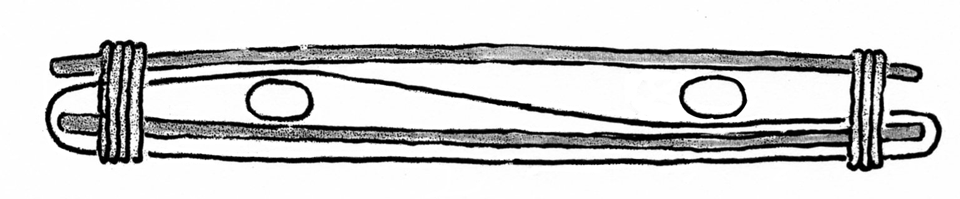
One of the best activities for understanding sound energy is creating “sound sandwiches.” In this experiment, kiddos use popsicle sticks, rubber bands, and drinking straws to explore vibrations and sound energy. Check out the link to get started making your own sound sandwiches!
9. Electrifying Discoveries
Now more than ever, electrical energy is integral to maintaining the comfort and ease of our daily lives! From keeping the lights on to powering our computers and cell phones, it’s no secret that this Digital Era is entirely dependent on electrical energy. In fact, after a bad storm a couple weeks ago, the power at my house went out for five days! It doesn’t sound too bad at first, but those five days really hammered home just how much we rely on electrical energy today.
Communicating the importance of electrical energy to students helps them understand the significance of electricity without having to go through a total blackout. So how can your kiddos fully grasp the concept of electricity, from circuits to conductors? With a hands-on activity, of course!
I’ve written before about my electrical energy light-up vest STEM project, but if you’re looking for something that’s not a full-blown STEM investigation, no worries. You can easily provide your students with the means to create simple circuits or even glowing pickles!
Even simpler, you can provide students (or centers) with copper wire, batteries, and tiny light bulbs to explore the basics. You can make things interesting by attempting to use different objects as conductors or insulators, too, such as rubber erasers!
As with every science activity, however, always take care to ensure that your students are exercising safe experiment procedures and are never, ever touching a wire directly. Students should only experience the shock of new discoveries, not physical shocks from electrical energy!
10. Types of Energy Transformations
Once you’ve explored the types of energy covered in the tactics above, it’s time to seal the deal! Summarize what you’ve learned about the types of energy, then encourage students to consider whether the different types of energy ever interact. How so? What objects or situations can they think of that use more than one type of energy? One common example is a toaster, which uses electrical energy to power the appliance and thermal energy to toast the bread.
Some energy transformations are easy to spot, such as potential energy being converted into kinetic, mentioned in my Types of Energy causation cards. Or, like when you’re at the top of the slide, you have potential energy, then when you begin to slide down, it’s converted into kinetic energy! Alternatively, have students rub their hands together. Their palms will become warm, right? Ask students what types of energy are at play here. Ultimately, kinetic energy is being transferred to thermal energy from the friction!

Understanding the way that types of energy exist and interact with one another is integral for students to understand the way that the world works around them. Thankfully, there are plenty of activities and even resources that you can use to ensure your students are building a strong foundational knowledge, from the tactics listed here to various others you can find online. In fact, my Forms of Energy Centers is a perfect way to keep students engaged and provide them with a comprehensive understanding of types of energy!
No matter how you look at it, everything in our lives is composed of energy—even our bodies. Next time that your students explain that they’re too tired to work today, remind them that while they may feel tired, the truth is that they actually have plenty of energy… So get back to that assignment! 😉