









Students may find science boring or difficult, and let’s face it, teachers may feel the same way at times. When introducing science concepts in a traditional “let’s memorize the definition of force” or “fill in the process of erosion fill-in-the blank worksheet” way, of course you wouldn’t expect your fifth graders to be excited to learn concepts like force and motion or geological processes.
What if we added a twist, though?
What if students became detectives solving science mysteries rather than memorization experts? As one of many ways to move beyond worksheets by solving science puzzles, your students may finally understand force and motion or love learning about rocks and minerals as much as I do (seriously, I LOVE studying rocks).
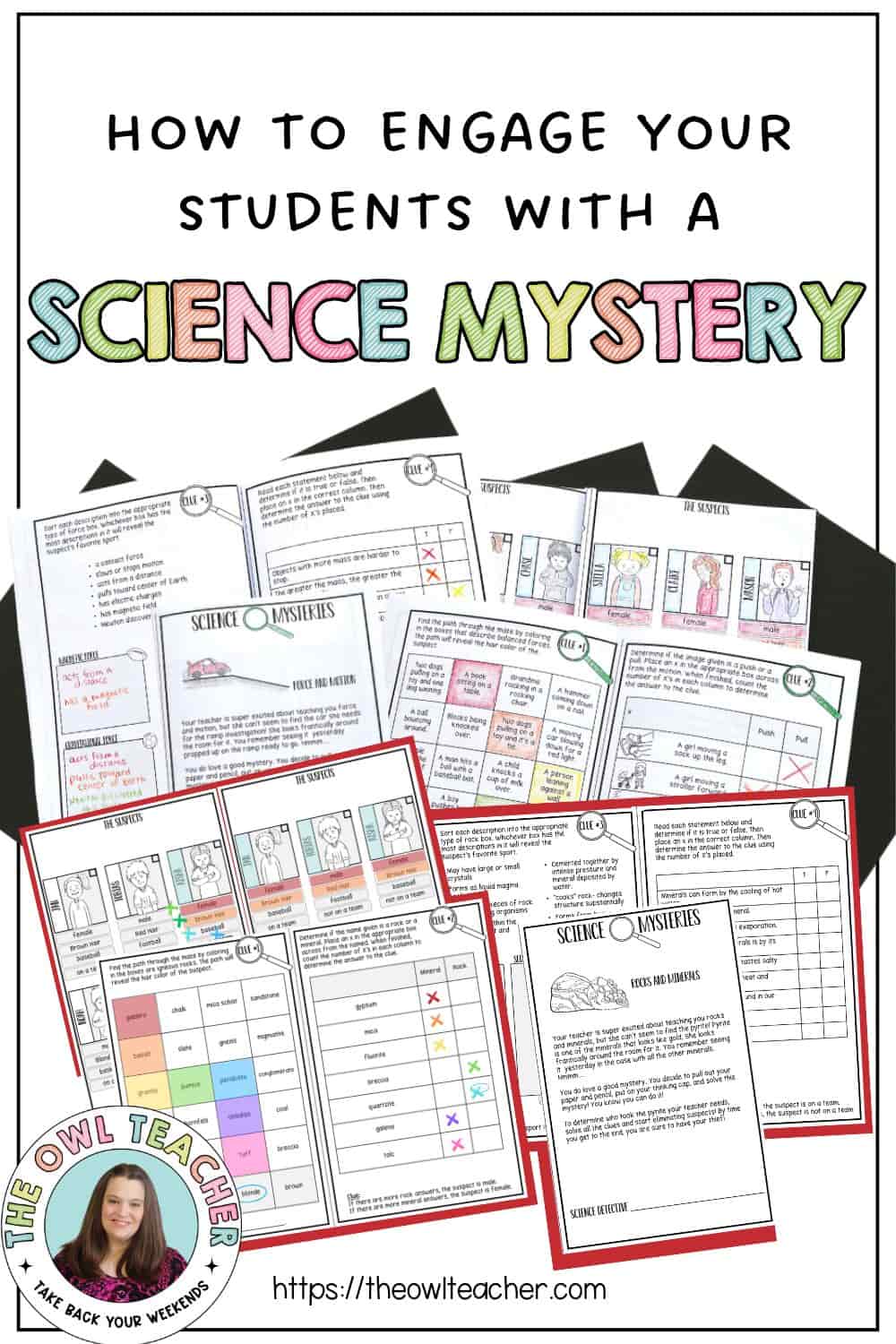
Why Teach Science Through Mysteries?
Imagine that when students arrive in class, you share that they will be solving a mystery. (You can get as creative or deck out your room as much as you want). They are now locating suspects and assembling clues rather than responding to worksheet questions. Through a mystery-based experience, they will discover science instead of just memorizing it. You will see your students light up with excitement (no better feeling) and make connections between concepts in a new and fun way.
When given a mystery, every student transforms into a science detective on a quest. It’s not just fun and games, either. When you put them together intentionally, science mysteries increase student engagement, foster critical thinking, and make routine lessons exciting. (I promise you that nothing is more satisfying than seeing a student “get” force all of a sudden).
Are you convinced yet? Worried about how you might use mysteries? I want to reassure you can use mysteries in your class. Just take a look at some of these ideas and ways to incorporate science mysteries into your science lessons.
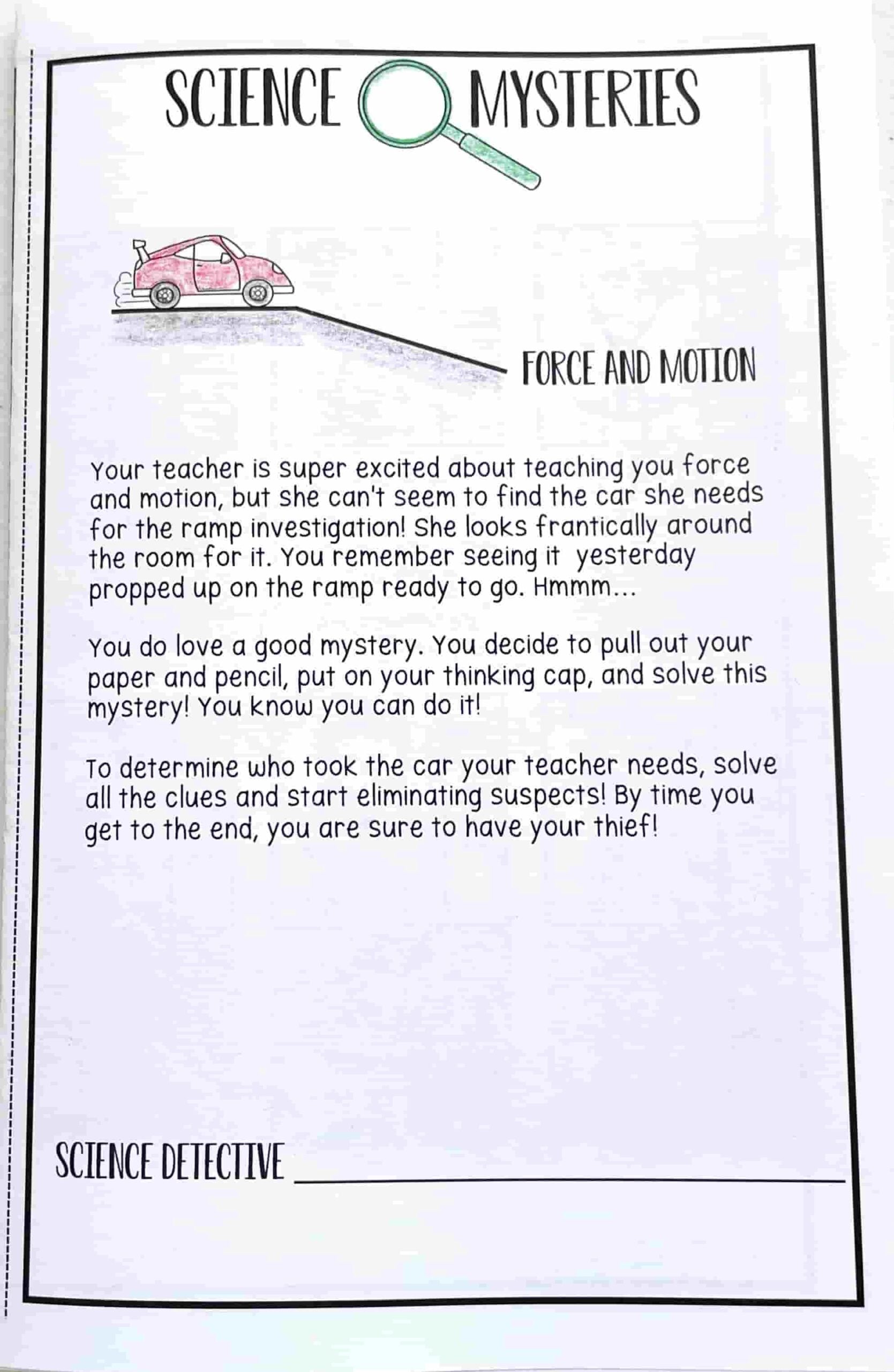
The Mystery of Force and Motion: Finding the “Thief”
In this mystery, finding a missing car gives your students a real-life classroom scandal! In this force and motion science mystery, your students become the investigators, assembling hints that guide them through fundamental ideas such as acceleration, mass, and inertia. By the time they solve the mystery, they will comprehend the role that gravity and friction play in all objects’ motion and why a rock doesn’t simply roll itself down a hill.
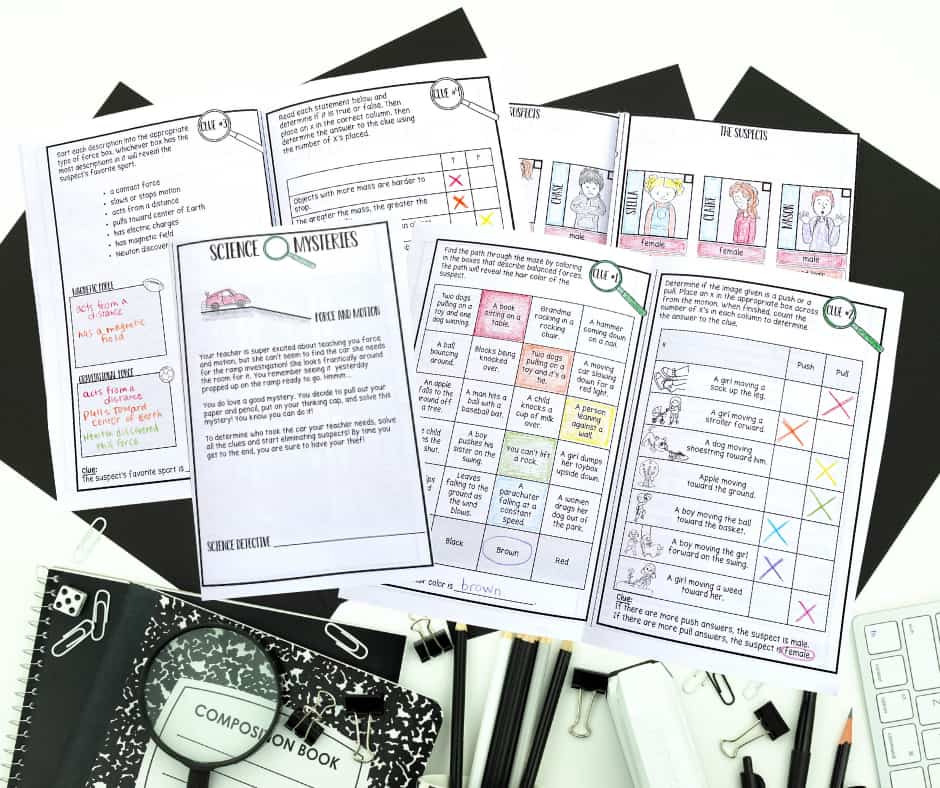
How does this mystery work?
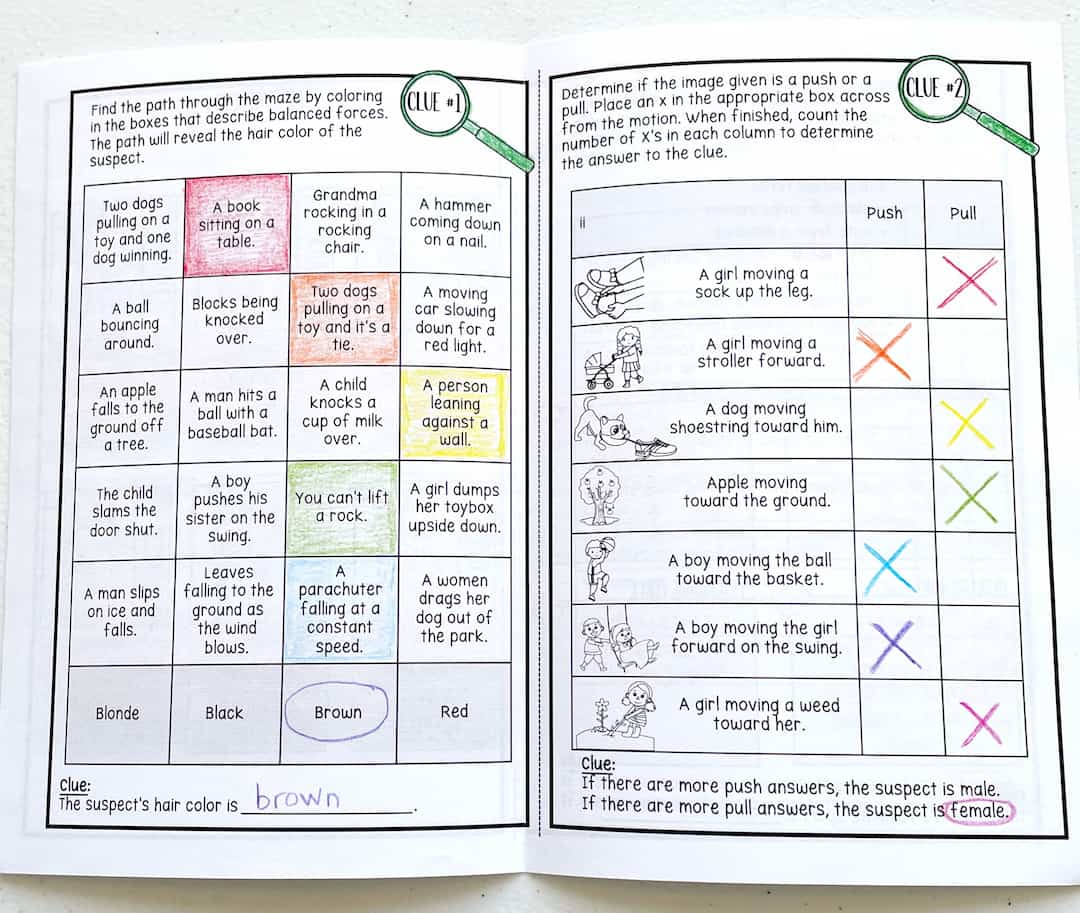
It’s set up so every hint highlights a distinct part of motion or power and encourages them to build on foundational skills needed to be scientists while they figure out which suspect is the thief. For example, to help exercise critical thinking skills, one clue will ask students to determine whether a certain circumstance involves a push or a pull.
As students move through the activity, they’ll continue collecting evidence while work through concepts such as classifying forces into categories. They get closer to solving the case while also learning essential concepts related to force and motion. It’s not a place for boring definitions or memorization!
Concepts of Force and Motion: Applying Theory to Practice
Consider these additional ideas focused on inertia you could include or create a new mystery with. One clue could challenge your students to determine if an object’s mass or an applied force will keep it moving or at rest. As they search for hints, they can experiment with inertia with various activities. In another clue, students could predict how quickly objects fall, then take note of how mass influences the speed with different activities. Students may notice gravity, or you may guide them to it depending on how you set up the clues they need to solve.
You can expand upon concepts as much as you want with a science mystery. In this example, your students will observe inertia in action by using the hints. They’ll be introduced to related concepts like friction, gravity, and acceleration which you can then allow them to explore more as you have time. When given space to be curious, your students will naturally enjoy the process of learning. They’ll be excited too, once they solve the mystery! Let’s face it, kids are far more likely to remember science concepts when they have hands-on involvement with it.
The Mysteries of Rocks and Minerals: Tracking Down the “Gold”
Another reason I love science mysteries is that it can help make “boring” concepts more engaging. One example is in the geology rocks and minerals science mystery. You students will look for pyrite, also known as fool’s gold. They get to be young geologists, searching for the “thief” while sorting through hints to discover the characteristics of rocks and minerals.
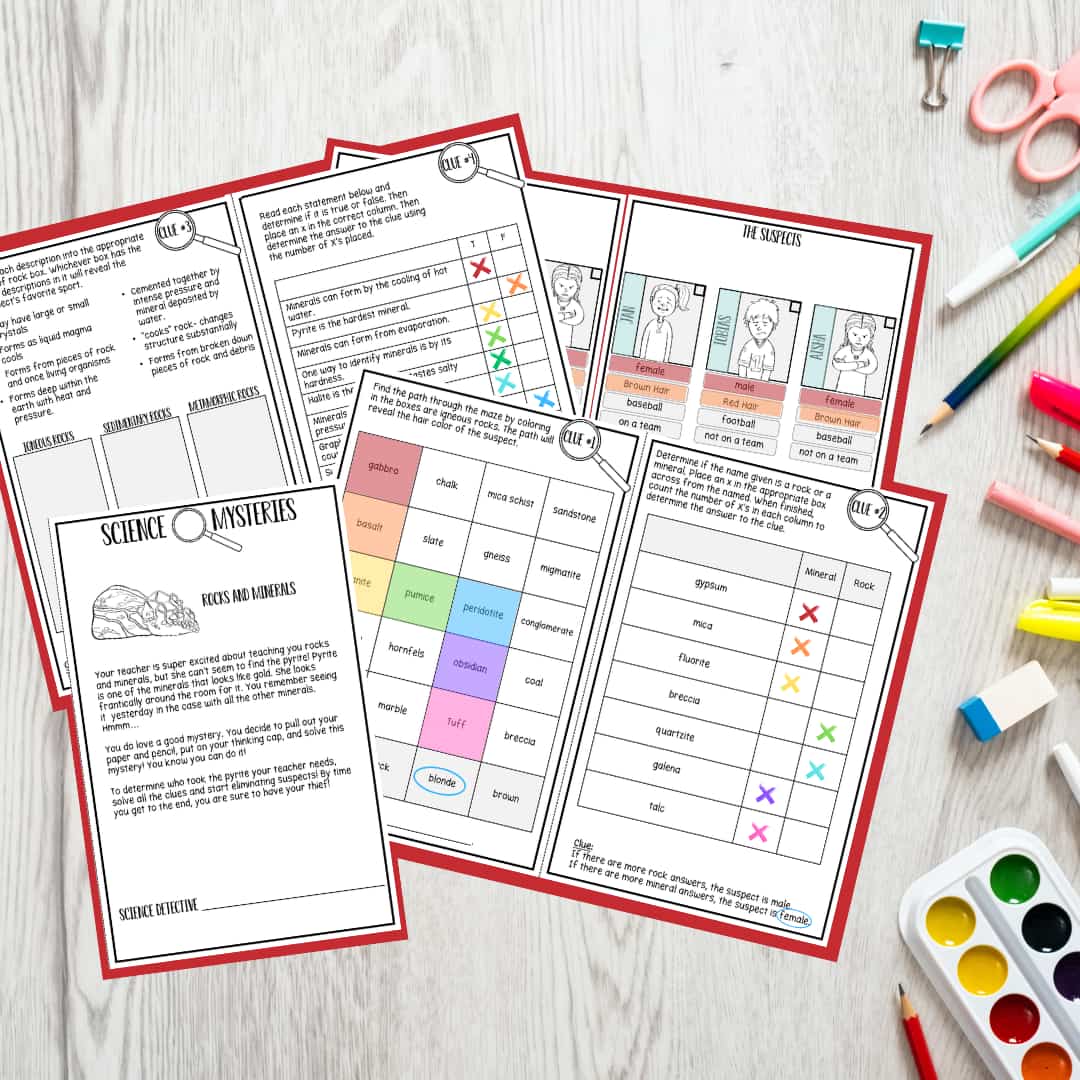
Students can solve this mystery by identifying the differences between igneous, sedimentary, and metamorphic rocks, classifying objects as either rocks or minerals (it’s more fun than it seems, I promise), or determining how different rocks form. Your class will gradually discover what distinguishes each rock type by solving clues. Students will be excited to find the answers, turning the science lesson that could have been boring on its own, into an adventure.
Making Geology Come to Life with Practical Hints
Taking the mystery a step further, you can add physical clues they can touch. One idea could be where students determine, depending on its formation, whether a rock is igneous, sedimentary, or metamorphic. To make it interactive, you could ask students to handle some samples of rocks so they can compare textures and observe the differences for themselves.
If you’re feeling particularly ambitious, prepare students ahead of time and have them bring in various rocks that they can sort and classify. Talk about a way to get them engaged! They are now sifting their own “evidence” to identify the suspect. Standard worksheets just can’t keep kids interested the way this type of activity can.
How to Make the Most of Your Classroom’s Science Mysteries
Are you prepared to jump right in? The following will help you make your science mysteries the talk of the school—in a positive way:
Divide and Conquer
The best way to enjoy science mysteries is in groups. Allowing students to solve the case in small groups or detective pairs promotes cooperation and a healthy dose of friendly competition. Additionally, it’s always entertaining to see students explain push and pull to one another.
Make Use of Hints or Clues as Checkpoints
Clues aid students in understanding what they are learning. Set up these hints as checkpoints for varying skill levels, and if students are having trouble, provide them with some “insider tips” to help them. It’s also a great way to assess their learning and provide scaffolding.
Promote the Use of Deductive Reasoning
As students rule out suspects, ask them to explain their thinking. As kids figure out why one solution fits and another doesn’t, this “whodunit” method subtly introduces critical thinking and gets them to support their thoughts and reasoning.
Don’t be afraid to make mistakes.
That’s all part of the fun, but some kids will (well, probably more than a few) get the clues wrong. Urge them to go back, look over their notes, and realize their own mistake. Surprisingly, while they are pursuing a suspect, they are driven to “get it right.” Help them recognize that is exactly how it works in real life too.
Seasonal Mysteries to Continue Learning New Things Throughout the Year
Consider varying the themes of the science mysteries over the year if they prove to be popular. A “Haunted Physics Mystery” would address eerie scientific ideas like sound waves and magnetic fields around Halloween. Investigating “mystery snowflakes” that have been “hidden” by a cunning snowman could be a water cycle project with a winter theme. Maintaining mystery themes throughout the year gives them variation and keeps students interested in what you’ll be planning next.
And as a tip, don’t be afraid to repeat or review various concepts with different themes throughout the year too! You could even combine various concepts from physics, earth science or your biology units into mega mysteries!
Conclusion: Secrets as a Doorway to Science
Incorporating science mysteries into your lessons not only helps you cover the material but also transforms scientific ideas into real and tangible concepts. With this method, students will learn by doing, while simplifying complex concepts like gravity and mineral hardness.
Who knew that so much could be found from a bogus gold nugget or a vanished car? Not only do students depart with solutions when they solve these puzzles, but they also leave with the thrill of solving a case. It’s time to put on your detective hats and start your investigations if you want to make science interesting, memorable, and perhaps even a little bit playful!