






When we begin our classification unit of vertebrate and invertebrate animals, I always like to start off with this fun activity from Science Spot. This activity is a fun way to introduce students to a dichotomous key and how scientists classify animals.
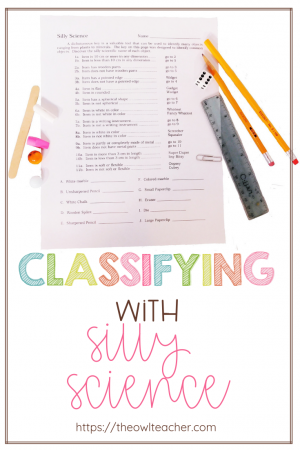
I break students up into groups and provide each group with a white marble, a colored marble, a sharpened pencil, an unsharpened pencil, a small and a large paperclip, a ruler, a die, a small craft stick, an eraser, and a piece of chalk. To begin, each student selects one of those items, such as a piece of chalk. They must measure it using a ruler and based on the first part, decide if it is less than 10 cm or more than. Depending on what the object is, they then move to the next part according to the key (go to 2, go to 5). They continue looking at the characteristics of the object and moving on down the chart until they officially have it ‘classified’ as its scientific name. What’s fun is that the scientific name is not “chalk” but rather something goofy such as an Oopsey or a Whatnot.
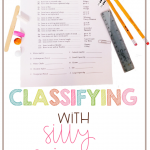
Here’s a look at the sheet:
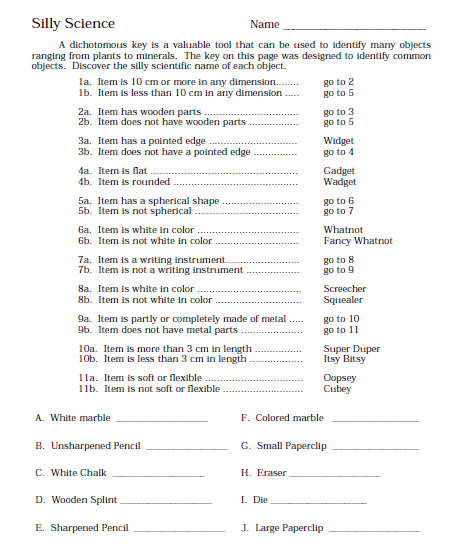 |
| This is NOT my creation – source: Science Spot. |
What’s great is this activity could also be used at the beginning of the year when you teach the scientific method and process skills. I wrote a post on fun activities for teaching those. You can read that here. The kids always enjoy this activity and it’s a great way to introduce how scientists use dichotomous keys for the classification of animals into specific groups.
You can download this free sheet from Science Spot by clicking here.