The Owl’s Strategy Nest · for grades 3 to 5
One themed toolkit a month for upper elementary teachers, borrowed from fields that almost never reach the classroom and rebuilt for a real room of twenty-five. Twenty-two new named strategies every month, and the whole membership works the same topic at the same time.
Start monthlyJoin for the year
A new drop lands the first of every month, and it stays in your library. Monthly members keep every month they pay for. Annual members get the whole school year, September through August, the day they join.
What the year looks like
Turn and talk. Exit tickets. A Bloom’s taxonomy poster with a fresh font. You have sat through the same strategies presented as breakthroughs for years, and you have quietly built better versions of most of them yourself.
The problem was never that you needed more strategies. It is that education keeps borrowing from education. Same well, same water.
So I stopped drinking from that well. Almost all of it comes from outside education, then gets rebuilt for your classroom.
Other professions have spent decades on problems that look exactly like yours. Attention, error, handoffs, wasted time, pressure. We go get their answers.
Sterile cockpit rules, taxiway routing, pre-flight checks. Transitions that do not leak twenty minutes a day.
See one, do one, teach one. Readbacks. Triage. Protocols built for high stakes and no room for a vague instruction.
Matching law, forced prioritization, the curiosity gap. Why students choose what they choose, and how to outbid the wrong choice.
Status work, tableau, cold opens, callbacks. Craft performers use to hold a room without raising their voice.
Poka-yoke, bottleneck analysis, 5S, first-article inspection. Systems that make the right move the easiest move.
Retrieval, spacing, dual coding, worked examples, applied through mechanisms that do not show up on the usual staff-room poster.
Six pieces, the same six every time, so you never have to relearn the system. That is twenty-two new named strategies a month, plus the reference pages that tell you how each kind runs.
One page per card. Each one names the field it was borrowed from, what it is, how it is different from the practice you would reach for first, how to run it, and what it looked like in a real classroom. Several carry a twist that changes the move for a different situation. The source is printed on every card.
Thirty-six across the year, filed into eight families by what the student is doing with the content. Each one gives you the tier, the minutes, the prep level, the group size, the problem it solves, the numbered steps, why it works, what to watch out for, three ways to differentiate it, and a version for math, science, and reading.
Twelve across the year, sorted into six jobs such as predict, catch, and anchor. Every beat runs under sixty seconds, moves every student at the same time, and leaves you something you can actually look at. Ten of the twelve need nothing but whiteboards.
Students out of their seats building something physical. Each sheet gives what it is, a ladder of solo moves from one idea up to transfer, a teacher bank of variations and prompt stems, and a full classroom example written out start to finish.
Two of the month’s strategies stacked into a single routine, with the engine explained, the steps numbered, and a lower-prep alternative for the week you have nothing left.
The printables that go with the month’s cards. Anchor charts, two-column sorting mats, student reference pages, prompt banks, card sets to cut apart, teacher forms. Laid out and ready to print, so you are not building the mat yourself on a Sunday night.
On the monthly plan, every month you pay for stays in your library. Month two you have two drops, month twelve you have twelve. What you do not get are the months released before you joined.
On the annual plan you get the whole school year library, September through August, no matter which month you join. If April is the month you are drowning, October's drop is still sitting there waiting.
Work out what is really going wrong in your room before you go looking for a strategy to fix it. Every member gets it, monthly or annual.
Search the whole library by the problem you are actually having, not by the month it happened to be released. Type what is going wrong in your room and it hands you the strategy.
Annual members get it for as long as they are members. Anyone can buy it outright for $27 and keep it for life, membership or not.
Upper elementary teachers working the same topic you are, in the same month, so a question you post is a question somebody else is already sitting on. Plus a live on the third Saturday of every month where we walk through the month's material and troubleshoot your actual classroom. Come to it or watch the replay.
Ask a question on the drive home and get an answer from me. An optional add-on at $27 a month, and completely optional. Spots are limited so I can actually keep up. Most members never need it.
Every month you are a member you get that month’s:
Every month you pay for stays in your library. You start from the month you join rather than from September.
The Strategy Finder is not included on this plan. You can buy it outright for $27 and keep it for life.
Everything in the monthly plan, plus the Strategy Finder for as long as you are a member, plus the entire school year library from September through August the moment you join. Three months free against paying monthly.
Monthly comes to $239.88 across a year.
The full year is $179.
You keep about $60, and the Strategy Finder comes with it.
All sales final, no refunds on digital memberships. Cancel anytime to stop future billing.
Both plans get you the same monthly drop. The difference is what happens to it afterward, and what you walk away owning.
Nothing rotates off
Monthly members build the library one month at a time, starting the month they join. You get the whole school year, September through August, open from day one. Nothing to download in a hurry, nothing you have to wait for.
The Strategy Finder is included
Type what is going wrong in your room and it hands you the strategy. Monthly members do not get it. Yours is included for as long as you are a member, at no extra cost, and you can buy it outright for $27 any time if you want to keep it for good.
One payment, then nothing
No card declining in November. No renewal you forgot about. You set it up once and do not think about it again all year.
Grades 3 through 5. Fourth and fifth grade teachers will feel the most at home. Third grade works well. Second grade teachers can use some of it, but the reading and independence assumptions will fight you.
Twenty-two new ones a month. Fifteen strategy cards, three Flight Patterns, two hands-on sheets, one Wingbeat, and one Combo Deck routine, plus the printables that go with the cards.
Across a full year that is a hundred and eighty cards, thirty-six routines, twenty-four hands-on sheets, twelve Wingbeats, and twelve combos. Somewhere north of two hundred and fifty named strategies, and you are never expected to run all of them.
That is the thing I screen hardest for. Every card gets held against one question before it ships, which is whether a twenty-year teacher could finish the sentence “this is basically just something I already do.” If she can, the card is cut and replaced, and plenty have been.
Will you recognize a piece of one here and there? Probably, and that is fine. What has to be new is the move itself. If you have seen a surgical readback protocol turned into a direction-giving routine on a staff-room poster, tell me where, because I have not.
On the annual plan, yes. The whole library is open to you, including everything released before you joined, and it only gets bigger.
On the monthly plan, no. Your library starts the month you join and grows from there, so you keep every month you pay for but not the ones before. This is the main reason teachers pick the year.
No. Take one card a month and you have gotten your money back. Nothing is due, nothing gets graded, and nothing disappears if you skip a month.
Every card names its source, so you can defend it in an observation. Curiosity gap work, the peak-end rule, retrieval practice, spacing, dual coding, matching law, and the citation is right there on the page.
Some cards borrow a working practice from a field rather than a research finding, and those say so on the card instead of dressing it up as a study. A surgical checklist and a machinist's go or no-go gauge are not experiments. They are things professionals do because they work, and you deserve to know which kind you are holding.
Same drops, same community. Monthly is $19.99 charged every month and you can cancel anytime, and your library starts the month you join. Annual is $179 charged once, which is three months free, and you get the entire school year library plus the Strategy Finder for as long as you are a member. The Classroom Diagnostic comes with both.
Your annual plan renews at the price on this page unless you cancel, and you get the next school year's library. A new set of twelve months, new material, following the same calendar because the school year does. Your Strategy Finder, the community, and the monthly lives carry straight over.
You can cancel anytime and you will not be billed again. There are no refunds on digital memberships, because everything unlocks immediately and cannot be handed back.
Your membership is for your classroom. Print what you need for your own students all year. If your team or building wants access, email me and we will work out a school license instead of passing files around.
A new toolkit every month, the source named on every card, and full permission to go at your own pace.
Free Resource
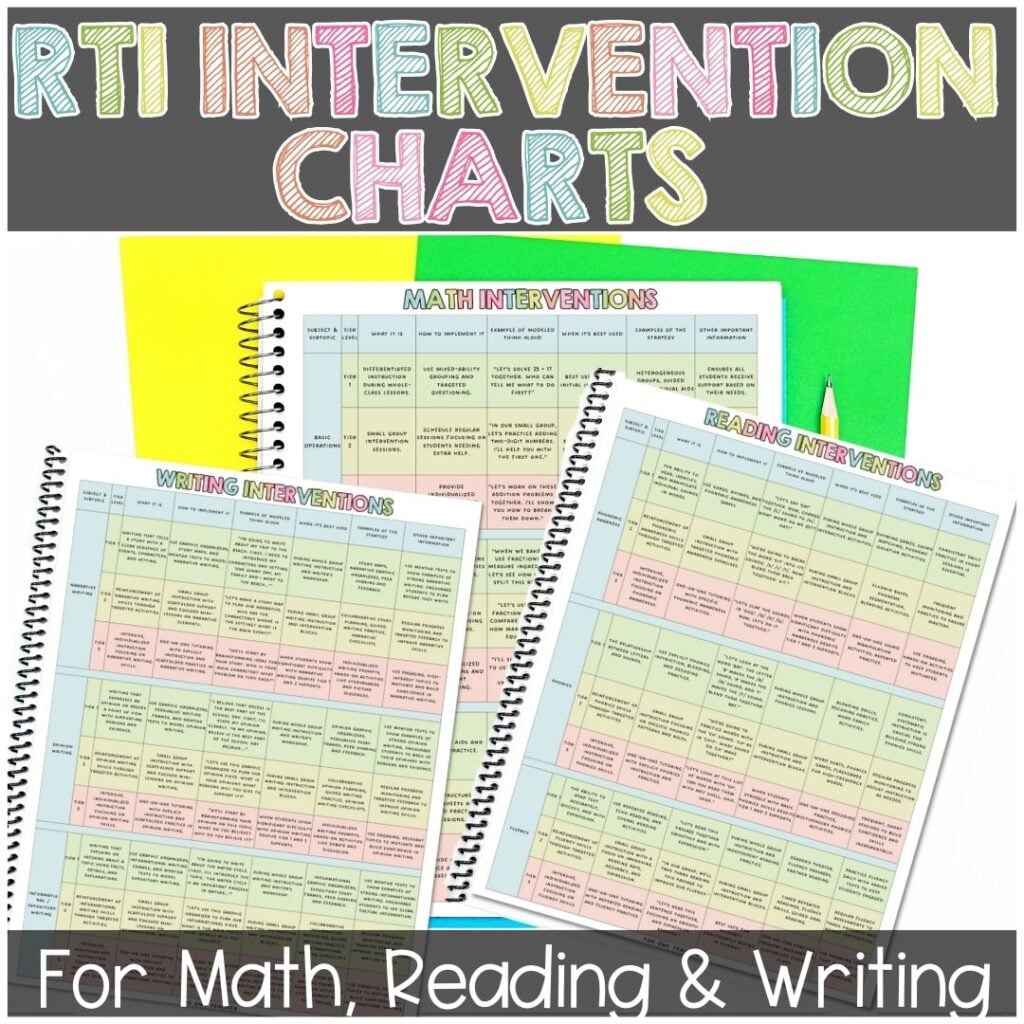
Support your students with research-based strategies. These free charts contain intervention strategies for 3 tiers of an RTI approach in math, reading, and writing.
Support your students with research-based strategies. These free charts contain intervention strategies for 3 tiers of an RTI approach in math, reading, and writing.
Free Resource